Anodizing vs Powder Coating: A Practical Comparison
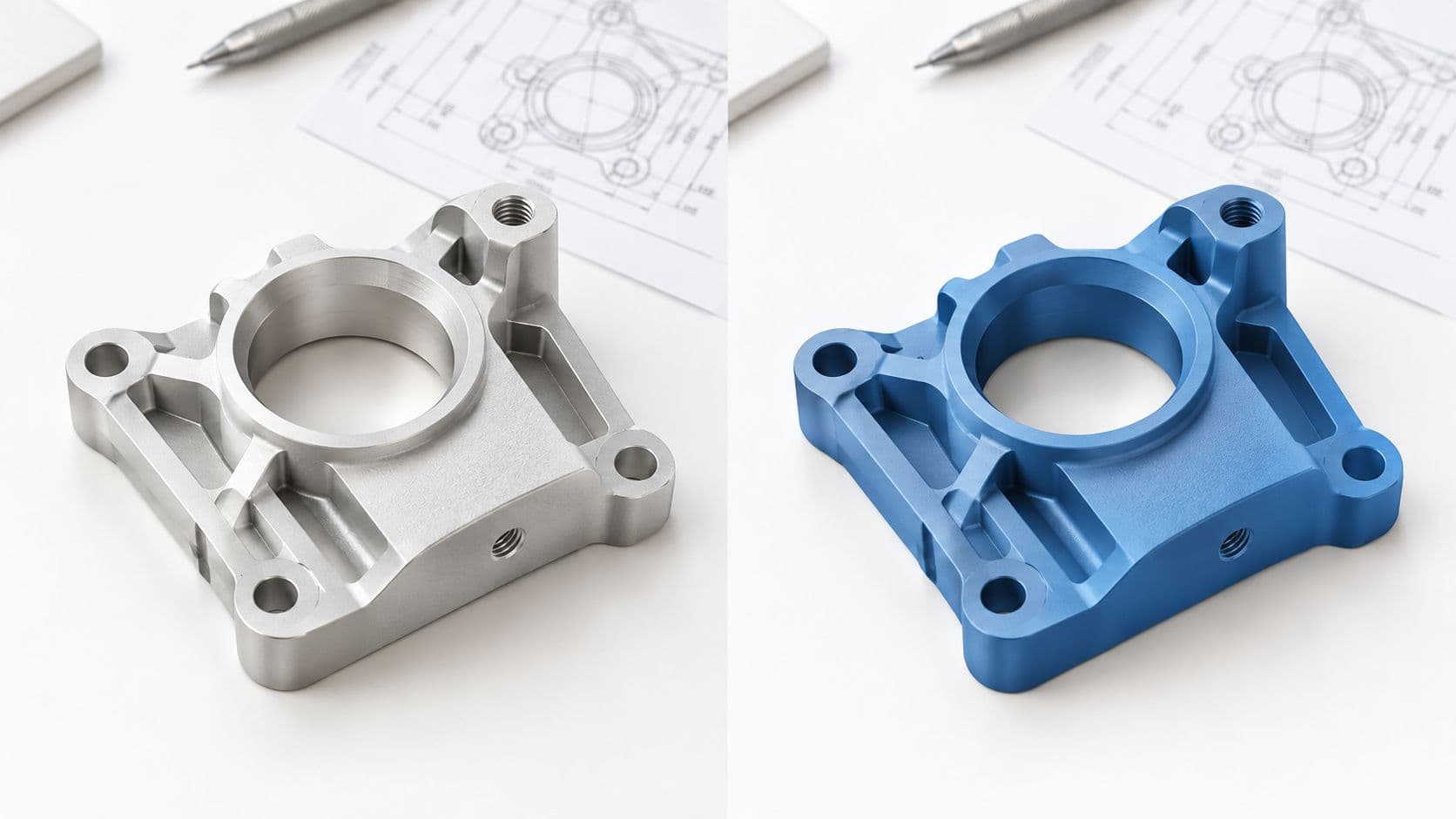
You've got an aluminum part ready for release. The CAD is clean, the CNC features are locked, and the drawing still has one finish note open. That last line item, anodizing or powder coating, looks simple until you think about what happens after finishing: threads tightening up, lids no longer seating, bearing bores closing, color expectations changing, or a scratched prototype coming back from field testing with no easy repair path.
That's the anodizing vs powder coating decision. It isn't about which sample chip looks better under office lighting. It's about what the part must still do after the finish is applied. On precision parts, the finish changes assembly behavior. On visible housings, it changes repair options. On prototype builds, it can decide whether the next iteration is a quick fix or a full redraw.
My practical rule is straightforward. Choose the finish by finished function, not day-one appearance. If the part lives or dies by fit, bore size, thread usability, or wear on aluminum surfaces, anodizing usually belongs in the conversation first. If the part needs broader color freedom, mixed-substrate compatibility, and more forgiving touch-up behavior, powder coating often makes more sense.
Table of Contents
What Anodizing and Powder Coating Are- Anodizing converts the aluminum surface
Side-by-Side Criteria That Matter Most- The deciding variable behind each criterion
How Finish Choice Changes Precision Assembly- What coating buildup does to real features
Repair, Rework, and Lifecycle Failure Modes- When the part gets damaged after finishing
Best-Fit Applications by Industry and Part Type- Where anodizing usually fits better
Decision Checklist and Drawing Notes- Use this checklist on the drawing
The Engineer's Choice at the Drawing Board
A common moment in NPI looks like this: an engineer signs off on a machined aluminum enclosure with threaded holes, a gasket land, and a mating cover. The industrial design team wants color consistency. The mechanical team wants the screws to start cleanly and the cover to seat without force. Purchasing wants a finish the supplier can repeat without drama. Those goals can point in different directions.
The mistake is treating anodizing vs powder coating as a cosmetic fork. It's a drawing decision with consequences for tolerances, masking, inspection, assembly sequence, and rework. If the part has critical datums, bearing fits, press features, or sliding contact, the finish note belongs in the same conversation as the tolerance stack.
What usually goes wrong
On early builds, teams often validate fit on unfinished aluminum, then add finish late. That's where trouble starts.
- Threads tighten unexpectedly: coating buildup can change how fasteners start and seat.
- Bores lose clearance: parts that slid together in bare metal can bind after finishing.
- Mating faces stop mating: a cover or bracket that once sat flush now rocks on coated surfaces.
- Validated prototypes stop being valid: a finish change during NPI can undo assembly checks even when the CNC program never changed.
Practical rule: The relevant requirement is the finished dimension, not the machined dimension before finishing.
That's the lens worth using throughout this comparison. Chemistry matters. Appearance matters. Corrosion behavior matters. But on real hardware, those factors only count if the part still assembles, survives service, and can be repaired in a way your program can tolerate.
What Anodizing and Powder Coating Are
A finish can change more than appearance. On a machined aluminum part, it can alter the usable size of a bore, affect a mating surface, and determine whether a damaged area can be repaired without replacing the part. Anodizing and powder coating create those effects through different surface systems.
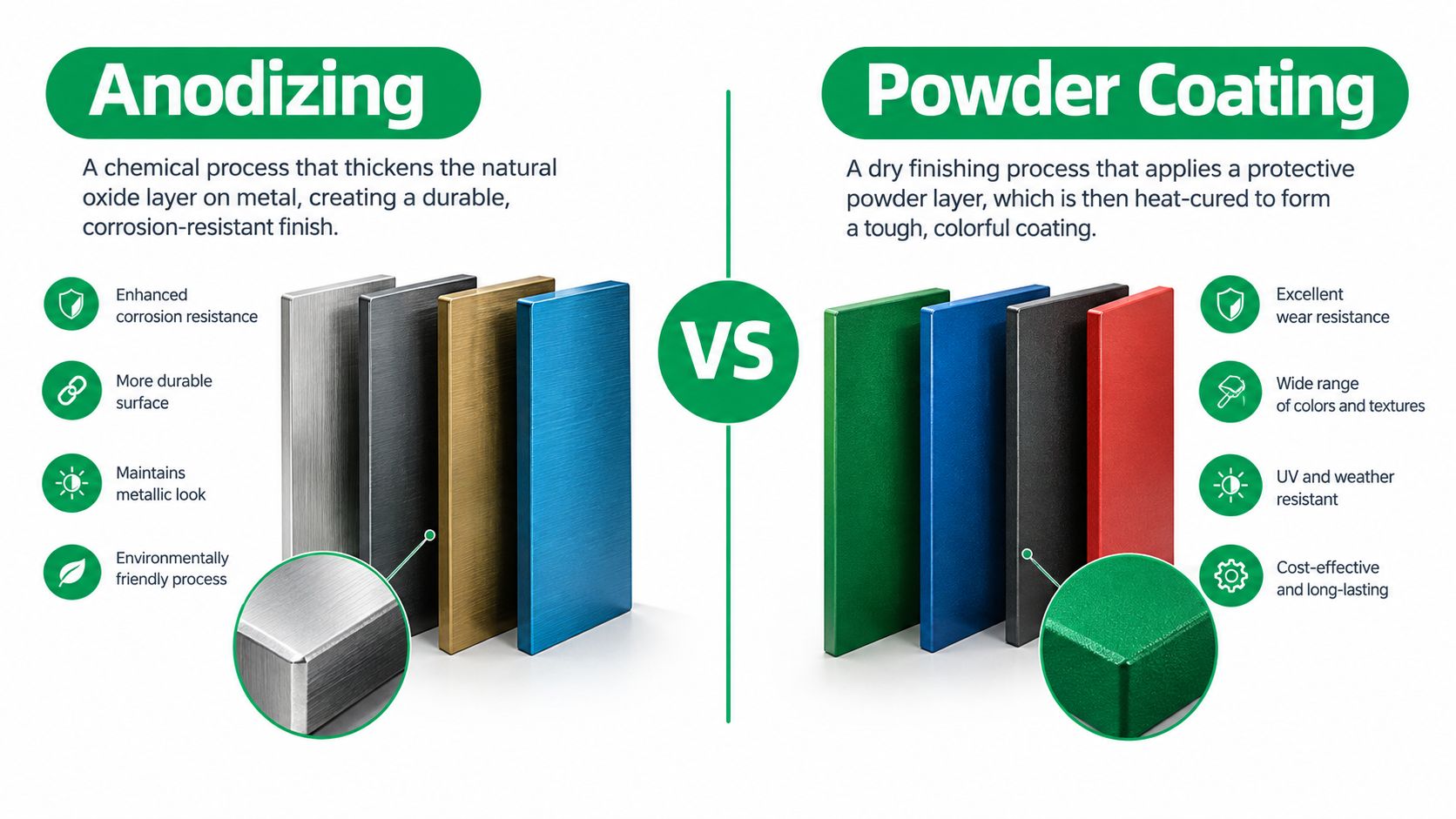
Anodizing converts the aluminum surface
Anodizing is an electrochemical conversion process. Rather than placing a separate film on the metal, it converts the aluminum surface into aluminum oxide. The resulting layer is integral to the substrate, which affects how it behaves at edges, in bores, and around masked features.
The process has long industrial roots. The Bengough–Stuart process was used industrially in 1923 in the United Kingdom to protect Duralumin seaplane components. Sulfuric-acid anodizing followed in 1927, after the process patented by Gower and O'Brien became important for decorative and functional finishing, as summarized in the historical overview of anodizing.
Natural aluminum forms a passive oxide layer of only about 2 to 3 nanometers. Anodizing deliberately grows a much thicker engineered layer. Commercial anodizing grows the oxide both inward and outward by roughly equal amounts. A specified coating of 20 micrometers therefore contributes about 10 micrometers of dimensional growth on each exposed surface. That growth must be considered wherever the finished dimension controls assembly. A supplier's description of aluminum anodizing services also shows how Type II and Type III are commonly positioned for machined aluminum parts.
Powder coating adds a polymer layer
Powder coating applies dry powder, usually by electrostatic spray, and then cures it into a continuous polymer film. The coating sits on top of the substrate, so its thickness affects the finished dimension directly. Coverage at edges, recesses, threads, and masked areas depends on part geometry and process control.
The technology became commercially important later than anodizing. Its roots include late-1940s and early-1950s thermoplastic flame-spraying and fluidized-bed development by Erwin Gemmer. The first thermoset powder coating appeared in the late 1950s, followed by broader adoption during the 1960s and 1970s. Regulations including Los Angeles Rule 66 in 1966 and the U.S. Clean Air Act increased pressure to reduce solvent emissions, as described in the powder coating industry history.
By 1973, four major thermoset chemistries were commercially available: epoxy, hybrid, polyurethane, and TGIC. Each offered different balances of weatherability, hardness, corrosion resistance, and appearance. Powder coating is also commonly described as a low-VOC process compared with solvent-based liquid coatings, while still requiring controlled curing energy and overspray management.
Anodizing is aluminum-specific and integral. Powder coating is additive and broadly applicable to metal substrates.
That distinction drives the drawing consequences. Anodizing changes the aluminum surface itself, while powder coating adds a polymer layer. Finished dimensions, edge coverage, wear behavior, and repair options follow from that difference.
Side-by-Side Criteria That Matter Most
Once the process basics are clear, the useful question is not which finish wins in general. It is which variable controls risk on the drawing. A sliding aluminum cam, an outdoor enclosure door, and a sealed laboratory device do not place the same demands on wear, corrosion protection, appearance, or repair.
For broader context on finishing methods used with machined parts, this surface finishing technologies guide provides useful background. The comparison below focuses on finished dimensions, rework tolerance, service behavior, and the consequences of specifying a coating on real features.
| Criterion | Anodizing | Powder Coating |
|---|---|---|
| Surface type | Integral aluminum oxide conversion layer rather than a separate film, as described in the anodizing process description | Applied polymer film deposited and cured into a continuous coating |
| Typical thickness range | Type II commonly 1.8 to 25.4 μm. Type III approximately 12.7 to 115 μm. NASA uses 0.0020 in ± 0.0004 in, about 51 ± 10 μm, as a default when no other value is stated, according to the anodic coating specification bulletin | Common overall build is about 60 to 200 μm, or roughly 30 to 100 μm per coated side |
| Dimensional effect | Usually a smaller, more predictable dimensional change on precision aluminum features | Greater buildup, with more variation at edges, corners, and recesses |
| Wear focus | Type III hard anodizing suits applications where sliding wear or abrasion dominates | A protective film choice where appearance and broad coverage matter more than a hard oxide wear surface |
| Color and finish options | More limited, with a metallic-looking family of finishes | Broad color and chemistry options, including multiple thermoset systems available by 1973, as recorded in the powder coating process history |
| Environmental profile | Established conversion process for aluminum | Commonly described as low-VOC compared with solvent-based liquid coatings |
| Best fit | Aluminum parts where fit, wear, and dimensional control drive the decision | Parts where appearance, broader substrate flexibility, and film coverage drive the decision |
The deciding variable behind each criterion
The table becomes useful only when tied to the part's service conditions and drawing tolerances.
- Durability has several meanings. A hard anodized sliding surface and a powder-coated enclosure may both be durable, but they fail through different mechanisms. Select the finish according to contact, abrasion, impact, and exposure.
- Corrosion performance needs context. Pretreatment, edge coverage, joint design, and service environment influence the result. A general corrosion claim does not replace a requirement for exposed edges or assembled interfaces.
- Appearance can control the decision. Broad color matching or a specific visual texture can make powder coating the practical choice even when anodizing offers better dimensional control.
- Thickness sets rework risk. A finish with a smaller and more predictable dimensional footprint generally leaves more tolerance for assembly. If a coated bore, thread, or mating face falls outside specification, the available repair options differ sharply from those for an uncoated or anodized surface.
Finish selection also affects lifecycle repair. A localized anodized defect may expose the aluminum and remain visible after correction, while a powder-coated area may require stripping, preparation, and recoating to restore consistent coverage. The right question is therefore not only whether the original finish meets the requirement, but whether the part can be repaired without losing fit or appearance.
The finish does not sit on a sample coupon. It sits inside an assembly.
Specify the features that cannot tolerate dimensional surprise after finishing. Then set the finish requirement around those features, the expected wear mode, and the amount of rework the build can absorb.
How Finish Choice Changes Precision Assembly
A part can look perfect on the bench and still fail at the fixture. That usually happens at threads, bores, bearing seats, press fits, gasket lands, or sliding interfaces, where finish selection becomes a dimensional decision first and an appearance decision second.
The common mistake is to specify a finish while still thinking in pre-finish machined size. For assembly, the control point is the finished dimension. Many prototype issues start when the drawing holds the substrate tightly and treats the finish as if it has no geometric cost.
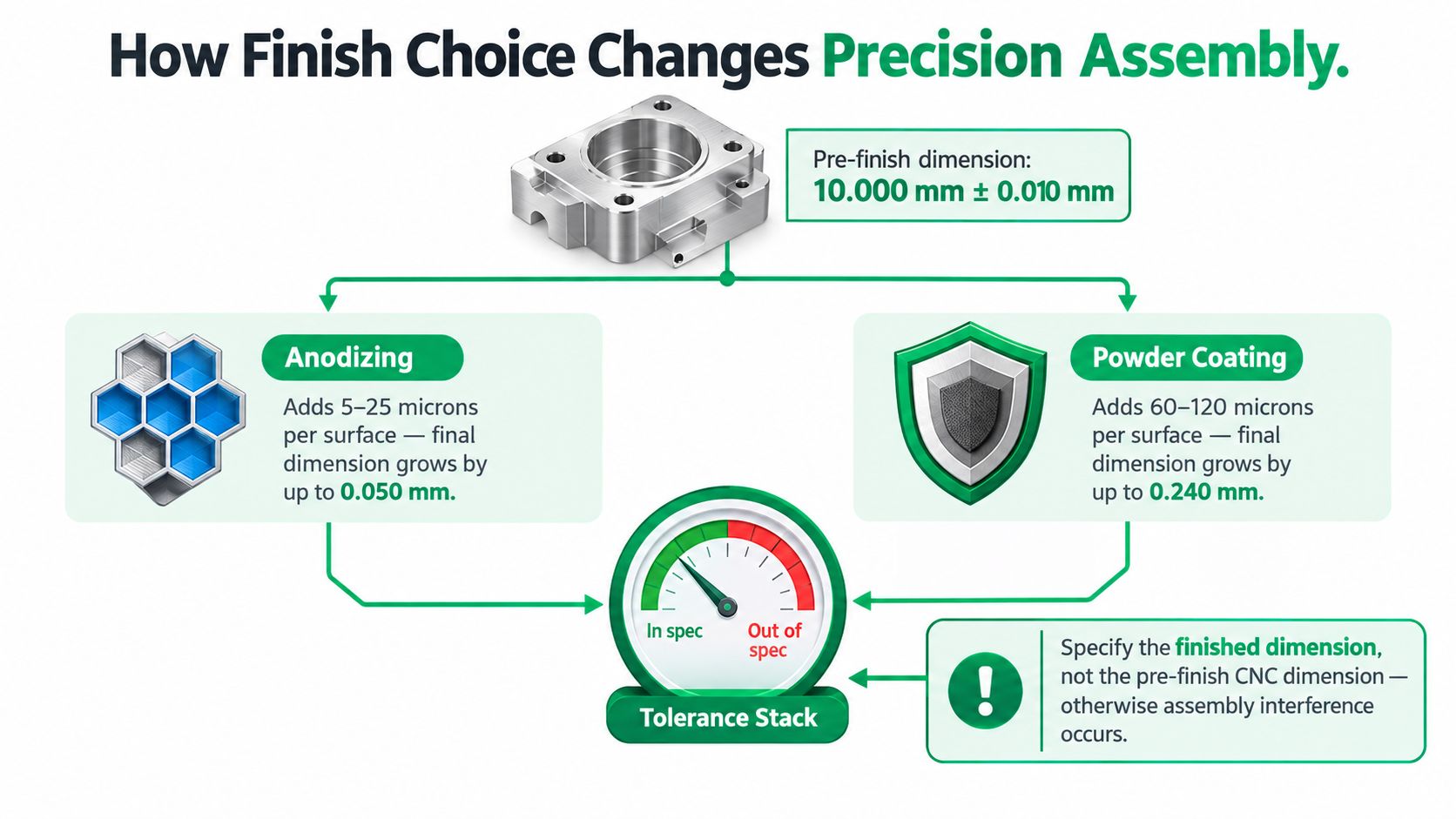
What coating buildup does to real features
For precision aluminum parts, the ranges from the comparison table matter most. Type II anodizing typically produces an oxide layer of 1.8 to 25.4 μm, while Type III hard anodizing can run from about 12.7 to 115 μm, depending on alloy and specification, according to the anodic coating specification bulletin. Powder coating commonly builds about 60 to 200 μm overall, with thickness variation more likely at edges, corners, and recesses.
A separate engineering discussion focused on CNC prototypes gives the practical assembly picture more plainly. Type II anodizing commonly adds about 5 to 25 μm of growth, with part growth limited because roughly half the layer penetrates the aluminum. Powder coating commonly adds about 60 to 150 μm to the surface, which can cut internal thread clearance, shrink bores, raise assembly torque, and stop mating parts from seating if the drawing did not leave room for it, as explained in the precision-assembly comparison of anodizing and powder coating.
Where engineers get caught
Anodizing is not dimension-neutral. It usually disturbs precision less than powder coating, but it still changes the finished part.
The trouble shows up in the same places every time:
- Internal threads: even modest growth can make fine threads feel gritty or too tight.
- Bearing seats and bores: added surface thickness can push a nominal slip fit toward interference.
- Mating covers and brackets: stack-up across two coated parts can keep the assembly from seating.
- Sliding interfaces: a finish that is fine on an external cosmetic wall may be wrong for a rail or guide surface.
If the fit was validated on bare metal and powder coating was added late in NPI, the design changed. The material and CAD model may be the same, but the final geometry is not.
Drawing notes that prevent expensive rework
Clear notes prevent avoidable scrap.
- Specify coating thickness, not just finish type. “Anodize black” is incomplete. “Powder coat matte black” is also incomplete if fit matters.
- Mask critical datums and functional interfaces. Threads, bearing seats, ground paths, gasket lands, and precision bores often need keep-out zones.
- Apply machining allowance only where tolerance permits. Do not shift every dimension if only a few features are function-critical.
- Use post-finish machining selectively. It takes longer, but on some bearing or sealing features it is the cleanest way to hit final geometry.
- Treat finish changes as engineering changes. Switching from anodizing to powder coating can invalidate earlier fit checks even when the material and CNC toolpath stay unchanged, as the prototype-focused assembly discussion makes clear.
On prototype and low-volume builds, that matters because assembly feedback arrives fast. A finish that looks acceptable on the first article can still be the reason the next mating part will not go together.
Repair, Rework, and Lifecycle Failure Modes
A part's finish is only half the story. In the shop, parts get scratched during assembly, drilled during rework, deburred after a drawing change, over-torqued at a fastener, or nicked on an edge in transit. The better finish is usually the one whose failure mode you can live with.
When the part gets damaged after finishing
Anodizing is an integral oxide layer, which helps it wear well in service. It also limits repair options. If a scratch cuts through to bare aluminum, a local touch-up usually will not disappear cleanly. The part may need refinishing, or the team may have to accept a visible mismatch. That trade-off is called out in the repairability discussion of anodizing and powder coating, which notes that localized anodized repair is typically not invisible and often means refinishing or accepting a visible difference in appearance.
Powder coating fails differently. It is more prone to chipping or edge damage, but localized touch-up and recoating can be more practical when appearance and service conditions allow it. That same repairability comparison makes the contrast clear.
The right question is not “Which finish lasts longer?” It is “Which damaged part can my team recover without blowing up cost, schedule, or appearance?”
Prototype reality is messy
Prototype parts rarely stay frozen. Teams drill extra holes. They open up slots. They deburr after inspection. They move cable exits. They add washers and change fasteners. On those builds, I have seen the stronger-sounding finish lose to the more recoverable one because the program needed one more change after the parts came back.
A practical way to choose:
- Choose anodizing when the part's long-term function depends on its hard oxide behavior and post-finish changes are tightly controlled.
- Choose powder coating when field repair, cosmetic touch-up, or local recoating matters more than preserving an integral oxide surface.
- Be cautious with edges and pretreatment assumptions. The lifecycle source also notes that salt-fog and accelerated-weathering outcomes vary between anodized and powder-coated systems and depend heavily on pretreatment and edge coverage, so those results are application-specific, not universal guarantees.
Failure mode matters more than marketing language
For a robot arm bracket, an edge chip that can be touched up may be acceptable. For a precision aluminum guide with sliding contact, a polymer film is often the wrong surface even if it looks perfect on day one. For a medical or lab housing, cosmetic consistency after service work may matter more than ultimate abrasion resistance.
That is why the finish decision should include one blunt service question. If this part gets damaged in a likely way, can we repair it in a way the product and customer will accept?
Best-Fit Applications by Industry and Part Type
There isn't a universal winner in anodizing vs powder coating. The better choice depends on the part's role, the substrate, and what failure the product can tolerate in service. If you map the finish to the application instead of to a general preference, the decision gets easier.
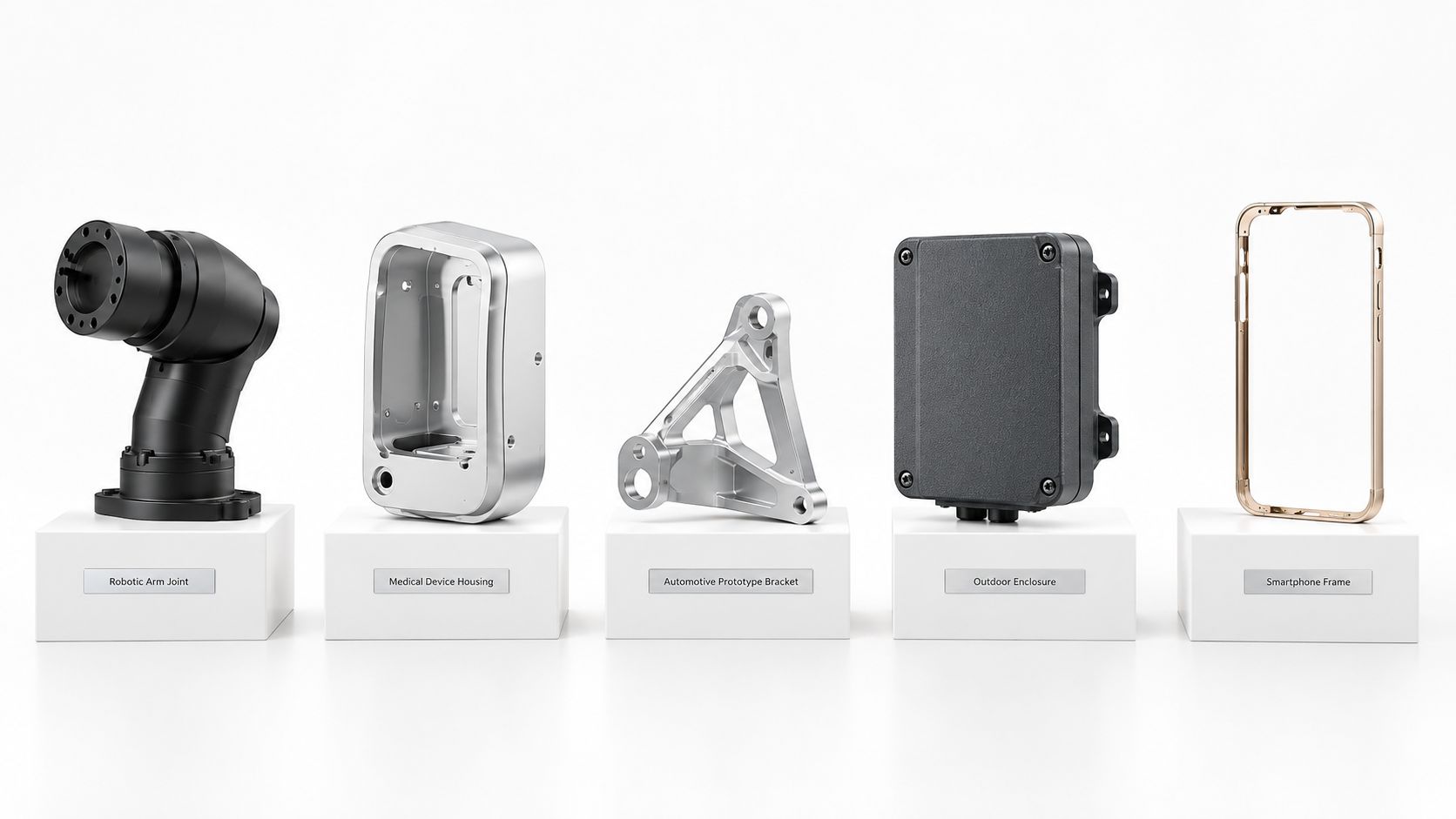
Where anodizing usually fits better
On robotics parts, especially aluminum carriers, guides, and brackets with close mating features, anodizing is often the safer specification when the assembly includes bores, threaded features, or sliding contact. If the design calls for Type II for cosmetic corrosion protection or Type III for wear, the dimensional behavior is usually easier to manage than a thicker polymer film.
For medical devices and laboratory aluminum hardware, anodizing often makes sense where the part is machined from aluminum and surface behavior matters more than broad color freedom. The same applies to automotive prototypes with aluminum components that need repeated fit checks across iterative builds. If a team is validating tolerances, changing to a thicker finish late can create noise in the data that has nothing to do with the design itself.
Where powder coating often earns the call
For outdoor enclosures, consumer-facing housings, and larger visible assemblies, powder coating becomes attractive when broad color choice, texture control, and more practical touch-up behavior matter most. It also fits situations where the substrate set may extend beyond aluminum or where the assembly can tolerate the added film thickness through masking and clearance planning.
A practical production source for powder coating services on fabricated parts is relevant in exactly those cases, especially when the part is less sensitive to micron-level buildup and more sensitive to finish consistency across visible surfaces.
Cases where either finish can work
Some parts sit in the middle. A non-critical aluminum cover, a bracket with generous clearance, or a panel that doesn't carry precision interfaces may work with either finish once the drawing notes are done correctly.
That's also where a supplier that handles CNC machining, rapid prototyping, and both finish types can be useful. FIRMFG offers anodizing and powder coating alongside machining and sheet metal work, which is relevant when the finish needs to be reviewed against tolerances and assembly behavior rather than selected in isolation.
On many low-volume builds, the finish choice isn't decided by the material alone. It's decided by the most sensitive feature on the part.
If the sensitive feature is dimensional, anodizing usually rises. If the sensitive feature is cosmetic lifecycle and field repair, powder coating often does.
Decision Checklist and Drawing Notes
Choose the finish by examining the part's finished dimensions, rework tolerance, and likely repair conditions. A finish that looks right on a sample can still create assembly problems if the drawing leaves critical surfaces undefined.
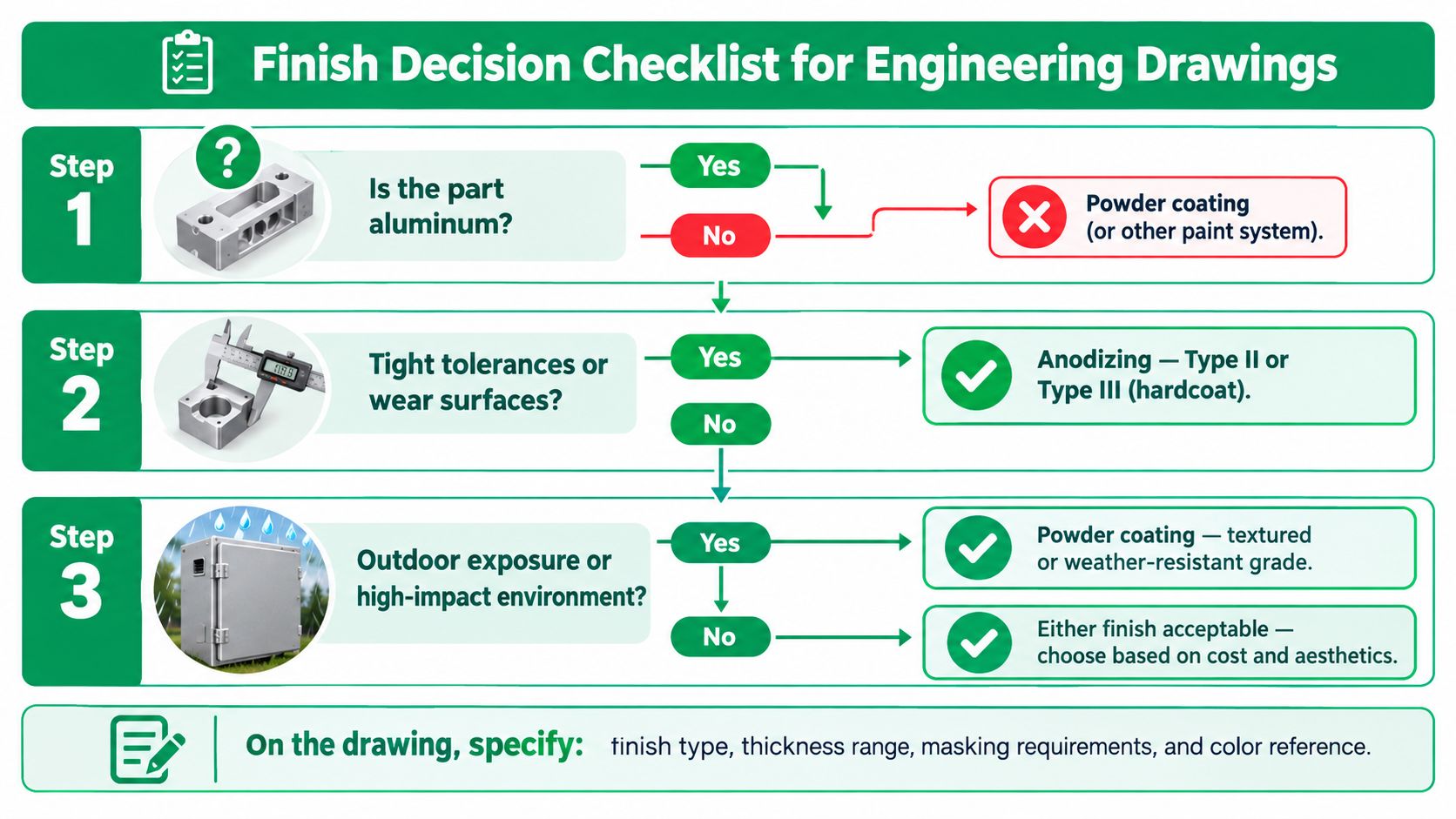
Use this checklist on the drawing
- Is the part aluminum? If yes, anodizing and powder coating may both remain viable. If not, anodizing usually drops out and a coating system becomes the practical route.
- Does it have tight tolerances, threads, bores, datums, or wear surfaces? Review anodizing first, then confirm how buildup and masking affect the final fit.
- Does the product need broad color choice, visible texture control, or localized repair? Powder coating often fits better when those requirements outweigh coating thickness.
- Will the part be reworked after finishing? Define whether the process must tolerate stripping, blending, recoating, or replacement.
- Does the drawing specify the finished condition? If it only names the substrate, manufacturing and inspection still lack the information needed to control the part.
Notes that belong on the print
A useful finish note gives manufacturing and inspection a measurable target.
- State the finish type and thickness requirement.
- Mask critical datums, threads, contact pads, and functional fits.
- Reserve coating allowance only where the tolerance stack permits it.
- Define how thickness will be checked. Eddy-current measurement for anodic coatings can follow ASTM B244. Polymer coating films can be checked using ASTM D7091, as described in the anodic coating specification bulletin.
The decision is therefore tied to finished dimensions, assembly sequence, rework tolerance, and lifecycle failure modes. A repairable surface may still be the wrong choice if its added thickness closes a fit. A dimensionally controlled finish may still be unsuitable if field damage requires frequent cosmetic restoration.
If CNC machining and finishing must be coordinated, FIRMFG provides aluminum anodizing, powder coating, sheet metal fabrication, and precision machining for prototype and low-volume builds. Send the drawing with critical fits, masking requirements, and finish intent so the process can be reviewed against the assembly.