Nylon vs Delrin: Which Engineering Plastic to Choose
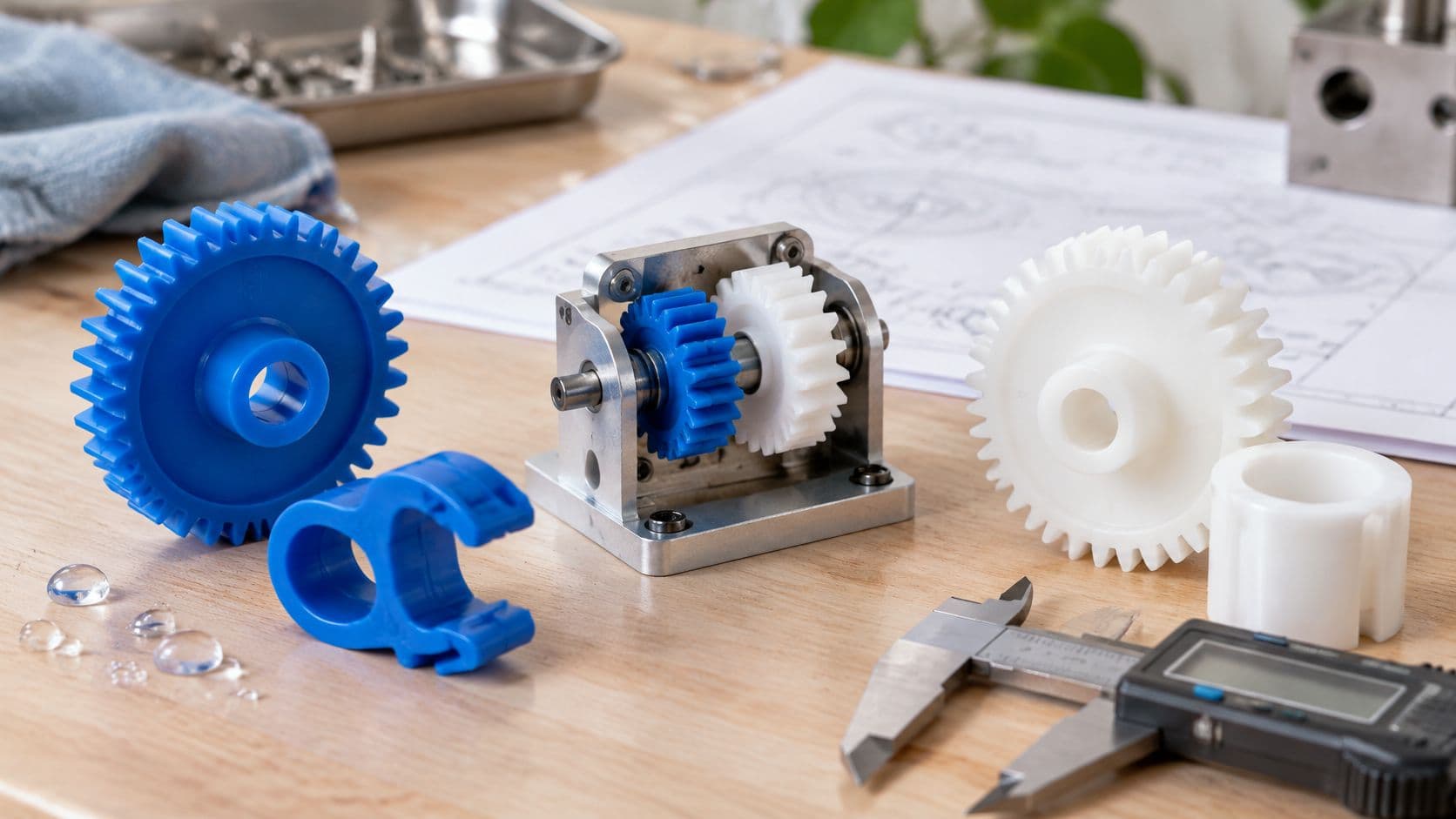
Pick the stronger plastic from a dry datasheet and you'll often pick wrong. That's the popular advice in most Nylon vs Delrin comparisons, and it's the advice that fails on the shop floor. A nylon gear that measures perfectly on a dry morning can bind after a humid week. A Delrin bushing that looks weaker on paper can hold its bore for years because its dimensions don't chase the weather.
The real selection variables aren't just tensile strength or friction. They're moisture condition, grade, and the moment you inspect the part. Read every number below with its test condition attached. Where sources disagree, that disagreement is the information, not a problem to average away.
Table of Contents
Moisture Uptake and Dimensional Stability- Moisture Uptake and Conditioned Properties
Wear, Friction and Bearing Performance- Dry Friction and Creep Data
Heat, Chemical Resistance and Machining Behavior- Chemical Exposure
Typical Applications and Cost Differences- Parts Each Material Serves Best
Choose Between Nylon and Delrin by Use Case- Choosing Nylon or Delrin by Requirement
Nylon vs Delrin at a Glance
Start with a naming problem that distorts half of all comparisons. Nylon is a polymer family, covering PA6, PA66, glass-filled grades, and cast grades. Delrin is a trade name for DuPont's POM homopolymer, so many acetal parts sold as POM-C copolymer aren't Delrin at all.
History explains that split. According to the PolymerAtlas nylon history, DuPont's team led by Wallace Hume Carothers first produced nylon 6,6 on February 28, 1935, and commercial nylon stockings reached consumers in 1940. DuPont synthesized polyoxymethylene around 1952 and commercialized it as Delrin in 1960 at Parkersburg, West Virginia.
Nylon began as a fiber and moved into structural parts. Delrin was developed as a precision engineering thermoplastic for mechanical work. That origin still shows in how each material behaves.
Baseline Properties for Dry Unfilled Grades
| Property | Nylon (PA6 / PA66) | Delrin (POM homopolymer) |
|---|---|---|
| Density (g/cm³) | 1.13 to 1.15 | 1.41 |
| Melting point | PA6 about 220°C, PA66 about 260°C | About 175°C |
| Continuous service temperature, unfilled, dry | About 100°C | About 80–100°C |
| Tensile strength, dry | 70–85 MPa (2026 Rapid Protos); about 76 MPa (Olympus) | 60–70 MPa (2026 Rapid Protos); about 70 MPa (Olympus) |
| Chemical resistance | Good to alkalis, fuels and oils; poor to strong acids | Good to fuels, oils and most solvents; poor to strong acids |
| UV resistance | Poor unless stabilized | Poor unless stabilized |
| Machinability | Fair; gums, smears and springs back | Excellent; clean chips and stable cuts |
| Relative material cost | Lower for common grades | Higher |
Read that table in two passes. First, look at rows that genuinely separate them. Delrin is denser, melts lower, and machines far more cleanly. Nylon carries a higher heat ceiling when dry and usually costs less as resin.
Second, look at tensile strength, where a single headline number misleads. The 2026 Rapid Protos comparison table reported tensile-strength ranges of 60–70 MPa for Delrin and 70–85 MPa for nylon. Those are dry, unfilled reference ranges, not guaranteed design values for your grade.
Don't specify "nylon" or "acetal" on a drawing. Specify PA6 or PA66, its moisture condition, and POM-H or POM-C.
Glass-filled nylon and modified acetals shift every row. So does moisture, which changes nylon enough to deserve its own analysis. The first takeaway is narrow but useful. Nylon leads on dry strength and heat ceiling. Delrin leads on machinability and dimensional baseline. Neither lead survives unchanged in humid service.
Moisture Uptake and Dimensional Stability
Moisture breaks the usual comparison because nylon's amide groups pull in water and Delrin largely doesn't. That absorbed water acts as a plasticizer. It doesn't just add weight, it changes stiffness, elongation, and size.
The Curbell Plastics nylon vs acetal matchup reports 24-hour water absorption of approximately 0.2% for Delrin versus 1.2–1.5% for nylon 6/6, with saturated nylon potentially reaching 6–8%. It also shows nylon 6/6 flexural modulus falling from 410,000 psi dry-as-molded to 175,000 psi at 50% relative humidity, while Delrin remains approximately 420,000 psi.
Moisture Uptake and Conditioned Properties
| Property | Nylon 6/6 | Delrin (POM homopolymer) |
|---|---|---|
| Water absorption, 24 hours | 1.2–1.5% | About 0.2% |
| Saturation (equilibrium) | About 6–8%; 7–10% in some sources | About 0.4–0.6% |
| Single reported absorption value | 2.8% (Nylon 66) | 0.2% (Delrin 150P) |
| Flexural modulus, dry to 50% RH | 410,000 to 175,000 psi | About 420,000 psi, stable |
| Tensile strength, dry to 50% RH | 12,000 to 11,200 psi | 10,000 psi |
| Elongation at break, dry to conditioned | 60% to above 300% | 75% |
The single-value row needs its own conditions, because absorption numbers depend on grade and test method. In 2025, PTSMAKE's Delrin guide reported moisture absorption of 0.2% for Delrin 150P and 2.8% for Nylon 66. Don't compare that pair directly with a 24-hour test or a saturation test and expect agreement.
Tensile strength shows the same trap. One dataset moves nylon only modestly with humidity, while Olympus Machining's nylon vs Delrin guide reported approximate tensile strengths of 70 MPa for Delrin and 76 MPa for dry Nylon 6/6, with conditioned Nylon 6/6 listed at approximately 55 MPa. That larger drop doesn't prove one source wrong. It proves you can't quote nylon tensile strength without naming its moisture state.
What Changes on a Real Part
Follow a bearing bore from machining to service. You cut it to size in dry stock, inspect it, and ship it. In humid service the nylon conditions, swells, and softens, so a housing that fit at the machine can bind on its shaft.
Snap fits tell the opposite story. Dry nylon can feel stiff and notch-sensitive during assembly. Conditioned nylon becomes far more compliant, which is why its elongation jump matters more for clips than its modest tensile change.
- Bearing bores: Condition before final inspection, or clearance will drift.
- Mating housings: Allow room for growth where service humidity is known.
- Snap fits and threads: Design for conditioned stiffness, not dry stiffness.
- Tight sliding fits: Default to Delrin unless nylon toughness is functionally required.
Specify conditioning before inspection, not after a dispute. Condition samples to a stated equilibrium, such as ISO 1110 at 50% RH and 23°C for polyamide, or use an immersion method such as ASTM D570 where wet service is the actual condition. Record that state on the inspection report and measure critical bores only after equilibrium.
Inspection rule: A nylon dimension without a moisture condition is an incomplete specification.
That's the non-obvious conclusion. Nylon isn't dimensionally hopeless, but it is dimensionally conditional. Delrin removes most of that conditionality, which is often worth more than a higher dry strength number.
Wear, Friction and Bearing Performance
Retire the simple rule that Delrin always rubs easier and nylon always wears longer. It sounds decisive, and the published ranges don't support it as a universal law. The overlap between datasets is the finding you should design around.
A bearing and gear comparison from PropProse places dry coefficient of friction against steel at approximately 0.20 for Delrin versus 0.25–0.30 for nylon 6/6, with bearing-oriented ranges of 0.10–0.20 for acetal and 0.20–0.30 for nylon. Grade, finish, pressure, velocity, lubrication, and counterface all move those numbers.
Dry Friction and Creep Data
| Data basis | Delrin (POM) | Nylon 6/6 |
|---|---|---|
| Comparative machining data, dry, vs steel | About 0.20 | 0.25–0.30 |
| Bearing engineering ranges, typical, vs steel | 0.10–0.20 | 0.20–0.30 |
| Single comparison, dry, vs steel | 0.12–0.35 | 0.25–0.26 |
| Creep under sustained load | Strong resistance | Weaker; worsens with time and moisture |
| Friction at high humidity | Stable | Can drop as moisture lubricates; not reliable for specification |
The third row widens the picture further. A TextileUS Delrin vs nylon comparison reported dry coefficients of friction of approximately 0.12–0.35 for Delrin and 0.25–0.26 for nylon. At the top of that Delrin range, the supposed friction advantage disappears.
Moisture complicates nylon friction in a way catalog tables hide. Absorbed water can act partly as a lubricant and lower friction, but you can't guarantee that benefit across seasons, washdowns, or dry storage. A specification that depends on humid nylon staying slippery isn't a sound specification.
Where the Materials Do Separate
Creep separates them more reliably than a single friction value. Delrin resists sustained deformation, so gear backlash, roller roundness, and guide block clearance stay repeatable under load. That's why it's a strong default for dry-running gears, bushings, rollers, and wear pads.
Nylon earns its place under different loading. It's generally tougher and more compliant, so it handles shock, vibration, and high compressive bearing loads with less risk of cracking. Filled nylon grades can also improve bearing wear economically compared with unfilled nylon.
Don't ask which plastic has the lowest coefficient in a table. Ask which one maintains acceptable wear over the complete duty cycle.
- Check PV limits: Pressure times velocity, with your actual shaft material.
- Match the finish: Test against the production counterface, not polished lab steel.
- Test the environment: Run dry, humid, and lubricated states if service includes them.
A catalog friction value can shortlist candidates. It can't validate a bearing. Prototype wear testing in the candidate grade is the step that turns a plausible choice into a defensible one.
Heat, Chemical Resistance and Machining Behavior
Heat favors nylon on paper, but only while you keep it dry. Unfilled POM is normally rated to about 80–100°C in continuous use, based on the dry reference table in the opening comparison. PA66 and PA6 have higher melting points, so nylon suits warmer housings and under-hood parts where Delrin would run out of margin.
The catch is stiffness in warm, wet service. A nylon part can survive the temperature and still deflect too much because moisture has plasticized it. Heat resistance and load-bearing stiffness aren't the same requirement, and nylon forces you to check both together.
Chemical Exposure
Both materials handle fuels and oils well enough for many mechanical parts. Both are attacked by strong acids, so neither should be approved for acid service from a generic compatibility chart.
- Fuels and oils: Either material can work, confirm the exact grade.
- Most solvents: Acetal has a strong track record in fuel and solvent contact parts.
- Alkaline solutions: Nylon generally tolerates alkalis, but check swelling in the actual fluid.
- Water exposure: Treat water as a chemical condition for nylon, not a neutral environment.
That last point matters commercially. Teams often run a chemical check for fuel and forget that humidity alone changes nylon. Your compatibility review should list water, coolant, and cleaning agents alongside process fluids.
Machining Behavior
Machining is where Delrin earns loyalty from CNC shops. It cuts with short, clean chips, holds tight tolerances, and stays stable after cutting. Sharp carbide, positive rake, moderate feeds, and good chip evacuation usually produce predictable parts.
Nylon pushes back. It gums, smears, and springs away from the cutter, especially with dull tools or excess heat. You'll get better results with sharp tooling, light finishing passes, supportive workholding, and enough feed to cut rather than rub.
For thick nylon stock, rough oversize, let the part relax, then finish cut. Recheck critical features after conditioning if service humidity will change them. Our plastics CNC machining services cover this kind of grade-specific process planning, and we offer plastics CNC machining for both material families.
On tight-tolerance prototypes, machinability shapes schedule and scrap as much as resin choice does.
That implication is easy to miss in a materials meeting. A cheaper resin that needs extra spring passes, deburring, and re-inspection can cost more per good part. Delrin's cleaner cutting often buys you tolerance confidence, not just convenience.
Typical Applications and Cost Differences
Application lists make sense once you map them back to moisture, creep, and impact. Nylon serves parts that bend, absorb shock, or tolerate growth. Delrin serves parts that slide, mesh, and must stay the same size.
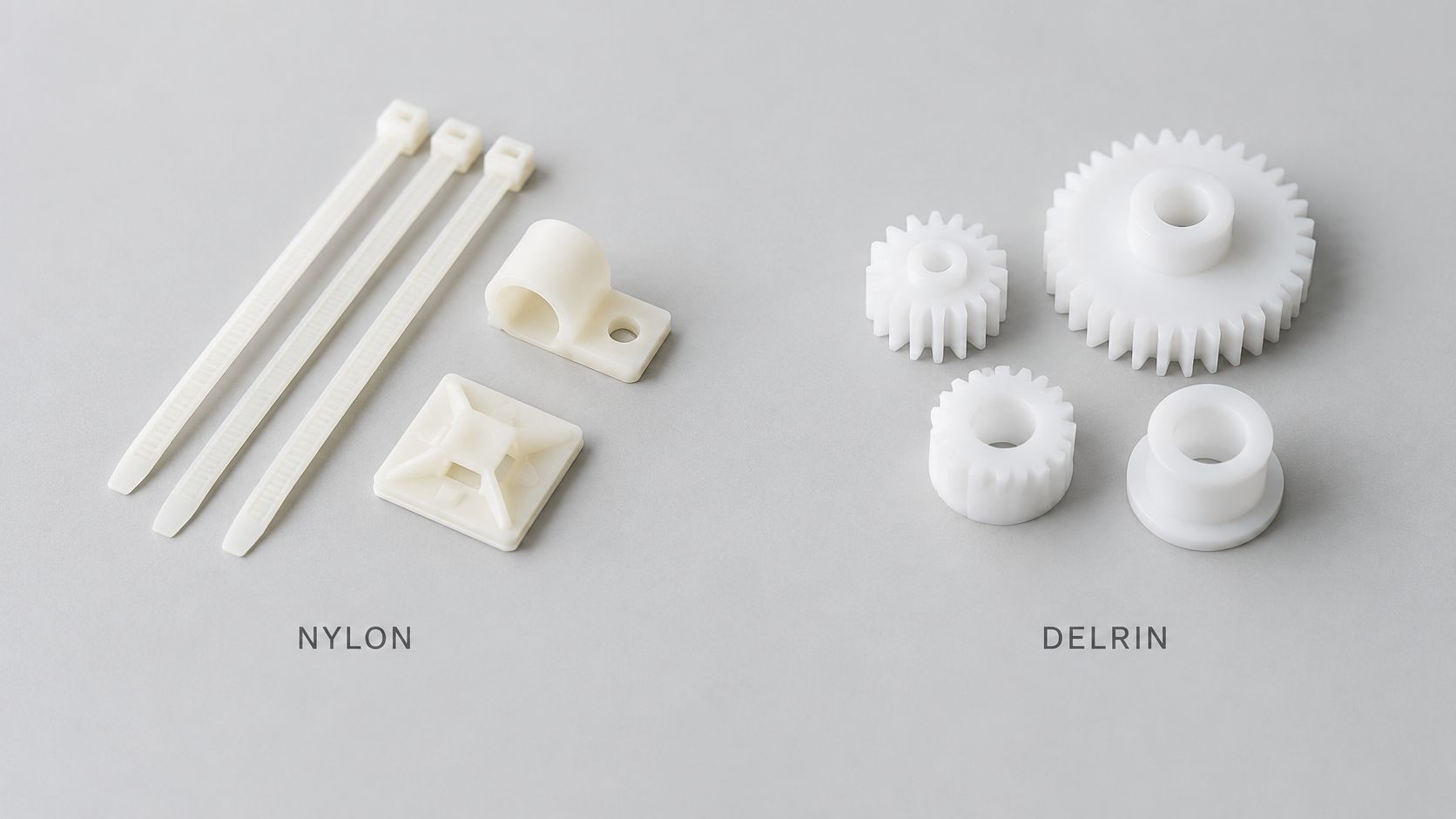
Parts Each Material Serves Best
- Nylon applications: Light-load gears, wear pads, cable ties, clips, snap-fits, impact-loaded housings, and bushings where moisture growth is acceptable.
- Delrin applications: Precision gears and cams, tight-fit bushings and bearings, guide blocks, conveyor parts, valve components, fuel-system parts, and insulating components.
- Shared territory: Rollers, pulleys, and low-load gears, where environment decides the winner.
Prototyping route can distort your test if you're not careful. Printed PA12 isn't machined PA66, and it absorbs less moisture than PA6 or PA66 grades commonly used for machined stock. Use printed nylon to test geometry and assembly, then validate fit and wear in the production candidate.
Our nylon 3D printing options sit within a broader material range, and FIRMFG offers 3D printing materials including standard resins, tough/durable resins, high-temp resins, flexible resins, nylon PA12, aluminum, titanium, and stainless steel. For a bearing or gear that must prove clearance, a machined Delrin or PA66 test part gives a more transferable result.
Cost needs the same discipline. Common nylon grades usually have cheaper resin, but resin is rarely the whole quote on small runs. Machining time, tolerance, feature count, finish, and scrap can outweigh the material price difference.
Say you're quoting twenty precision bushings. Nylon stock may cost less, yet Delrin can finish faster, hold size with fewer passes, and avoid a conditioning recheck. The cheaper resin doesn't guarantee the cheaper accepted part.
Buy prototypes at production tolerance in the candidate material. A loose prototype that passes tells you almost nothing about a tight production fit.
Choose Between Nylon and Delrin by Use Case
Choose Delrin for tight, humidity-stable sliding fits, dry-running precision motion, and fuel or solvent contact. Choose nylon for impact loads, snap-fits, higher dry service temperatures, and lower resin cost. If you remember one sentence, make it that one.
Start with your most demanding requirement, because it usually decides the material. If two rows conflict, the row tied to function outranks cost. A cheap part that binds, cracks, or creeps isn't cheap.
Choosing Nylon or Delrin by Requirement
| Requirement | Choose | Reason |
|---|---|---|
| Tight sliding fit in humid or washdown service | Delrin | Low moisture uptake keeps bores and clearances stable |
| Dry-running gears, cams, rollers or guide blocks | Delrin | Lower friction and better creep resistance hold backlash |
| Precision machined prototype at tight tolerance | Delrin | Machines cleanly and stays dimensionally stable after cutting |
| Snap-fits, clips or impact-loaded parts | Nylon | Higher conditioned elongation and toughness absorb shock |
| Bearings under shock or high compressive load | Nylon, filled grade preferred | Tougher, and filled grades improve wear economically |
| Continuous dry service above about 100°C | Nylon (PA66 or reinforced) | Higher melting point and heat ceiling |
| Fuel, oil or solvent contact | Either; confirm the grade | Both resist most fuels, oils and solvents |
| Strong acid contact | Neither without a chemical check | Both are attacked by strong acids |
| Lowest material cost on a common grade | Nylon | Cheaper resin for common grades |
Now correct the default rejection of nylon. Many teams rule it out for any precision part, and that's too blunt.
An Alibaba Seller Central precision components guide reported saturation values of roughly 7–10% for common nylon grades versus about 0.4–0.6% for Delrin. That gap is real, but it doesn't end the analysis, because preconditioned nylon inspected at equilibrium is far more predictable than dry nylon shipped into humid service.
The better question isn't which material is more stable in the abstract. It's what dimensional state the part must meet, and how you'll condition it before inspection and use. If you can't answer that for nylon, choose Delrin and remove the variable.
If you can answer it, nylon stays in play. Specify dry as-machined, equilibrium at a stated humidity, or fully wet. Allow moisture clearance where service humidity is known, and name PA6, PA66, reinforced nylon, or cast nylon rather than writing "nylon" and hoping procurement guesses right.
Our related guide on Delrin vs acetal terminology and grades helps if your drawing still uses those names interchangeably. That distinction matters because substituting POM-C for POM-H, or PA6 for PA66, can change the result you just engineered.
Buyer Checklist Before You Quote
- List critical dimensions: Identify tolerance callouts, bores, press fits, and gear geometry.
- State the environment: Give service humidity, temperature, water exposure, and fluids.
- Name the exact grade: Include PA6, PA66, cast or filled nylon, and POM-H or POM-C.
- Define inspection condition: State the moisture state at measurement and in service.
- Request engineering input: Ask for grade and process feedback before you lock the drawing.
At quote stage, FIRMFG's engineers suggest the optimal resin grade, Shore hardness, and mold strategy to meet functional and cosmetic requirements in the quote. Send that checklist with your drawing, not after first articles fail. You'll get DFM feedback that's tied to service conditions instead of generic material claims.
Final test: Order identical geometry in both candidate materials when fit or wear is uncertain. One humidity cycle will teach you more than another property table.
That's the conclusion a dry ranking can't reach. Delrin wins when stability is the function. Nylon wins when conditioned toughness is the function. Choose by the state your part will live in, then prove it with a two-material test run at production tolerance.
Send your drawing, service humidity, temperature, and target grade to FIRMFG for DFM feedback on Nylon vs Delrin before you commit tooling or a production run. We'll help you specify conditioning, inspection state, and machining strategy, then produce identical test parts in both candidates so your decision rests on measured fit and wear.