6061 vs 2024 Aluminum: How to Choose the Right Alloy
You're probably in the familiar spot where a part started as “just machine it from aluminum,” then the requirements showed up. The bracket now has a fatigue target. The enclosure now needs anodizing. The support arm might see outdoor exposure. Someone asks whether 2024 is the stronger choice, and someone else points out that welding or corrosion may make that a bad idea.
That's where most 6061 vs 2024 decisions get off track. Teams compare tensile strength, notice that 2024 is much stronger on paper, and assume the answer is settled. In practice, the wrong call usually comes from ignoring what happens after machining. Can the part be welded? Will it take a clean finish? Is the service environment dry and controlled, or exposed and maintenance-sensitive? What temper are you buying, and what happens if the part gets formed, repaired, or protected?
For design teams, the better question isn't “Which alloy is stronger?” It's “Which alloy still works after fabrication, finishing, and real service exposure?” That shifts the conversation from catalog values to lifecycle performance.
Table of Contents
- Introduction to 6061 vs 2024 for Engineers and Product Teams
The decision usually starts with the wrong question
What actually separates these alloys in practice
Early comparison table
Understanding 6061 and 2024 Aluminum at a Glance- What the alloy families imply
Mechanical Properties and Strength Compared Head to Head- 6061-T6 vs 2024-T3 mechanical properties at a glance
Fatigue Performance Versus Corrosion Resistance- Where 2024 earns its place
Machinability Weldability and Surface Finishing in Practice- What 6061 does well in production
Typical Applications and When to Use Each Alloy- Where 6061 usually makes more sense
Cost Availability and Final Recommendation for Your Project- Use 6061 when the program needs flexibility
- Use 2024 when performance clearly justifies the burden
- A practical recommendation for prototyping and NPI
Introduction to 6061 vs 2024 for Engineers and Product Teams
A lot of alloy selection mistakes happen late, not early. The CAD model looks fine, the stress case passes, and then manufacturing asks whether the part needs anodizing, whether it will be welded into an assembly, or whether the customer expects long outdoor life with minimal maintenance. At that point, 6061 and 2024 stop being interchangeable.
The decision usually starts with the wrong question
If you only compare published strength values, 2024 looks like the obvious upgrade. That's why engineers often reach for it when a design gets load-critical. But stronger stock material doesn't automatically produce a better part. The manufacturing route matters, and so does the service environment.
A machined aerospace fitting in a protected environment is one conversation. A robotic frame, test fixture, or electronics housing that needs welding, cosmetic finishing, and corrosion tolerance is a very different one. In those jobs, 6061 keeps winning because the alloy is easier to make into a reliable finished part.
Practical rule: If your team hasn't discussed welding, coating, inspection interval, and exposure before choosing between 6061 and 2024, the material decision isn't finished.
What actually separates these alloys in practice
The split is simple:
- 6061 fits fabrication-first programs where machining, joining, coatings, and corrosion durability matter.
- 2024 fits load-first programs where structural efficiency and fatigue performance matter more than downstream finishing simplicity.
- Temper and protection strategy often decide the winner more than headline strength.
That's why experienced teams don't treat 6061 vs 2024 as a basic strength ranking. They treat it as a trade between shop-floor flexibility and performance under repeated load.
Early comparison table
| Selection factor | 6061 | 2024 |
|---|---|---|
| Core advantage | Easier fabrication and corrosion resistance | Higher strength and fatigue-focused use |
| Welding | Generally favorable choice | Commonly avoided for welded structural parts |
| Coatings and finishing | Good acceptance of coatings | Often needs more protection attention |
| Corrosion behavior | More forgiving in general service | More susceptible to localized/intergranular corrosion |
| Typical fit | Frames, fixtures, enclosures, machined parts | Aerospace skin and high-stress components |
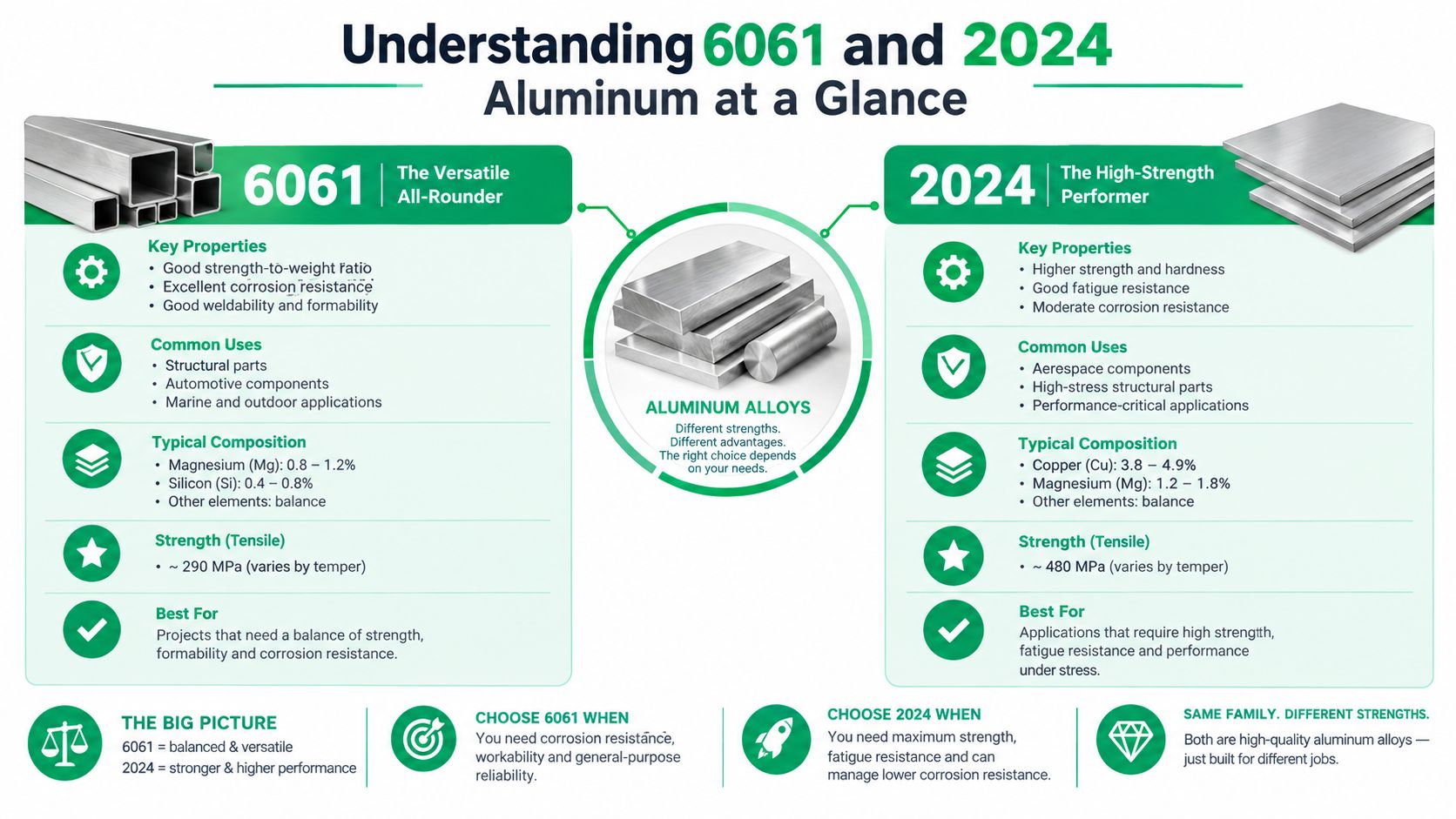
Understanding 6061 and 2024 Aluminum at a Glance
Both alloys sit in the heat-treatable aluminum family, but they were developed for different priorities. That difference shows up in how engineers specify tempers, buy stock forms, and plan manufacturing.
What the alloy families imply
6061 is the classic general-purpose structural aluminum. It's widely used because it balances strength, workability, joining behavior, and corrosion resistance in a way that suits a large range of machined and fabricated parts.
2024 is a higher-strength copper-bearing alloy that's closely associated with aerospace structure. That copper helps drive stronger load performance, but it also makes the alloy less forgiving when corrosion protection, finishing, or repair enters the conversation.
How to read temper designations correctly
When engineers say “6061” or “2024,” they usually mean a specific temper, not just the base alloy. That matters because the temper tells you how the material got to its delivered condition.
- 6061-T6 is the reference condition most design teams know. It's a heat-treated temper commonly used for CNC parts, frames, brackets, and structural hardware.
- 2024-T3 is a common comparison point for mechanical properties.
- 2024-T351 and T3511 often come up in real procurement and production because actual aerospace-oriented supply forms and stress-relieved product conditions matter.
That last point gets missed in quick comparisons. The published “winner” on a datasheet may not be the same winner once you specify the actual temper, form, and protection method needed for the part.
Why product form matters
2024 is often discussed alongside clad or protected service conditions because corrosion control is a normal part of using it well. With 6061, teams more often focus on machining and finishing flow because the alloy is already a comfortable fit for anodizing, general coatings, and broader structural use.
For prototyping and low-volume production, availability also tends to shape the decision qualitatively. 6061 is the easier default for many shops because it supports a broader mix of machining, finishing, and assembly paths with less process sensitivity. 2024 usually enters the discussion when performance requirements justify the tighter handling.
A material spec that ignores temper, stock form, and protection method isn't a finished engineering decision. It's just a starting point.
Mechanical Properties and Strength Compared Head to Head
A familiar design review problem goes like this: the stress numbers say 6061 is close, but not comfortable, and 2024 makes the margin easy. That often pushes teams toward 2024 too quickly. Static strength matters, but the better choice depends on whether the program can use that extra strength without creating new manufacturing or service-life penalties later.
For straight strength in the common comparison tempers, 2024 leads. The margin is large enough to affect wall thickness, fastener bearing checks, and how aggressively you can trim section size. The density difference is modest, so the trade is usually about strength efficiency, not a major weight jump.
6061-T6 vs 2024-T3 mechanical properties at a glance
The published comparison from Thomasnet's review of 6061 and 2024 aluminum properties and uses gives a practical baseline.
| Property | 6061-T6 | 2024-T3 |
|---|---|---|
| Tensile strength | About 310 MPa | About 470 to 483 MPa |
| Yield strength | About 276 MPa | About 324 to 345 MPa |
| Density | About 2.70 g/cm³ | About 2.78 g/cm³ |
Using those values, 2024 typically offers roughly 50% higher tensile strength and about 17% to 25% higher yield strength than 6061.
That is enough to change a part.
On thin, highly loaded parts, 2024 can reduce section size or buy margin where 6061 starts to run out of room. I pay attention to that in fittings, brackets with tight envelope limits, and parts with local bearing or net-section concerns. If the geometry is already constrained, stronger stock can solve a real problem.
Strength still does not settle the material call by itself. For fixture plates, housings, equipment structures, and general machined hardware, 6061 often wins because the part has to survive the whole route, not just pass the FEA model. Shops can machine it predictably, finish it with fewer surprises, and keep more options open if the design changes between prototype and production.
Temper lifecycle matters here too. A part that starts strong on a comparison table can lose practical advantage if later operations, joining choices, or protection requirements complicate the build. Design teams that compare only ultimate and yield numbers often miss that they are really choosing a manufacturing path and a service strategy, not just a stronger alloy.
Use 2024 when the extra strength changes the design in a meaningful way. Use 6061 when the section already works and the program benefits more from easier fabrication, finishing latitude, and lower risk over the life of the part.
Higher strength only helps if the finished part keeps that advantage through manufacturing and into service.
Fatigue Performance Versus Corrosion Resistance
A bracket that looks great in FEA can still be the wrong alloy choice if it spends five years seeing vibration, road spray, or salty air. This comparison turns on two service-life questions. How much cyclic load margin the part needs, and how much corrosion the surface will have to tolerate without constant protection.
Where 2024 earns its place
For repeated loading in controlled environments, 2024 keeps a real advantage. Independent technical summaries reviewed in this fatigue-focused aerospace paper report representative fatigue strength around 138 to 140 MPa for 2024-T3 versus about 96 to 97 MPa for 6061-T6.
That gap matters on parts that see high cycle counts and have little room for extra section. Aircraft skins, fittings, lightly built brackets, and other load-driven components are the typical cases. If the environment is managed and the protection system is disciplined, 2024 can buy real fatigue life, not just a stronger datasheet line.
Where 6061 changes the decision
Dry fatigue numbers are only part of the job. Corrosion changes crack initiation at the surface, and once that starts, the alloy with the better lab result in air may not be the alloy that lasts longer in service.
The same fatigue and corrosion-fatigue review notes that 6061 offers better corrosion resistance and better corrosion-fatigue retention under saline exposure. One aerospace-focused review cited there reported roughly a 20% fatigue-life reduction for 2024 in corrosion-fatigue testing versus about 10% for 6061.
That is the trade-off strength-only comparisons miss. If the part lives outdoors, sees condensation, gets handled hard in maintenance, or may go too long between inspections, 6061 often closes the gap enough to become the safer engineering choice over the full service life.
For exposed parts, fatigue capability and corrosion resistance have to be judged together. Separating them usually leads to the wrong alloy call.
Temper lifecycle and protection burden
The temper route matters here. 2024 often starts with the fatigue advantage designers want, but it usually asks for more discipline afterward. Surface damage, coating gaps, fastener interfaces, and poor storage conditions cost more with 2024 than with 6061 because corrosion becomes part of the fatigue problem.
That has practical consequences in both prototype and production builds. A prototype tested indoors may point toward 2024, while the released product, shipped, stored, assembled, and used in a less controlled environment, may be better in 6061 once finishing and maintenance are counted. If your team plans a protective finish, review how production anodizing methods affect aluminum parts before freezing the material and temper.
Use 2024 when fatigue margin in a controlled environment changes the design enough to justify the added protection burden. Use 6061 when service exposure, finishing latitude, and lower lifecycle risk matter as much as the starting strength.
Machinability Weldability and Surface Finishing in Practice
On the shop floor, these alloys don't feel the same. A good material decision should reduce process friction, not create it.
What 6061 does well in production
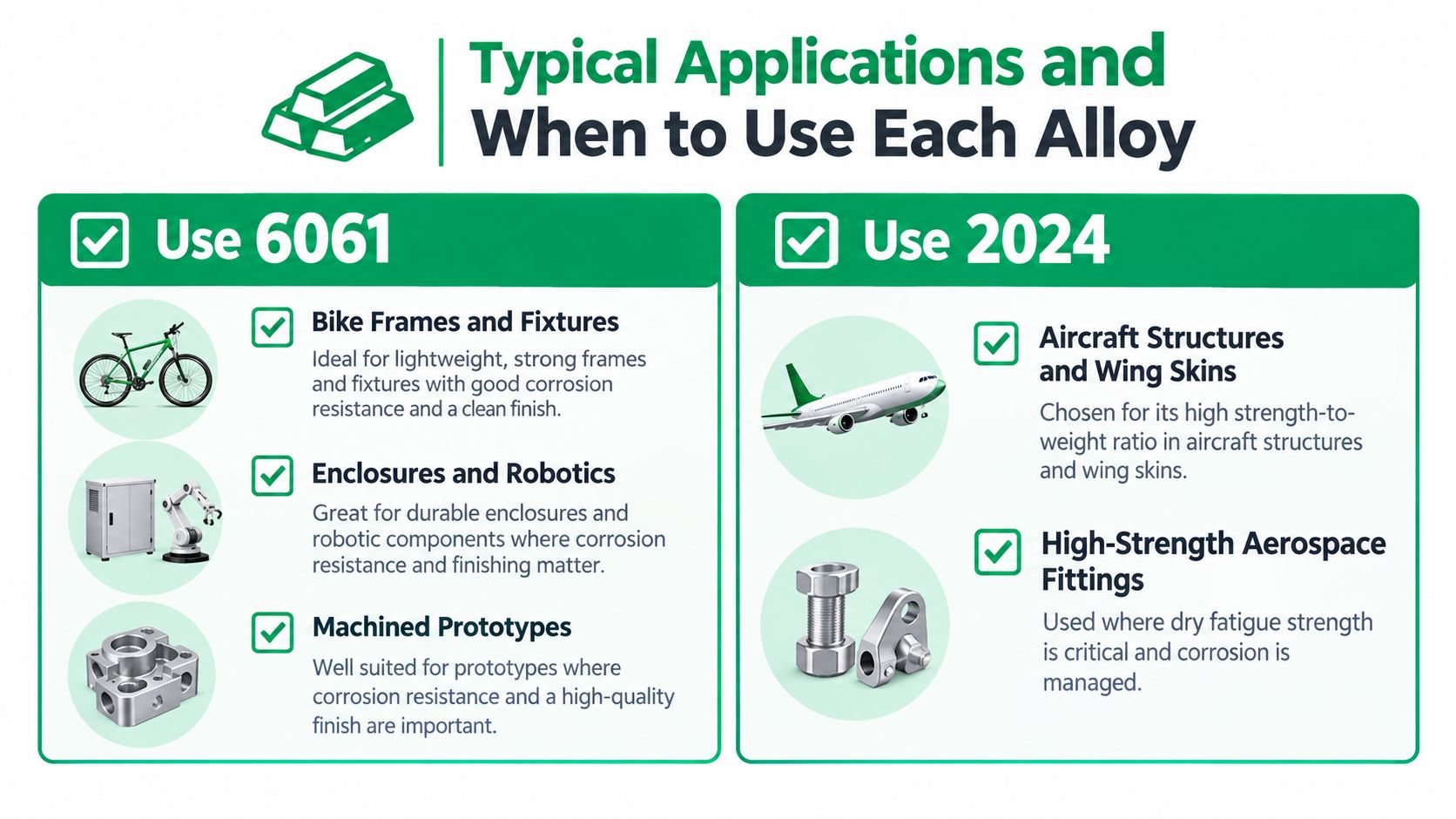
MatWeb describes 6061-T6 as combining relatively high strength, good workability, high corrosion resistance, excellent joining characteristics, and good acceptance of applied coatings in its 6061-T6 material record. That summary matches real production behavior. 6061 is the safe choice when a part may pass through CNC machining, deburring, welding, blasting, anodizing, and assembly without a lot of special handling.
That's why 6061 is common in welded frames, support structures, tooling, enclosures, and cosmetic machined parts. It gives manufacturing teams options.
Where 2024 adds constraints
2024 can be a strong machining material for load-driven parts, but the overall process route is less forgiving. Welding is the obvious problem area, and finishing is the other. The higher-copper chemistry that helps strength also makes corrosion management and appearance control less straightforward.
For CNC programs that need rapid iteration across prototypes and early production, engineers often choose the alloy that keeps the process stable from first article through revision builds. For many parts, that points to 6061 and standard aluminum CNC machining workflows.
Practical DFM cues for choosing between them
- If the part may be welded later, don't treat 2024 as a simple substitute.
- If appearance matters, 6061 is usually the easier path for consistent coating and finish acceptance.
- If the environment is uncertain, 6061 gives more room for real-world variation.
- If the part is purely load-driven and protected, 2024 becomes easier to justify.
Shop-floor advice: Don't select 2024 unless the design is prepared to support the alloy's protection and joining limitations all the way through production.
Typical Applications and When to Use Each Alloy
Once you step away from generic pros and cons, the selection becomes clearer. Each alloy has a natural home.
Where 6061 usually makes more sense
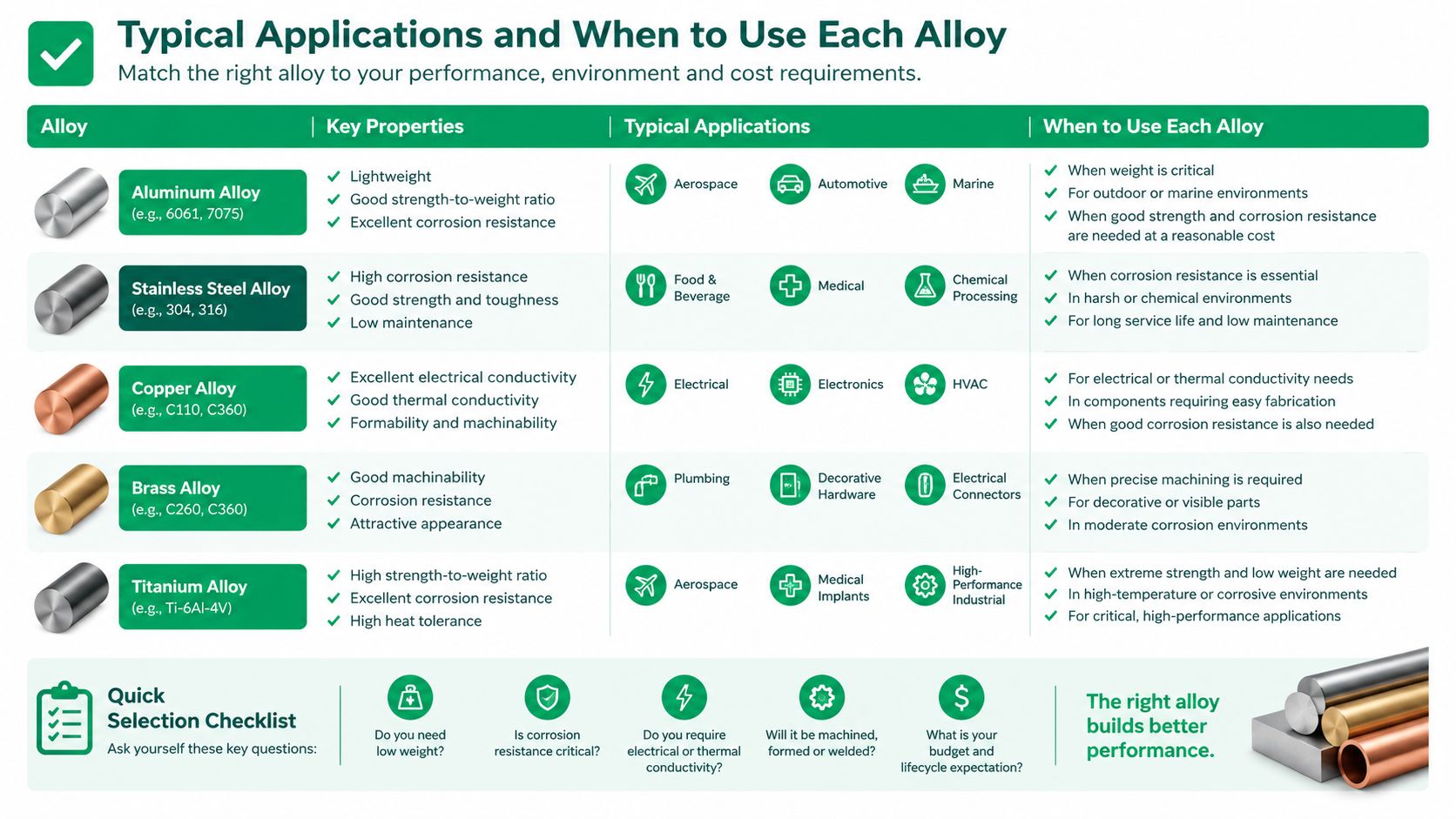
Use 6061 for products that have to survive normal manufacturing abuse and normal service exposure without a protection-heavy plan. Typical examples include:
- Frames and fixtures where machining, assembly, and occasional welding are all on the table.
- Enclosures and robotics parts that need a presentable surface and stable downstream finishing.
- Machined prototypes and low-volume builds where engineering may still revise geometry, coatings, or joining method.
These are the kinds of programs where manufacturing flexibility matters as much as raw property values.
Where 2024 earns its keep
Use 2024 when the design is driven by structural efficiency and repeated loading, and the team is prepared to manage protection strategy deliberately. Typical examples include:
- Aircraft structures and wing skins
- High-stress fittings
- Fatigue-critical components in controlled service environments
That logic aligns with the way many aerospace teams think about material choice, especially in CNC machining for aerospace applications, where fatigue and weight-efficient strength often outrank finishing convenience.
Quick decision matrix
| Requirement | Better fit |
|---|---|
| Welding required or likely | 6061 |
| Cosmetic finishing matters | 6061 |
| Outdoor or corrosion-sensitive service | 6061 |
| Dry fatigue-critical loading | 2024 |
| High structural stress with managed protection | 2024 |
| Early prototypes with evolving process assumptions | 6061 |
A better way to explain the choice internally
When you need to justify the spec to purchasing, manufacturing, or program management, don't say “2024 is better” or “6061 is cheaper.” Say what the alloy is solving.
For 6061, the justification is usually process reliability and service forgiveness. For 2024, it's structural performance under demanding loads where the extra controls are worth carrying.
Cost Availability and Final Recommendation for Your Project
The final choice usually comes down to risk. Not material price alone. Not datasheet strength alone. Risk across sourcing, fabrication, finishing, and service.
Use 6061 when the program needs flexibility
Choose 6061 if any of these are true:
- You're still iterating the design and don't want the material choice to block welding, coating, or assembly changes.
- The part needs corrosion durability without a protection-heavy maintenance plan.
- The geometry already closes in 6061, so extra strength doesn't create a meaningful design benefit.
This is why 6061 is such a common NPI material. It gives teams more room to learn without trapping them in a narrow processing window.
Use 2024 when performance clearly justifies the burden
Choose 2024 when the part is fatigue- or load-driven and the team can support the full lifecycle requirement. That means specifying the right temper, managing corrosion protection, and avoiding casual assumptions about repair or joining.
Independent guidance summarized in this 2024 vs 6061 manufacturing overview keeps making the same point. Higher strength doesn't automatically make 2024 the better design choice once protection and fabrication control are included.
A practical recommendation for prototyping and NPI
For most prototype and low-volume mechanical assemblies, start with 6061 unless the structural analysis says otherwise. If testing later shows the design is fatigue-limited or strength-limited in a way that geometry changes can't solve, then move to 2024 with the protection plan defined at the same time.
For teams that want one manufacturing partner to machine aluminum parts, review DFM, and coordinate finishing during that transition, FIRMFG is one available option for CNC prototyping and low-volume production support.
If you can't explain how the alloy choice affects finishing, joining, and field exposure, you're not ready to release the material spec.
Before you lock the drawing, ask four questions. Will the part be welded? Will it need a cosmetic or protective finish? Will it live in a corrosive environment? Does the load case require 2024, or are you using it as a proxy for “safer”? Those questions usually settle 6061 vs 2024 faster than another hour in a property table.
If you're weighing 6061 against 2024 for a machined part, FIRMFG can support the decision with CNC prototyping, DFM feedback, and coordinated finishing for low-volume builds. That's useful when the question isn't just strength, but how the alloy will behave through machining, coating, and service. Visit FIRMFG to review capabilities and discuss your part requirements.