CNC Machining Materials: A Complete Engineering Reference
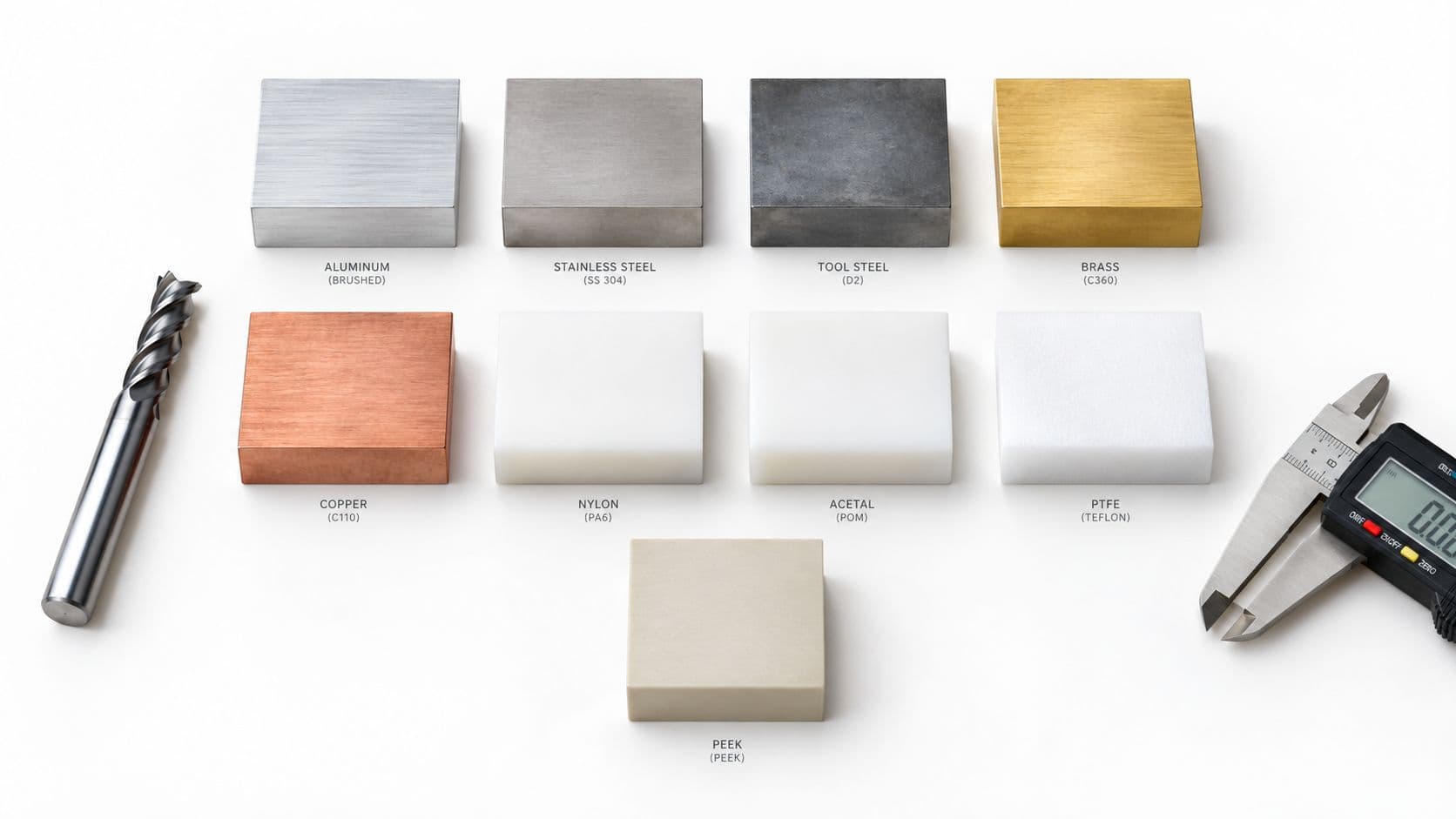
Metals account for 72.1% of precision CNC machining-service revenue, compared with 14.8% for plastics and polymers. That makes material selection the first cost and schedule decision, not a detail to finalize after the design is complete.
CNC machining materials determine more than whether a part reaches its strength target. They affect tool geometry, cutting forces, heat flow, chip control, fixturing, finishing, inspection, scrap recovery, and whether a supplier can source the specified grade when production starts. A material that looks economical on a drawing can become expensive after slow machining, difficult deburring, specialty finishing, or a failed substitution forces retesting.
The practical approach is to evaluate every candidate through three lenses: functional performance, manufacturability, and total delivered impact. The last category includes material waste, finishing, logistics, documentation, and supply risk.
Table of Contents
- Why Material Selection Dominates CNC Cost and Schedule
The specification must describe the real requirement
Aluminum Alloys for CNC Machining- Start with the application, not the alloy name
Steel, Stainless Steel, and Tool Steel Selection- Steel family comparison matrix
Non-Ferrous Metals for Precision Components- Match the alloy to the function
Engineering Plastics in CNC Machining- Machining strategy follows polymer structure
Achievable Tolerances and Surface Finishes by Material- Specify the finish with the function
Sustainability and Scrap Recovery in CNC Machining- Evaluate the material after machining
Geopolitical Supply Risk and Material Substitution- Build an approved alternate path
Quick Reference Guide to CNC Machining Materials
Why Material Selection Dominates CNC Cost and Schedule
The market split provides a useful starting point. Metals represent 72.1% of precision CNC machining-service revenue, while plastics and polymers represent 14.8%, according to a market estimate for CNC machining services. A separate estimate places aluminum and stainless steel together at 58% of machined materials, with engineering plastics at 17%. These figures aren't universal shop-floor ratios, because the measurement may reflect revenue, part count, or machine time, but they show where most sourcing decisions occur.
Material choice changes the process immediately:
- Tooling: Ductile aluminum needs sharp, positive cutting geometry, while stainless steel can work-harden if the tool rubs instead of cutting.
- Fixturing: Soft plastics may deflect under clamping force, while hardened steels demand rigid workholding to control chatter.
- Heat management: Titanium and some plastics retain or respond strongly to heat, affecting dimensional stability and tool life.
- Finishing: Aluminum may need anodizing, stainless steel may need passivation, and brass may need polishing or protective coating.
- Inspection: A part machined from a thermally sensitive polymer may need temperature stabilization before dimensional verification.
The specification must describe the real requirement
A material callout should answer more than “strong enough.” Define the load case, operating temperature, chemical exposure, electrical behavior, wear condition, appearance, joining method, and required certification. A housing that only needs stiffness and low mass may suit aluminum or POM, while a fluid fitting may require brass or stainless steel because corrosion behavior and thread durability dominate.
NIST guidance emphasizes that physical and mechanical properties influence production methods. Plastics may be suitable for molding but not forging, while steels can be cast or forged but cannot be vacuum formed. The manufacturing route therefore belongs in the material decision, not after it.
Practical rule: Quote the material and the process together. “7075-T6, five-axis milling, anodized” is a meaningful manufacturing requirement. “High-strength aluminum part” is not.
Before releasing a drawing, ask the machine shop to review the grade, temper, stock form, tolerances, and finish as one package. That review often identifies a readily available alternate or a simpler design condition before the material locks the project into a costly route.
Aluminum Alloys for CNC Machining
Aluminum is often the first material engineers evaluate because it combines low mass, useful corrosion resistance, and good machinability. The grade and temper still matter. They affect cutting behavior, dimensional movement, burr formation, and surface quality, so “aluminum” isn't specific enough for a production quote.
Start with the application, not the alloy name
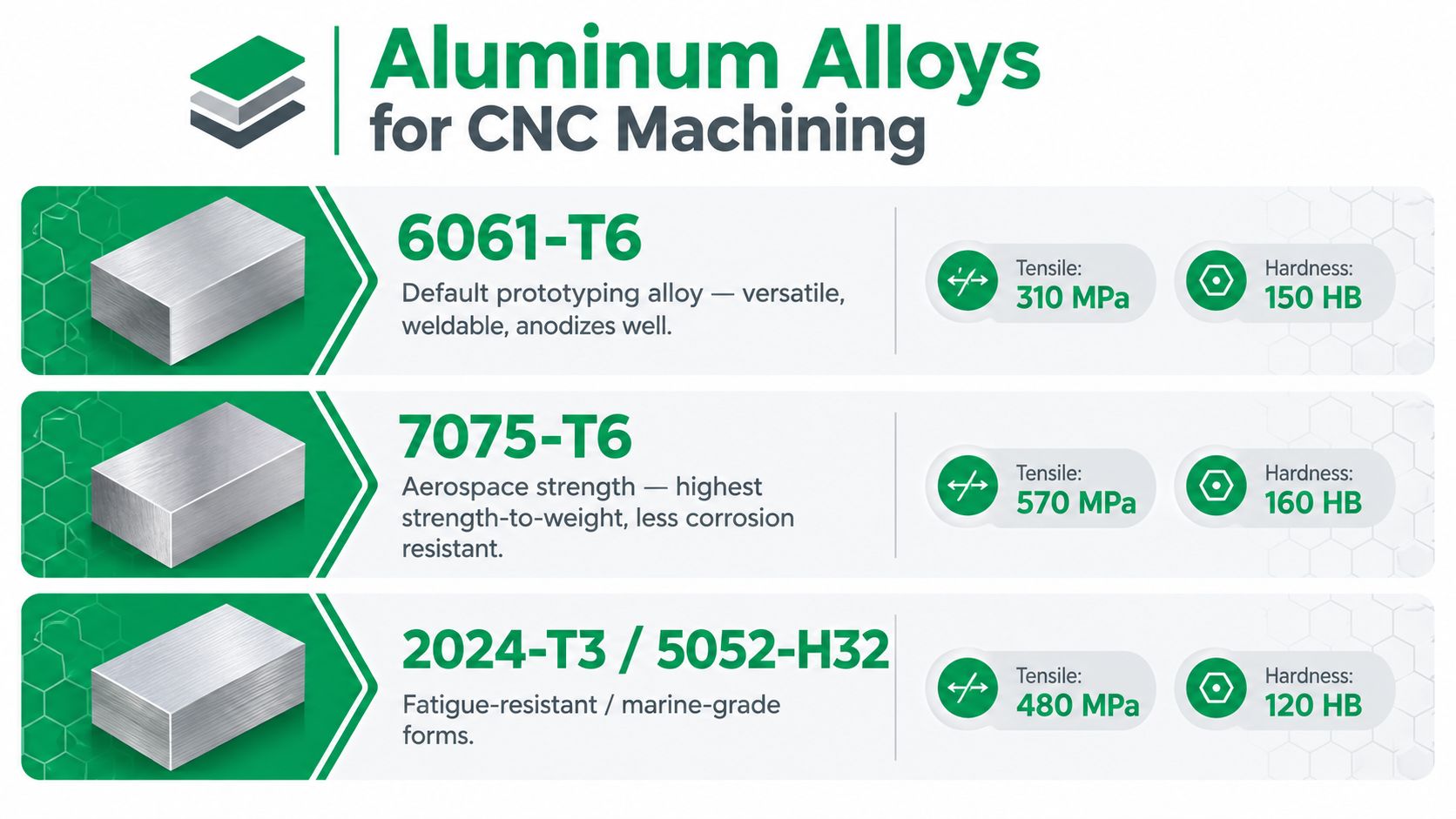
For rapid prototypes, 6061-T6 is usually a practical starting point when the design needs a balance of machinability, corrosion resistance, weldability, and cost. It suits housings, brackets, fixtures, and general structural parts where extreme strength isn't the primary constraint.
7075-T6 makes more sense when strength-to-weight performance leads the decision. It can be more sensitive to burr formation, tool wear, and stress-related distortion, especially in thin sections or parts with uneven stock removal. Don't substitute it automatically for 6061-T6. The stronger alloy may increase process difficulty without improving the part's actual function.
Other aluminum conditions can be appropriate when fatigue behavior, forming history, corrosion exposure, or a specific finishing route controls the decision. The drawing should identify the required grade and temper, not just a family.
NIST machining guidance recommends positive tool geometry for aluminum. Typical guidance includes approximately 6–10° top rake, with rake generally not below −6°. Milling cutters may use 10–20° radial rake, 15–45° axial rake, and roughly 10–12° clearance, as described in ASM International's machining guidance. These geometries reduce cutting forces and help limit built-up edge in ductile alloys such as 6061-T6 and 7075-T6.
Select cutting parameters from the actual setup
Avoid generic “aluminum” speed-and-feed presets. Use the actual alloy, temper, tool diameter, flute count, radial engagement, machine power, and coolant strategy. A large-diameter cutter taking a light finish pass is a different cutting problem from a small tool slotting a deep pocket.
For a first prototype, document the material certificate and keep the same grade through dimensional validation. If a surrogate is used for fit testing, record the difference in strength, thermal expansion, corrosion behavior, and finishing response before treating the prototype as representative.
For a practical starting point, review FIRMFG aluminum CNC machining alongside the drawing's material and finish requirements. The useful question isn't just whether the shop can cut the alloy. It's whether the alloy, temper, geometry, tolerance, and post-process finish can be delivered as one controlled sequence.
Steel, Stainless Steel, and Tool Steel Selection
Steel selection becomes clearer when the design separates strength, corrosion resistance, wear resistance, and machinability. Carbon steel, stainless steel, and tool steel aren't interchangeable versions of the same material. Each creates a different balance of cutting load, heat treatment, surface protection, and inspection effort.
Carbon steel is often the economical choice for structural components, brackets, fixtures, and jigs. Low-carbon grades generally machine more easily than high-carbon grades, while alloy steels such as 4140 can provide a stronger heat-treatment pathway at the cost of more demanding cutting and finishing.
Stainless steel earns its place when corrosion resistance, hygiene, or exposure to moisture matters. Annealed 304 and 316 can machine well with the right setup, but rubbing encourages work hardening. Keep the tool engaged, use rigid workholding, and evacuate chips rather than allowing recutting.
Tool steel belongs in wear surfaces, molds, dies, and components that must retain hardness. Its carbon and alloy content increase cutting loads, so stable fixturing and suitable coated carbide tools become more important.
Steel family comparison matrix
| Property | Carbon Steel | Stainless Steel | Tool Steel |
|---|---|---|---|
| Primary advantage | Economical strength and broad availability | Corrosion resistance and hygiene | Wear resistance and heat-treatment capability |
| Machinability | Excellent to moderate, depending on grade | Moderate, with work-hardening risk | Challenging, especially after hardening |
| Corrosion behavior | Usually needs protection | Naturally resistant, grade dependent | Usually needs protection |
| Heat treatment | Commonly available | Grade and condition dependent | Central to performance |
| Typical parts | Fixtures, brackets, structural components | Enclosures, fittings, medical and food-contact hardware | Dies, molds, wear components |
| Process priority | Efficient roughing and economical finishing | Rigid setup and continuous cutting | Tool life, rigidity, and controlled engagement |
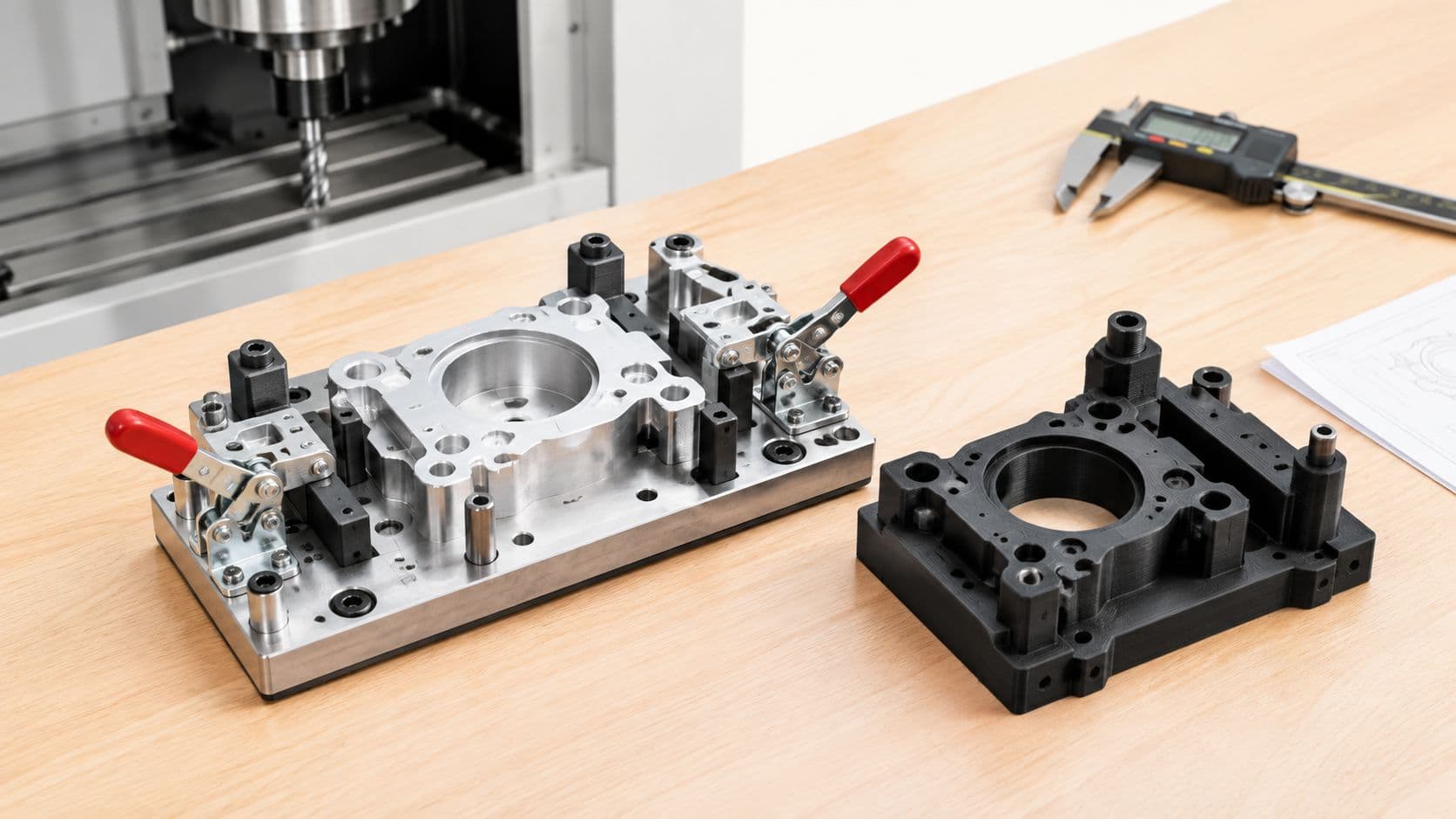
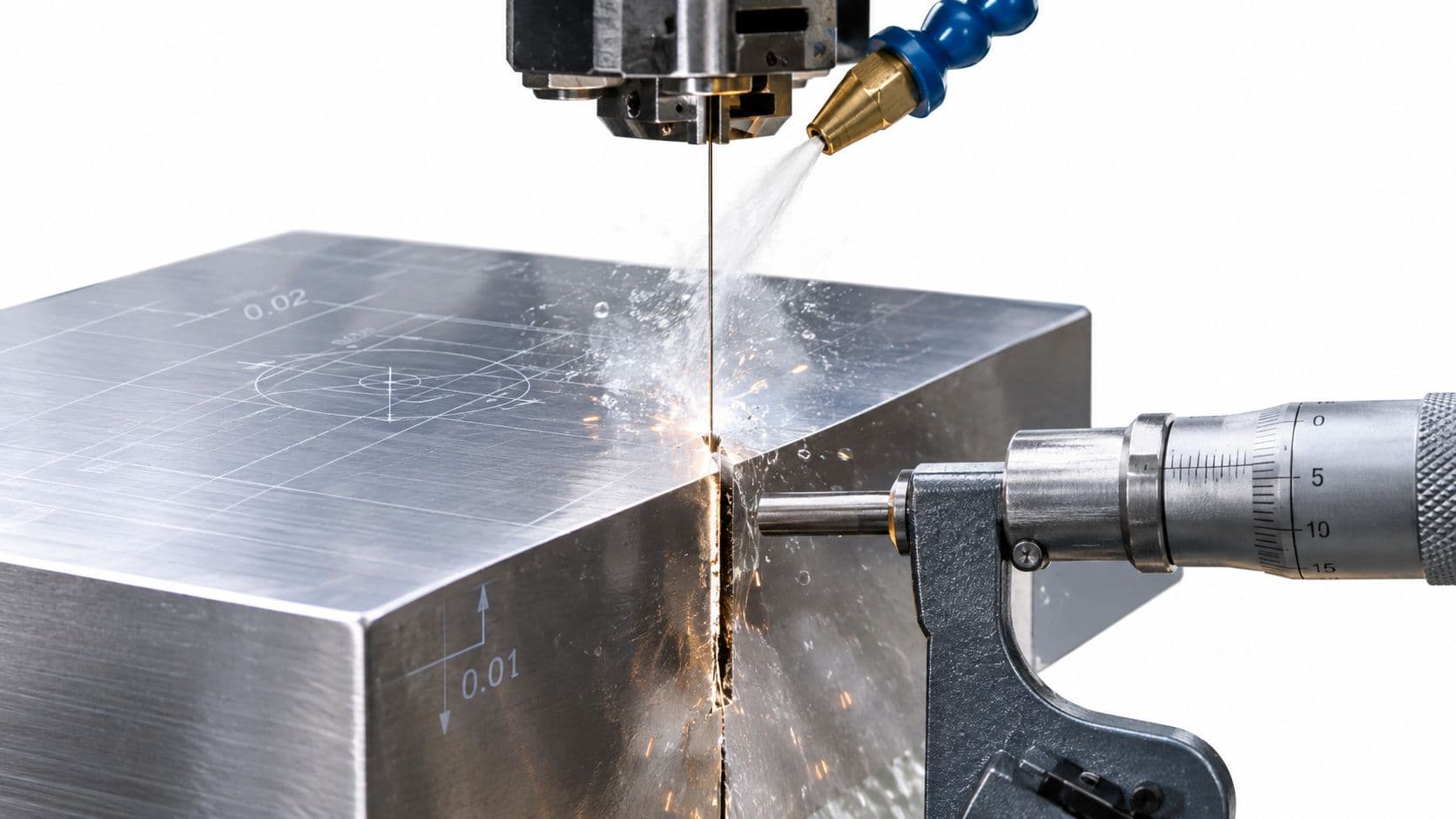
A 3-axis mill can handle many prismatic steel components when access is straightforward. Four-axis or five-axis machining becomes useful when multiple faces, angled holes, or complex blends would otherwise require repeated setups. Wire EDM can be the better route for thin profiles or hardened tool-steel features where cutter access and distortion control are difficult.
For grade, finish, and corrosion requirements, compare the process with stainless steel CNC machining. The correct choice depends on the service environment, not on which steel happens to be in stock.
Non-Ferrous Metals for Precision Components
Brass and copper solve problems that aluminum and steel don't. Their value often comes from electrical conductivity, thermal transfer, machinability, or appearance, rather than from maximum structural strength.
Brass is usually forgiving in the machine. It cuts cleanly, has useful natural lubricity, and supports accurate threads, fittings, valves, connectors, and decorative components. Its appearance also reduces the finishing burden when a warm metallic surface is acceptable. For a matte appearance, bead blasting can work. Polishing suits visible components where a bright surface is part of the design.
Copper is different. It conducts heat and electricity extremely well, but its softness and gummy chip formation can complicate machining. Sharp tools, controlled engagement, and effective chip evacuation matter more than just increasing cutting speed. Deep features may need carefully planned peck cycles to prevent chips from packing and to keep heat from accumulating at the tool tip.
Match the alloy to the function
Use brass when the part needs reliable threads, fittings, moderate strength, or a naturally attractive finish. Use copper for electrical contacts, heat sinks, busbar-like features, and electromagnetic shielding where conductivity justifies the machining difficulty.
Burrs deserve early attention. A sharp tool with suitable geometry can reduce edge deformation, but toolpath direction, entry strategy, and a deliberate deburring operation still matter. Thin copper walls and small holes are especially vulnerable to raised edges and distortion.
Surface protection also differs. Brass can be polished or bead blasted, while copper may need lacquering or another protective coating to slow oxidation. Don't specify a cosmetic finish without defining whether the part must retain conductivity, accept solder, or survive handling.
For intricate brass profiles, wire EDM can provide access where milling would require fragile tools or multiple setups. Complex copper heat exchangers may benefit from five-axis milling when tool access and uninterrupted flow paths are important. Process choice should follow the feature geometry, not the material label alone.
Engineering Plastics in CNC Machining
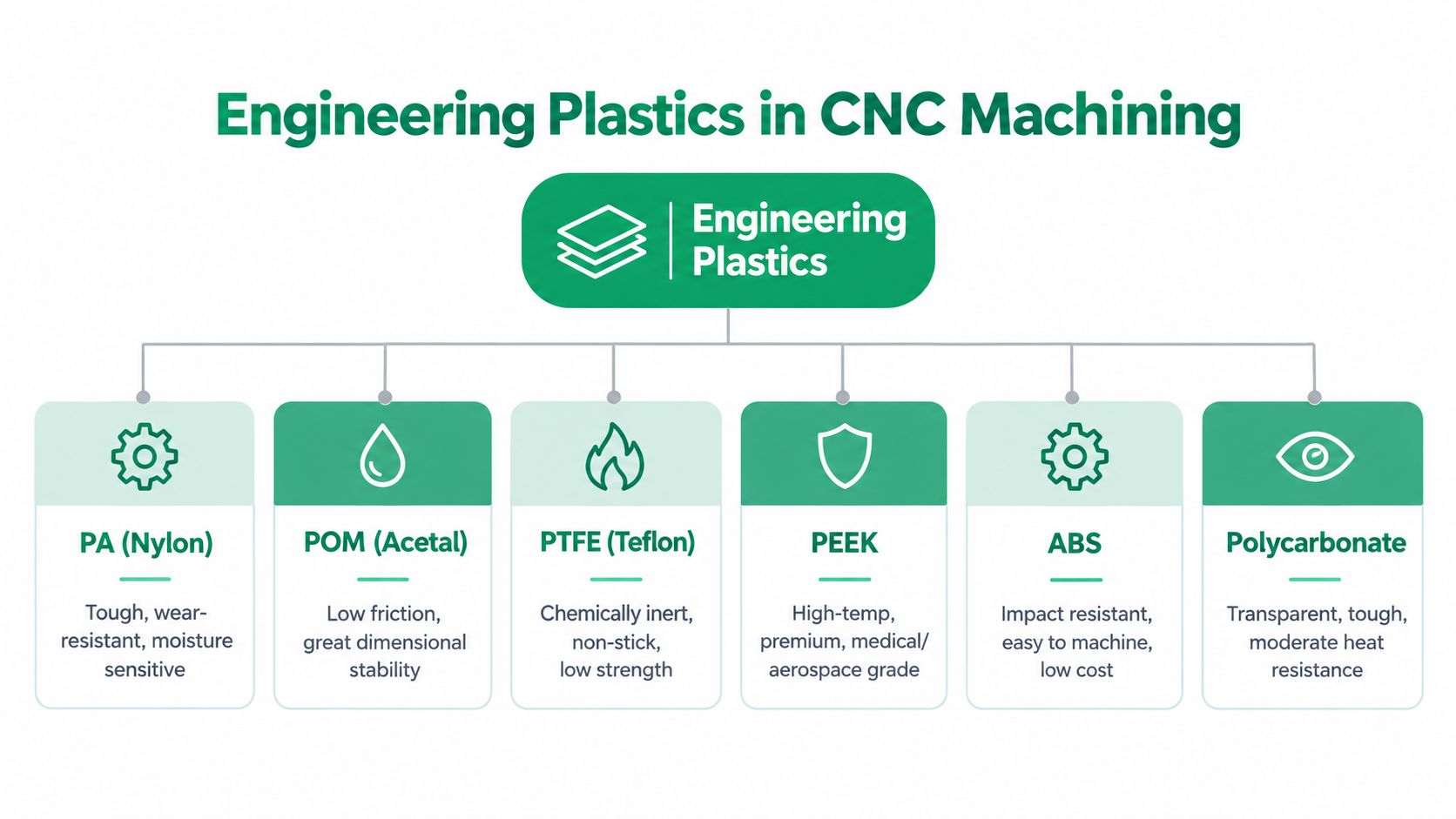
Engineering plastics are useful when a part needs low mass, electrical insulation, chemical resistance, low friction, or a combination of those properties. They aren't “easy aluminum substitutes.” Their thermal expansion, moisture absorption, stiffness, and tendency to deform under clamping can dominate the result.
POM, or acetal, is a strong general-purpose choice for gears, bushings, guides, and precision mechanisms. It has low friction and good dimensional stability, making it more predictable than moisture-sensitive nylon in many environments.
PA, or nylon, offers toughness, wear resistance, and useful sliding behavior. It also absorbs moisture, so a dimension that passes inspection in a dry machine shop may shift in service. Account for conditioning, storage, and the operating environment before assigning tight fits.
PTFE provides very low friction and strong chemical resistance, but it has low stiffness and can cold-flow under sustained load. It works well for seals, low-friction elements, and chemically exposed components, but it isn't a default structural material.
PEEK is selected when high temperature capability, chemical resistance, strength, or demanding medical and aerospace requirements justify its cost and more controlled machining. It needs sharp tools, stable workholding, and careful heat management.
ABS machines readily and suits housings, fixtures, and early functional prototypes. Polycarbonate adds toughness and transparency, but designers should consider scratching, environmental exposure, and stress around holes or sharp internal corners.
Machining strategy follows polymer structure
Semi-crystalline plastics such as POM and PEEK respond differently from amorphous plastics such as ABS and polycarbonate. Tool geometry, chip evacuation, clamping pressure, and cooling must suit the resin. A tool that produces a clean edge in POM may generate heat or stress in a softer polymer.
| Plastic | Practical strength | Main caution | Common use |
|---|---|---|---|
| Nylon | Tough and wear resistant | Moisture changes dimensions | Gears, bearings, sliding parts |
| POM | Rigid, low friction, stable | Can chip if the tool is dull | Precision mechanisms |
| PTFE | Chemically resistant, very low friction | Cold flow and low stiffness | Seals and sliding elements |
| PEEK | High-performance and temperature resistant | Cost and process control | Medical and aerospace parts |
| ABS | Easy to machine and economical | Limited heat performance | Housings and prototypes |
| Polycarbonate | Tough and transparent | Stress, scratching, and UV concerns | Guards and transparent covers |
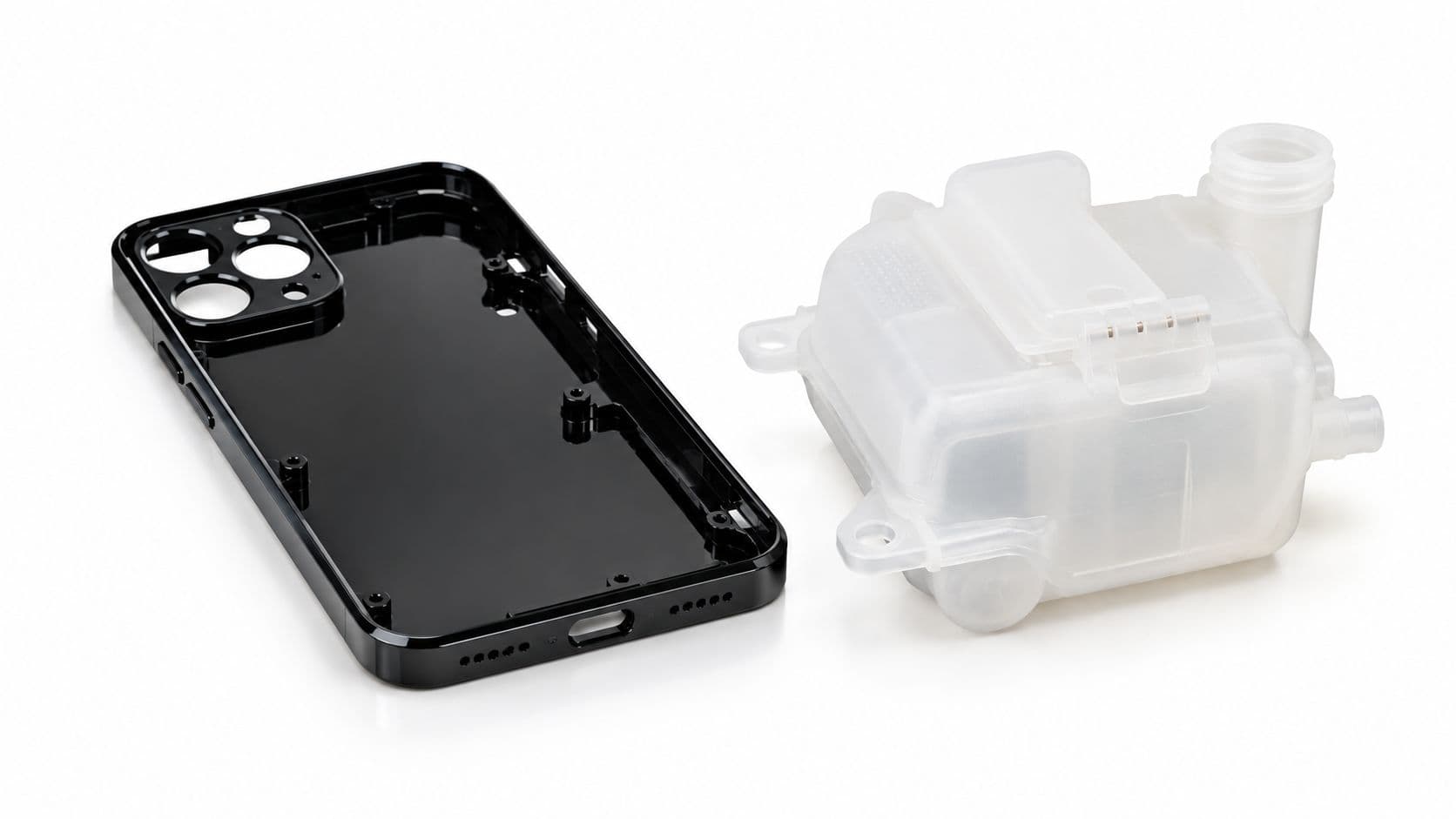
Use micro machining for small polymer components only after confirming tool deflection and burr control. Five-axis milling can reduce setups on complex plastic geometries, but it won't remove the need for adequate support under thin walls.
Achievable Tolerances and Surface Finishes by Material
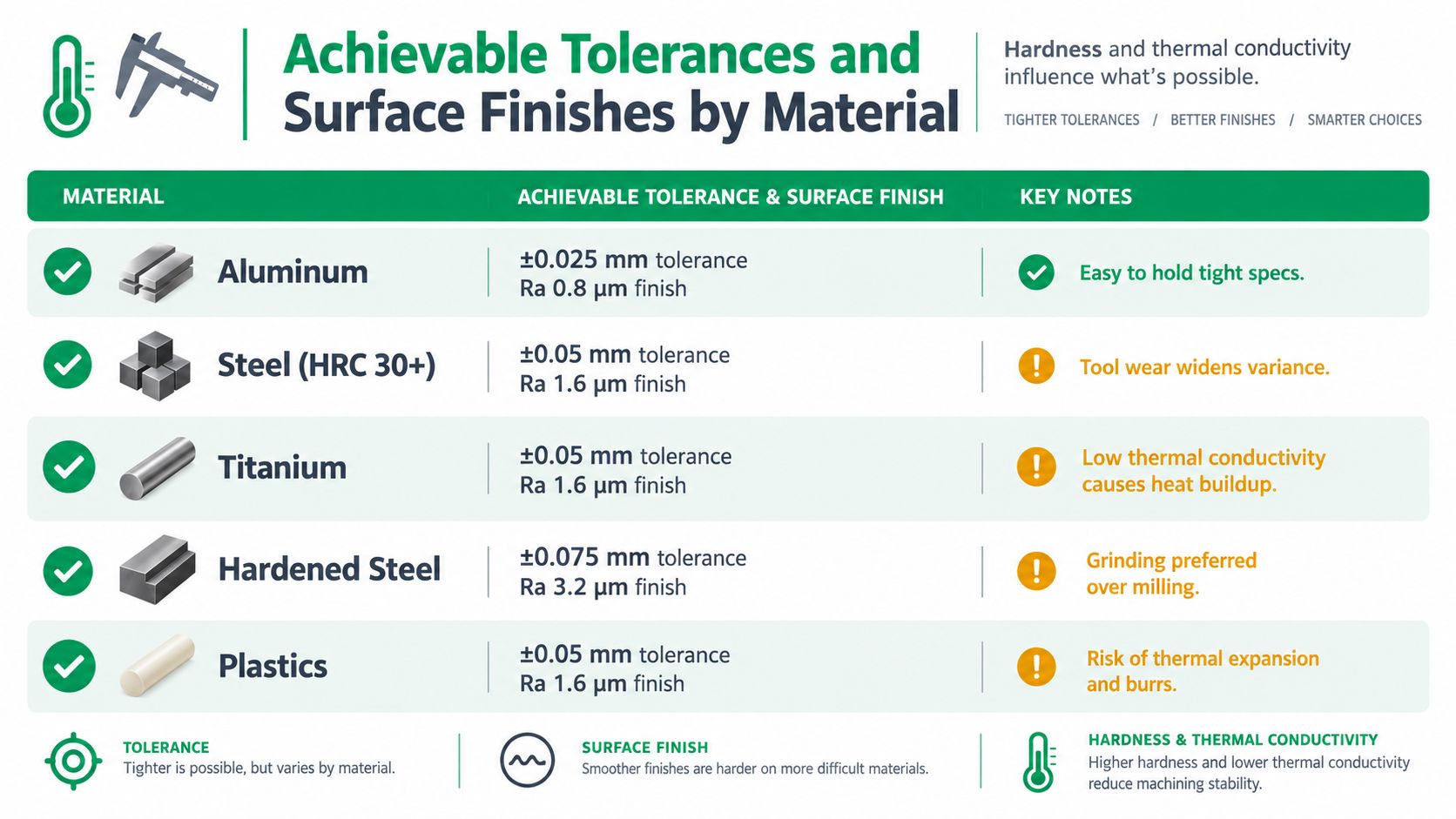
A tolerance belongs to a material and process combination. Hardness affects tool wear, thermal conductivity affects heat concentration, and chip formation affects cutting stability. Plastics introduce another variable, because the part can expand, contract, or deflect after machining.
Aluminum generally supports tight tolerances and clean finishes when the alloy, tool, and setup are controlled. Stainless steel demands more attention to rigidity and work hardening. Titanium is more heat-sensitive, while engineering plastics can move with temperature or moisture even when the machining itself looks clean.
Specify the finish with the function
Choose the finish because the surface has a job to perform:
- Anodizing aluminum can improve surface hardness and provide color, but the process can affect critical dimensions.
- Passivating stainless steel supports corrosion resistance without adding a thick decorative layer.
- Bead blasting creates a uniform matte appearance, though it can soften edges and alter visual texture.
- Polishing brass or copper improves appearance, but the final treatment must be compatible with oxidation and conductivity requirements.
- Machining plastics cleanly may be preferable to aggressive secondary finishing, which can round edges or introduce stress.
Review a surface roughness chart for CNC machining before assigning a numerical roughness requirement. A finish callout without a functional reason often adds cycle time and inspection effort without improving the part.
For plastic components, let the supplier know how the tolerance will be measured and at what temperature. For metal components, identify datum structure, critical fits, and whether the finish applies before or after coating. ISO 9001 and ISO 13485 quality frameworks can support documented inspection and traceability, but the drawing still needs a clear acceptance method.
Sustainability and Scrap Recovery in CNC Machining
Material efficiency belongs in the engineering decision, not only in the sustainability report. CNC machining can remove roughly 60–80% of starting stock as chips, according to guidance on sustainable CNC machining. That range varies with part geometry, stock form, nesting, and process planning, but it changes the economics of high-buy-to-fly parts.
Common CNC metals such as aluminum, steel, titanium, brass, and copper are generally recyclable. Aluminum recycling can save about 95% of the energy required for primary production, while steel recycling can save about 74%, as reported in the same sustainability reference. Those figures don't establish a universal carbon result for every supplier, because electricity mix, transport, alloy purity, coolant handling, and recycled feedstock all matter.
Evaluate the material after machining
A higher purchase price can sometimes make sense if the alloy has strong scrap value, reliable recycled feedstock, and a clean chip-recovery route. Mixed chips contaminated with coolant or other metals are harder to manage than segregated streams, so the shop's collection practice matters.
Ask procurement and manufacturing to document:
- Buy-to-fly ratio: How much stock becomes the finished part?
- Scrap segregation: Can the supplier keep aluminum, steel, copper, and other alloys separate?
- Coolant compatibility: Will the coolant complicate chip recovery or disposal?
- Finishing burden: Does plating, blasting, or coating add material and process impact?
- Carbon evidence: Can the supplier provide auditable assumptions for recycled content and production?
- End-of-life route: Can the finished part be identified and recovered within the customer's system?
Scope 3 reporting needs part-specific assumptions, not a universal claim that one material is always the lowest-impact option. Compare the full route, including stock production, machining waste, finishing, logistics, and end of life.
Geopolitical Supply Risk and Material Substitution
A material specification can pass every mechanical review and still fail the program if the grade, temper, or certificate becomes unavailable. The United States depends heavily on foreign sources for critical minerals and semiconductor components, creating exposure to geopolitical instability, according to NDIA's advanced-manufacturing policy submission. A manufacturing outlook also identifies disruption, delays, and increased costs as risks for 2025, so sourcing resilience needs to appear in the design review rather than after a purchase order is delayed.
Build an approved alternate path
An alternate isn't automatically a substitute. A different aluminum temper may alter strength and distortion. A different stainless grade may change pitting resistance, magnetic behavior, or galvanic compatibility. A different polymer may change sterilization resistance, moisture response, thermal expansion, or chemical compatibility.
Use a controlled hierarchy:
- Primary material: The grade, temper, condition, and certification required for validation.
- Prototype surrogate: A readily available material used only for fit, interface, or early form testing.
- Qualified alternate: A material reviewed against mechanical, environmental, regulatory, and finishing requirements.
- Revalidation trigger: The test or approval required if the alternate changes a critical performance characteristic.
A prototype can sometimes use a near-equivalent aluminum grade for enclosure fit or assembly checks. It shouldn't be used to validate fatigue, corrosion, sterilization, thermal behavior, or safety performance unless the engineering team has approved that equivalence.
For medical, automotive, robotics, and startup NPI programs, late substitution can trigger retesting, tooling changes, and documentation rework. Put alternate materials on the bill of materials with clear restrictions. Procurement should also verify mill certificates, heat or lot traceability, country-of-origin needs, and whether the supplier can maintain the same condition across prototype and production.
A material alternate is an engineering change, not a purchasing shortcut.
Quick Reference Guide to CNC Machining Materials
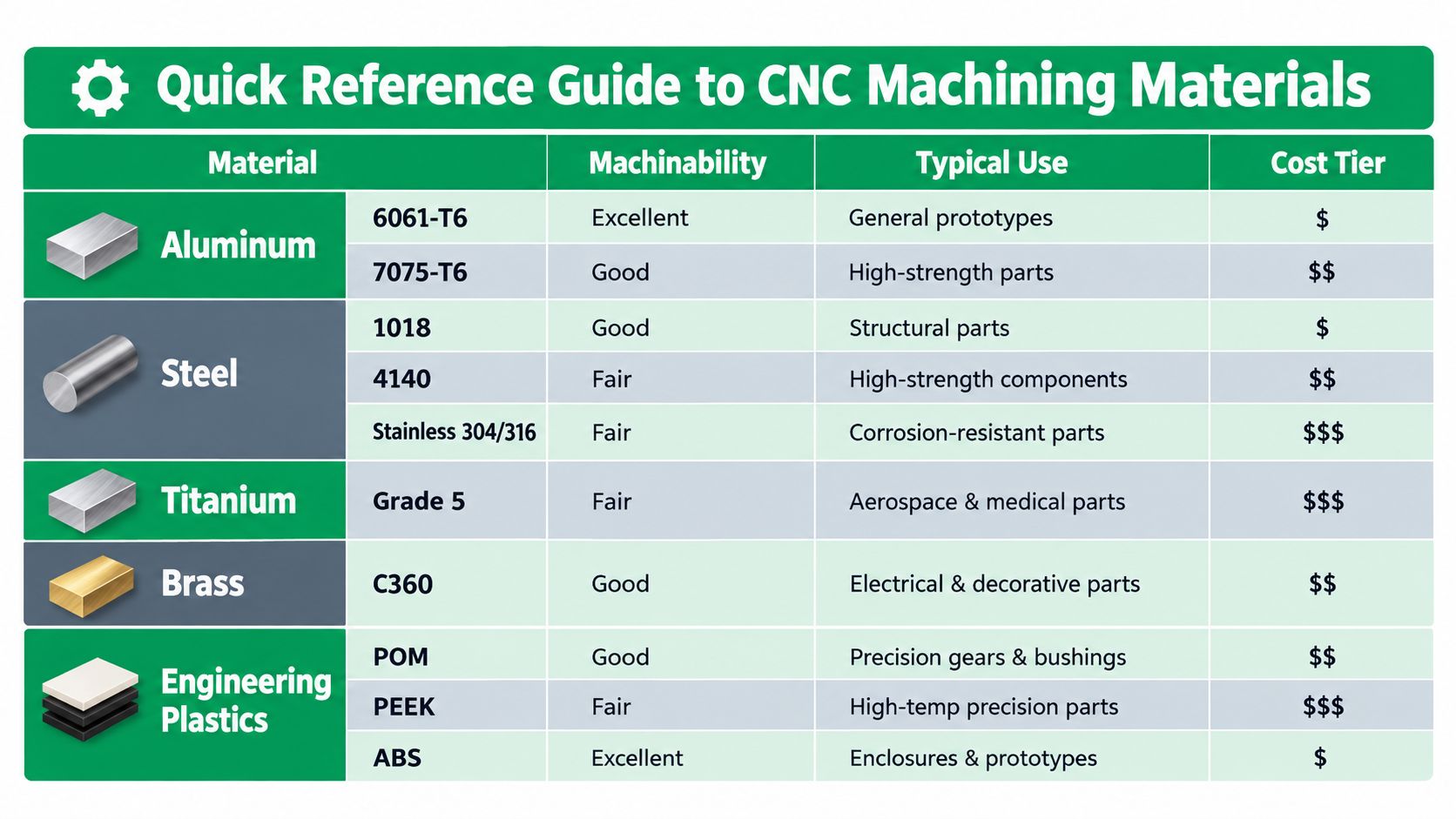
Use the table below as a screening tool, not as a substitute for a drawing review. The best CNC machining materials choice depends on the actual load, environment, geometry, certification, finish, and supply route.
| Material family | Functional profile | Machining and tolerance considerations | Finish options | Suitable process match |
|---|---|---|---|---|
| 6061-T6 aluminum | Balanced mass, strength, corrosion resistance, and machinability | Positive geometry, burr control, stable workholding for thin sections | Anodizing, bead blasting, polishing | 3-axis or 5-axis milling, turning |
| 7075-T6 aluminum | Higher strength-to-weight priority | Watch burrs, tool wear, and stress-related distortion | Anodizing where compatible, blasting, polishing | 3-axis or 5-axis milling |
| Carbon steel | Economical structural strength | Grade and carbon content influence tool load and finish | Painting, plating, black oxide where specified | 3-axis milling, turning |
| 304 or 316 stainless steel | Corrosion resistance, toughness, hygiene | Continuous cutting, rigid setup, work-hardening control | Passivation, bead blasting, polishing | 3-axis or 5-axis milling, turning |
| Tool steel | Wear resistance and heat-treatment capability | Rigid setup, coated carbide, controlled engagement | Grinding, polishing, protective treatment | Milling, turning, wire EDM |
| Brass | Excellent machinability, conductivity, appearance | Burr control is usually manageable, but features still need support | Bead blasting, polishing, protective coating | Milling, turning, wire EDM |
| Copper | High electrical and thermal conductivity | Sharp tools, chip evacuation, heat management | Polishing, lacquering where suitable | 3-axis or 5-axis milling, turning |
| Nylon | Tough, wear resistant, moisture sensitive | Account for moisture and clamping deflection | Machined finish, limited coating routes | Milling, turning, micro machining |
| POM or acetal | Low friction and dimensional stability | Clean sharp cutting and controlled support | Machined finish, selective polishing | 3-axis milling, turning, micro machining |
| PTFE | Chemical resistance and low friction | Cold flow and low stiffness constrain load-bearing use | Machined finish | Milling and turning |
| PEEK | High-performance polymer for demanding environments | More demanding heat and dimensional control | Machined finish, application-specific treatment | 3-axis or 5-axis milling, micro machining |
| ABS | Easy machining and economical prototyping | Limited heat performance and possible edge burrs | Painting, bonding, machined finish | 3-axis milling, micro machining |
| Polycarbonate | Tough, transparent, electrically insulating | Control stress, scratching, and thermal movement | Polishing, painting, selective coating | 3-axis or 5-axis milling |
Start with the material row that satisfies the primary functional requirement, then check the tolerance and finish columns against the actual drawing. If no row satisfies every requirement cleanly, don't force a compromise without flagging it. Review the geometry, identify a qualified alternate, or split prototype validation from production validation.
FIRMFG provides CNC milling and turning across aluminum, steels, brass, copper, titanium, and engineering plastics, with 3-axis, 4-axis, 5-axis, micro machining, and wire EDM options. Its documented quality frameworks include ISO 9001 and ISO 13485, which can support traceable inspection for prototype and low-volume manufacturing workflows.
Send your part files, material specification, tolerance scheme, and finish requirements to FIRMFG for a manufacturability review. The team can help compare CNC machining materials, identify process and finishing implications, and quote a practical route from prototype validation through low-volume production.