Copper vs Brass: Engineering Properties and CNC Selection
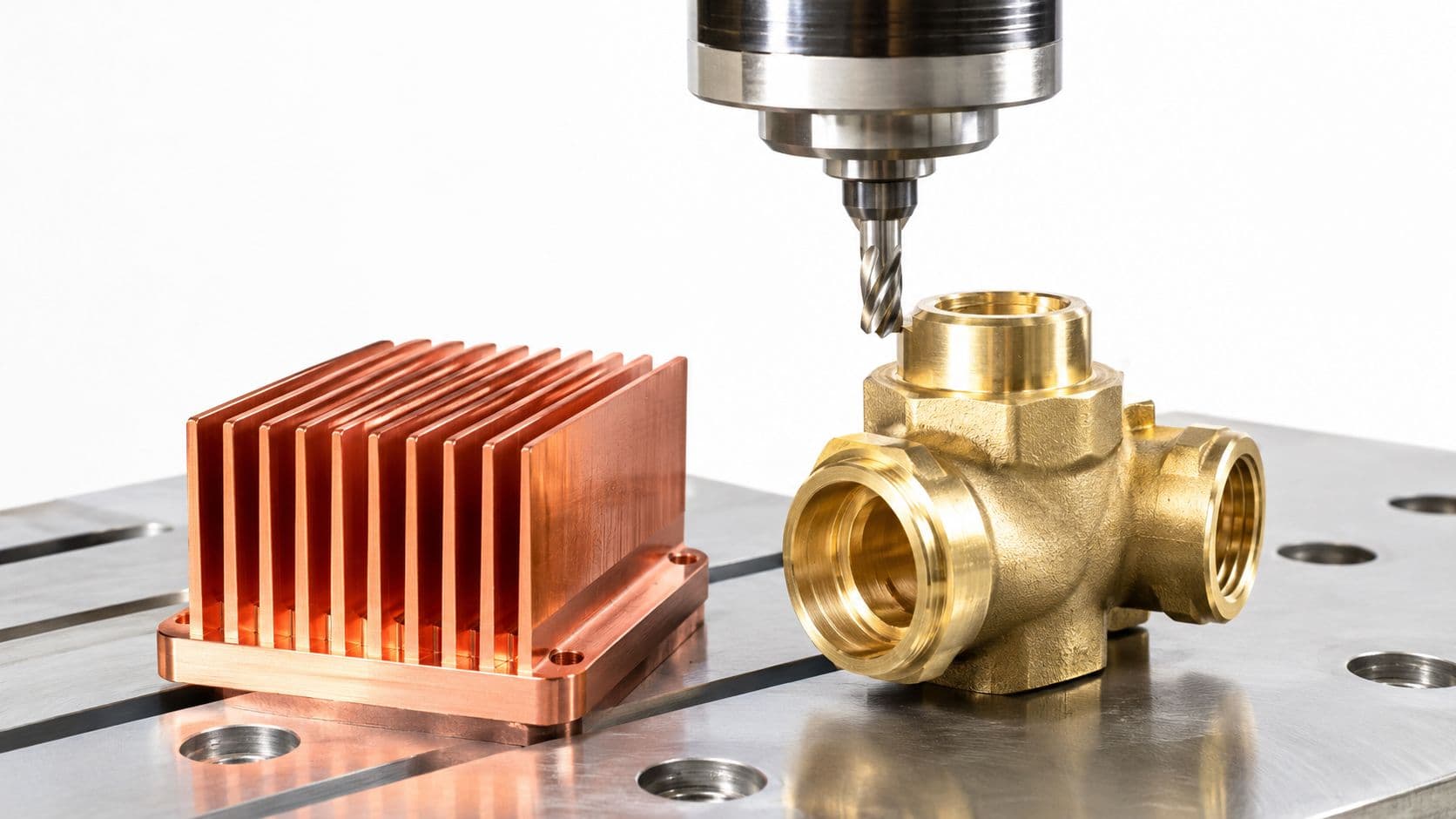
You've got a drawing open, a shop waiting for a material call, and two familiar names on the stock list. One will carry current beautifully but fight you on the machine. The other will cut like butter, hold a thread, and fail a thermal test. That's the Copper vs Brass problem, and it's rarely solved by looking at a color swatch or a price per kilogram. This guide treats the choice as a process decision, tied to tolerance, certification, scrap, and total part cost.
Table of Contents
Element vs Alloy: What You Are Buying
Comparing Physical and Mechanical Properties- Reading the Trade Row by Row
CNC Machinability and Fabrication Behavior
Corrosion Behavior and Regulatory Considerations- Dezincification and Drinking Water Rules
Cost, Recycled Content, and Lifecycle Impact
Matching Material to Component Types
Choosing the Right Alloy for Your Next CNC Build- A Short Specification Checklist
The Real Decision Behind Copper vs Brass
A product team brings you a compact enclosure. Inside it sits a busbar that must not overheat, two threaded ports for fluid lines, and a cover plate customers will handle every day. Someone suggests making everything from copper because it's the premium option. Someone else wants brass everywhere because the last quote came back cheaper.
Both instincts will create problems. Put brass in the busbar and you'll pay for that decision in voltage drop and heat you then have to remove. Put soft copper in the threaded ports and you'll watch threads deform, gall, and loosen after repeated assembly. Use either material for the cover without thinking about finish, and you'll get fingerprints, tarnish complaints, or a coating that doesn't behave the way you expected.
What Actually Drives the Call
In practice, six questions decide Copper vs Brass for prototype and low-volume CNC work. None of them is academic.
- Electrical or thermal duty: Does the part carry current or move heat as its primary job?
- Mechanical load: Does it need threads, press fits, or wear surfaces that survive handling?
- Machinability: Can your shop hold tolerance and finish without excessive deburr, rework, or scrap?
- Environment: Will it see freshwater, chlorides, stagnant water, or outdoor air?
- Regulatory status: Does it touch drinking water or a medical fluid path where alloy certification is mandatory?
- Total cost: What happens after raw stock, including cycle time, tool wear, finishing, inspection, and replacement risk?
Answer those in order and the material usually selects itself. Skip them and you'll iterate the expensive way, by building parts, testing them, and discovering the failure mode in hardware.
Practical rule: Name the part's primary function in one verb, carry, seal, spread, fasten, or enclose. The right material almost always follows that verb.
The sections that follow don't rank one material above the other. They show where each wins, where each creates shop floor risk, and what to put on the drawing so the quote you get back reflects the part you need.
Element vs Alloy: What You Are Buying
A purchase order that says only "brass" can come back as free machining bar, casting stock, or a grade your cert package rejects. Copper carries the same risk in a quieter way: the element is fixed, but purity, temper, and mill practice still change how it machines and how it proves out.
Copper is a chemical element bought by purity and temper. Brass is a copper zinc alloy where composition is the control knob. More zinc generally buys strength, hardness, and cleaner chip breaking; less zinc moves behavior back toward copper, including softness and better conduction.
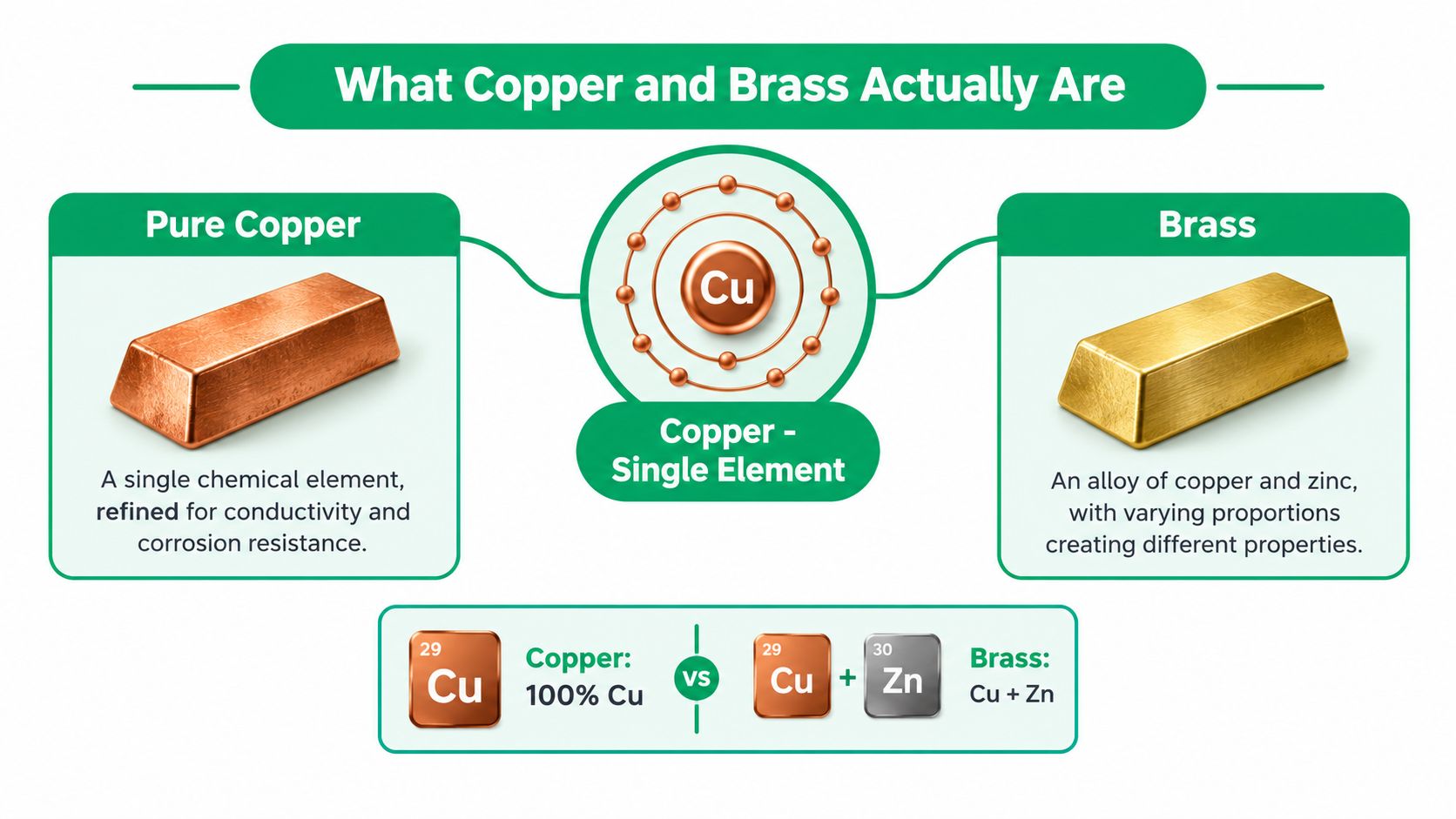
Historical brasses commonly fell around 11% to 28% zinc, with many modern grades pushing higher for ductility, strength, color, or castability, according to the Deutsches Kupferinstitut history of copper as a material of mankind. The same source dates early brass finds to the Babylonian Empire in the 3rd millennium B.C., after the Bronze Age began around 3500 B.C. and after earlier Chalcolithic copper work.
That timing tracks the process burden. Brass needed zinc bearing ore reduced while copper was hot, so the alloy became practical when producers could control a more difficult reduction, not when the concept was first imagined.
For quoting, keep the numbering systems straight. C110 and C36000 are UNS designations, while H59 is a Chinese GB designation, so confirm which standard the purchase order references. Use C110 or T2 copper when conductivity governs, H59 when strength and machining must balance, and C36000 when cycle time and chip control govern. Two parts both labeled brass can still machine, corrode, certify, and price differently, so grade selection inside the family controls scrap risk more than the family name.
Comparing Physical and Mechanical Properties
Catalog tables are useful only if you translate each row into a design consequence. A conductivity number becomes heat in your enclosure. A tensile number becomes a thread that either strips or doesn't. Read the comparison that way and the Copper vs Brass trade becomes clear.
For electrical and thermal work, C110/T2 copper typically provides approximately 98 to 100% IACS electrical conductivity and about 401 W/m·K thermal conductivity, while common H59 brass provides only about 25 to 30% IACS and roughly 120 W/m·K, respectively, according to the JLCCNC comparison of copper and brass properties.
Copper vs Brass Property Comparison
| Property | C110 Copper | H59 Brass |
|---|---|---|
| Electrical conductivity | 98 to 100% IACS | 25 to 30% IACS |
| Thermal conductivity | 401 W/m·K | 120 W/m·K |
| Tensile strength | 220 to 250 MPa | 390 to 440 MPa |
| Primary strength | Conductivity | Mechanical robustness |
| Typical risk | Softness, thread damage | Resistive and thermal losses |
Reading the Trade Row by Row
A copper busbar, heat spreader, grounding component, or high current connector carries current or rejects heat with substantially lower resistive and thermal losses than an equivalently sized brass part. You can compensate for brass conductivity with a larger cross section, but that adds mass, envelope, and sometimes a new packaging problem. In tight electronics, you usually don't have that space.
The mechanical row runs the other way. The tensile ranges in the table, 390 to 440 MPa for H59 brass versus 220 to 250 MPa for T2 copper from that same comparison, explain why brass holds threads, resists handling damage, and stays dimensionally stable in small fittings. Copper's relative softness makes it less suitable for threaded, wear exposed, or repeatedly handled components, even when its conductivity looks attractive.
Copper wins on conductivity by a wide margin. Brass wins on tensile strength by a wide margin. There's no grade tweak that makes either fact go away.
Brass still earns its place in electrical hardware. Low to moderate current terminals, threaded connectors, and parts where stiffness or appearance matter more than efficiency can use brass without penalty, provided you've carefully checked the current and temperature rise. The mistake is assuming moderate means whatever your part happens to draw.
Before you lock a specification, work through the FIRMFG CNC machining materials guide alongside your drawing and verify alloy, temper, section thickness, and operating temperature. Conductivity and strength vary materially across grades, so select by the governing requirement, voltage drop, Joule heating, thermal spreading, or mechanical load, not by family average.
CNC Machinability and Fabrication Behavior
A buyer sends the same connector drawing out for quotes twice, once in C36000 brass and once in copper. The brass quote returns with a routine cycle time. The copper quote comes back carrying extra deburr labor, an inspection note on exit burrs, and a caution that thin slots may need a second cleanup pass. Same geometry, different process plan.
The gap starts with rated machinability. Free cutting C36000 brass carries the 100% machinability benchmark and produces short, easily cleared chips, low cutting forces, and consistent surface finish, while copper sits near 20% on the same relative scale and tends toward gummy chips, burrs, and material sticking to the tool, as detailed in the Madearia guide to copper, brass, and bronze machining.
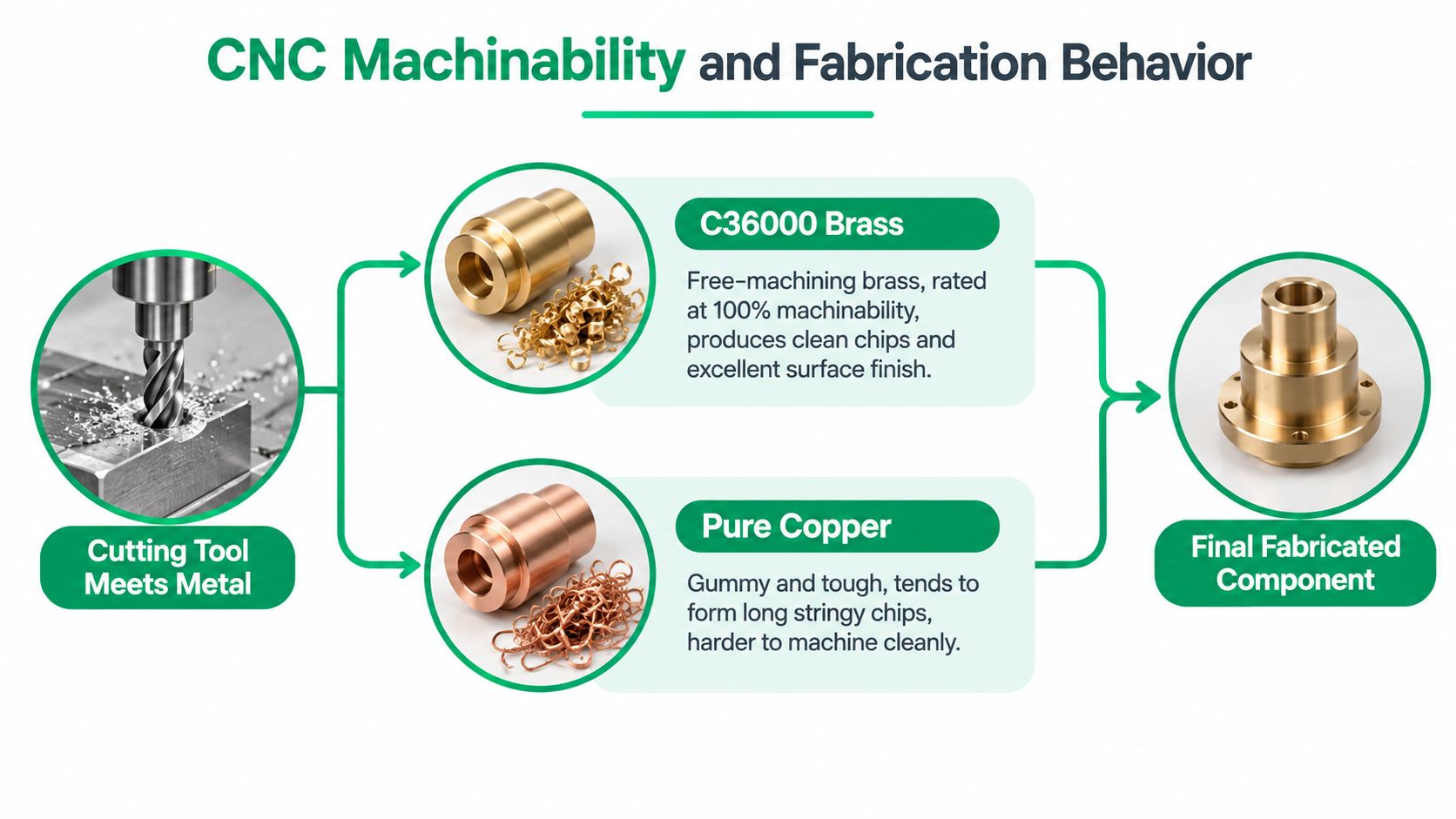
Those ratings translate directly into shop behavior:
| Process factor | C36000 brass | Copper |
|---|---|---|
| Chip formation | Short, broken, easy to evacuate | Long, gummy, prone to wrapping |
| Edge condition | Clean hole exits, minimal burr | Burrs at exits and thin edges |
| Feature holding | Threads and small features hold size | Thin walls deflect, fine slots tear |
| Cycle impact | Standard feeds, predictable tooling | Sharper tools, tuned parameters, added deburr |
Brass behaves predictably enough that turned threads come off the machine ready for inspection. That is why it stays the default for small threaded fittings, valve bodies, electrical hardware, and cosmetic parts where the machined finish is part of the product.
Copper rewards good process discipline and punishes assumptions. Sharp tooling, aggressive chip evacuation, rigid workholding, and a proven setup turn it into a workable material. Skip those steps and the part survives machining only to lose hours in manual deburr, or arrives with handling dents because soft stock picked up damage between operations.
Finishing follows the same logic. Bead blasting, powder coating, and plating all work on both metals, but pretreatment response and adhesion differ with the substrate. If appearance is a release criterion, approve a finished coupon in the actual alloy rather than trusting a generic finish callout.
Raise these points with the shop running your CNC machining services for prototype and low volume parts before tolerances freeze. A five minute conversation about chip behavior is cheaper than a respin on a copper part designed like brass.
Corrosion Behavior and Regulatory Considerations
The claim that copper is always safer and brass always corrodes will get you into trouble. Both materials can perform well. Both can fail. The difference lies in water chemistry, alloy grade, and whether your certification paperwork matches the market where the product ships.
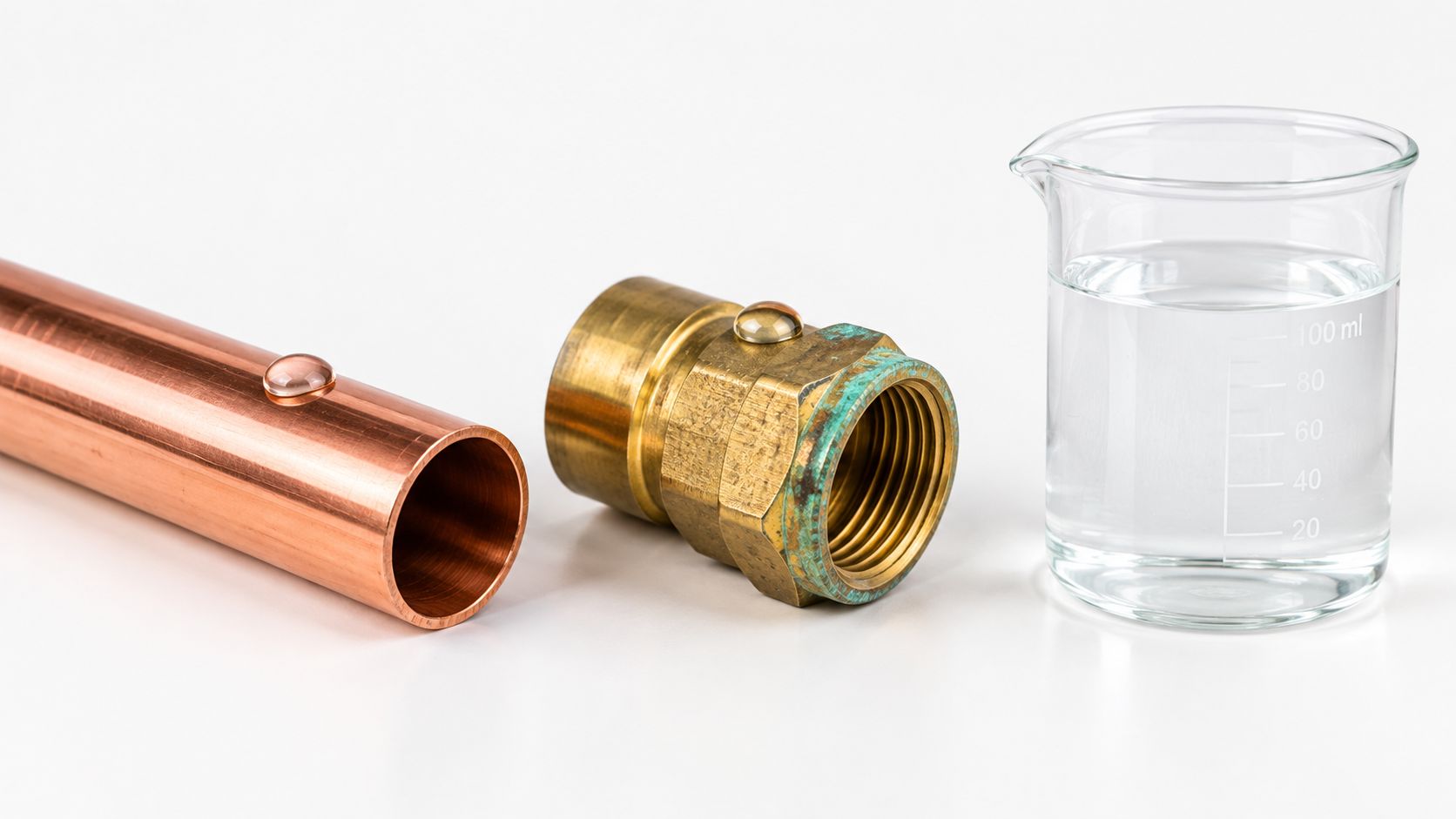
Copper forms a protective patina and performs well in atmospheric and freshwater service. That patina is a feature outdoors and on architectural parts, although it's a complaint generator on consumer hardware where customers expect a stable color. Decide early whether an evolving surface is acceptable or whether you'll pay for lacquer, plating, or another barrier.
Dezincification and Drinking Water Rules
Brass carries a specific failure mode copper doesn't. Higher zinc grades can suffer dezincification in acidic, chloride rich, or stagnant water, leaving a porous, weakened copper rich structure. The part can look intact while losing mechanical integrity, which is exactly the kind of failure you don't want in a pressurized fitting. Specify dezincification resistant or marine brass where potable water or chloride exposure is expected, and validate the grade rather than assuming all brasses behave alike.
Regulatory questions are separate from corrosion questions. The U.S. EPA notes in its EPA fact sheet on identifying household plumbing materials that brass plumbing is primarily a copper and zinc alloy and that components installed before 2014 may contain lead in solder or in the alloy itself, with corrosion able to release metals into drinking water.
Vermont's environmental authority, cited alongside that EPA material, lists an EPA lead action level of 15 ppb and a copper action level of 1,300 ppb. Those numbers reframe the debate. Brass isn't automatically unsafe for potable water or medical hardware. Seven brass rod alloys were added to the 2024 NSF/ANSI/CAN 61 Acceptable Materials list after meeting tighter lead leaching requirements, and those approved alloys are reported as fully recyclable with nearly 100% recycled content.
The practical conclusion is that alloy designation, dezincification resistance, water chemistry, certification, and traceability matter more than the word brass. U.S. NSF requirements and European drinking water rules aren't interchangeable, so don't carry a U.S. approval into a European launch without checking. For surface strategies in harsh service, review corrosion resistant surface finishing options as part of the alloy decision, not as a rescue plan after parts tarnish.
Cost, Recycled Content, and Lifecycle Impact
A turned fitting comes through quoting twice in one week: once in a free-cutting brass, once in copper. Same geometry, same tolerance callouts. The brass part runs at a higher feed, breaks its own chips, and drops off the turret close to finished. The copper part needs slower passes, produces long stringy swarf that has to be managed, and gets deburred by hand. Brass wins that quote on cycle time alone, even when the bar stock costs more per kilogram.
That is the pattern for prototype and low volume work. Unit price per kilogram tells you almost nothing. Total cost builds from cycle time, tool wear, scrap rate, finishing, certification, and whether the part survives its intended service without a redesign. Copper still wins plenty of those jobs, because conductivity can shrink a conductor section, cut operating losses, or delete a separate heat spreading component. I've watched programs spend the machining delta back twice over by specifying copper where brass would have forced a larger, hotter-running part.
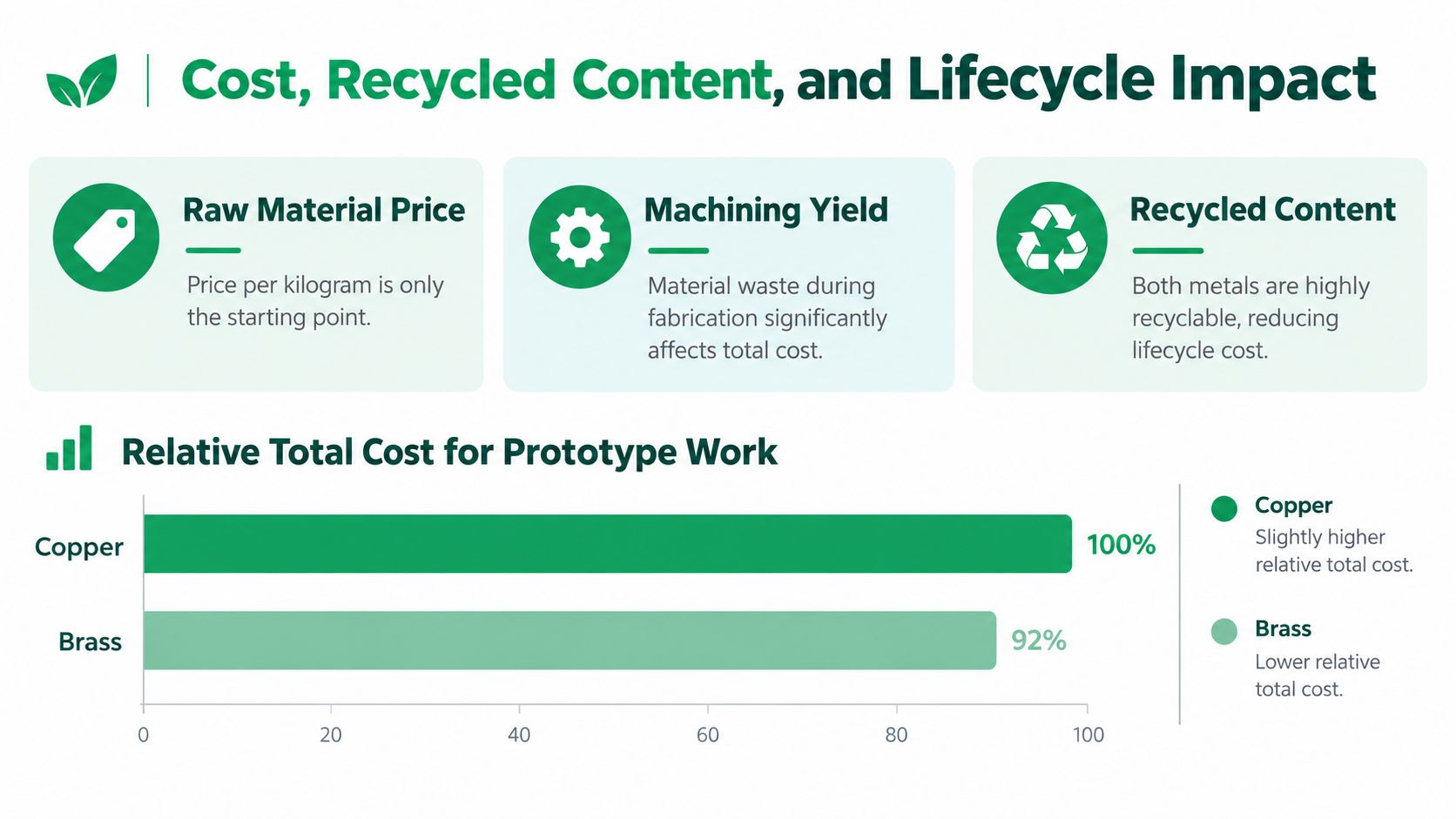
Feedstock swings the environmental answer harder than alloy choice. A 2025 life cycle assessment of shipbuilding materials, published as the MDPI Journal of Marine Science and Engineering life cycle assessment, modeled copper and brass components with closed loop recycling and reported approximately 2 kg CO2e per kg for recycled material versus roughly 4 to 5 kg CO2e per kg for virgin copper.
Composition still matters. Brass carries zinc alongside copper, so its footprint shifts with alloy mix, recycled content, scrap recovery, and machining yield. Copper's profile improves when conductivity cuts energy draw across years of service. A longer-lasting part that avoids a replacement can outweigh the feedstock gap between the two alloys.
Ask which material has the lowest lifecycle impact for this geometry, this process, and this service condition. A generic ranking cannot answer that for your part.
The RFQ is where this gets real. Ask for alloy certificates confirming exact grade, recycled content declarations stating whether feedstock is virgin or mixed, and confirmation that machining chips return to a recovery stream. Request scrap and energy data if your customer or regulator requires it. A supplier who documents those items gives you cost control and environmental claims that survive an audit. A supplier who cannot leaves you holding a low unit price and a folder of unanswered questions.
Matching Material to Component Types
Schedule pressure rewards pattern matching. Most copper and brass parts fall into a handful of recurring component families, and each family carries a governing requirement, a usual winner, and a predictable failure mode when the drawing names the wrong alloy.
| Component family | Governing requirement | Default material | Failure mode if you pick wrong |
|---|---|---|---|
| Busbars, grounding lugs, heat spreaders, high current connectors | Voltage drop, Joule heating, thermal spreading | Copper | Excess heat, oversized sections, a failed temperature rise test |
| Threaded fittings, valve bodies, instrument housings, cosmetic hardware | Thread strength, surface durability, finish | Brass | Dents, deformed sealing faces, slow careful machining for no functional gain |
| Connector systems needing strength plus a low loss current path | Mechanical thread and conductivity in one assembly | Hybrid | One alloy forced into both jobs, doing neither well |
The hybrid row solves a cost problem, not just a physics one. A brass connector body terminating a copper conductor gives you a threaded interface that survives wrenches and handling, and high conductivity where current flows. Two simple parts, each machined in the material it suits, will often beat a single part machined in a compromise alloy.
Scale explains why both supply chains stay intertwined. USGS data for 2023 reported U.S. mine production of approximately 1.1 million metric tons of recoverable copper, valued at about $10 billion, and the 2024 USGS summary reported that brass and wire rod mills accounted for approximately 80% of copper recovered from scrap, according to the USGS Mineral Commodity Summaries copper report.
That recycling flow reaches the part level. Copper scrap can return as refined copper or feed alloy production. Brass scrap already contains zinc, so it must be managed by alloy chemistry, and that chemistry shows up later in certification and surface appearance on precision parts. Treat scrap handling as material control.
Choosing the Right Alloy for Your Next CNC Build
Make the decision in a fixed order and you'll avoid most respins. Start with function, move to environment and regulation, then let the shop tell you what your geometry costs in the material you've chosen. Reversing that order, by letting an easy quote set the material, is how thermal and corrosion problems get designed in.
If conductivity, thermal spreading, or voltage drop governs, specify copper and budget for tighter process control. Use generous edge breaks where burrs will form, protect finished surfaces from handling damage, and don't demand brass style fine threads in a soft conductor without a mechanical insert or a hybrid design.
A Short Specification Checklist
If strength, threadability, cosmetic finish, or certified water contact governs, specify brass and name the sub alloy. Free machining, dezincification resistant, and lead free certified grades solve different problems. Writing brass on a drawing without a designation invites the shop to choose whatever bar is on the rack.
- Alloy and temper: state the exact designation and condition required.
- Tolerance and finish: tie both to function, and approve cosmetic samples in the actual alloy.
- Certification scope: name the standard, market, and fluid contact conditions.
- Documentation: require alloy certificates and recycled content declarations when customers will ask for them.
- Environment: describe water chemistry, chlorides, temperature, and cleaning agents in the RFQ.
Ask one final question before release. What fails first if this material choice is wrong? If the answer is overheating, revisit conductivity. If it's stripped threads, leaks, or a failed leaching test, revisit grade and certification. That single question forces the Copper vs Brass decision back to the failure mode you can least afford.
Specify the material that controls your governing failure mode, document the exact alloy, and give the machine shop enough process information to quote accurately. That's how copper and brass parts arrive on tolerance, pass certification, and stay within budget on the first build.
Send your copper or brass drawing to FIRMFG for a manufacturability review that checks alloy grade, tolerances, finish, and certification needs before machining starts. You'll get practical feedback on whether copper, brass, or a hybrid design gives you the lowest total part cost for your prototype or low volume run.