Metal Cutting Coolants: A Complete 2026 Guide
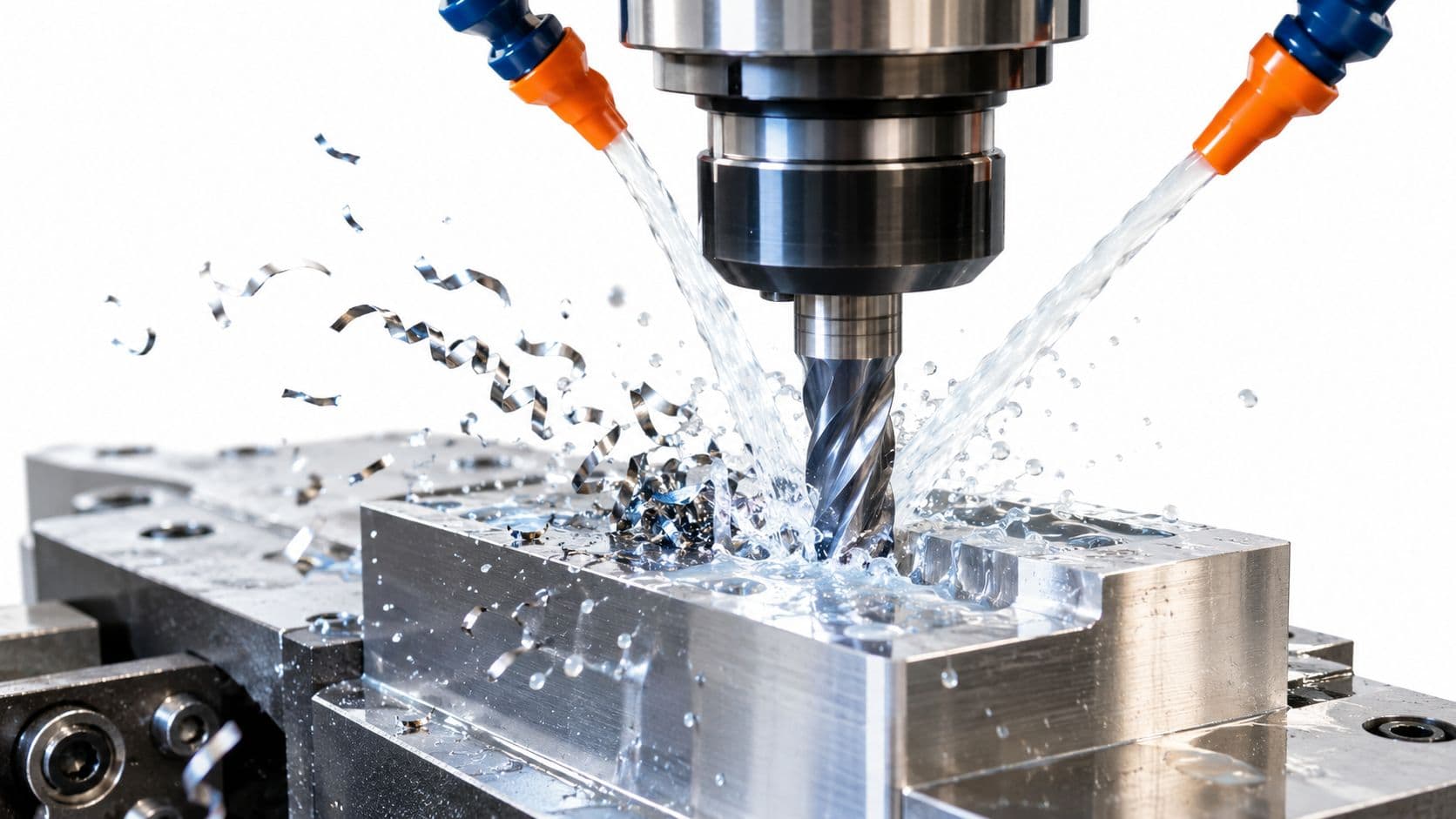
You're halfway through a prototype run when the finish starts to deteriorate. The tool still cuts, the spindle load looks acceptable, and the program hasn't changed, yet the pocket walls show faint marks and the coolant stream is missing the actual cut zone. In a short-run CNC cell, that situation is common because the fluid is often treated as something to top up, not something to engineer.
Metal cutting coolants influence heat, friction, chip evacuation, corrosion, tool wear, surface finish, operator exposure, and waste. The right decision depends on more than whether a fluid is called soluble, synthetic, or bio-based. You need to connect the fluid family, additive package, concentration, delivery method, filtration, and health controls to the material and operation.
Table of Contents
- Why Coolant Choice Matters on the CNC Floor
- What Metal Cutting Coolants Actually Do
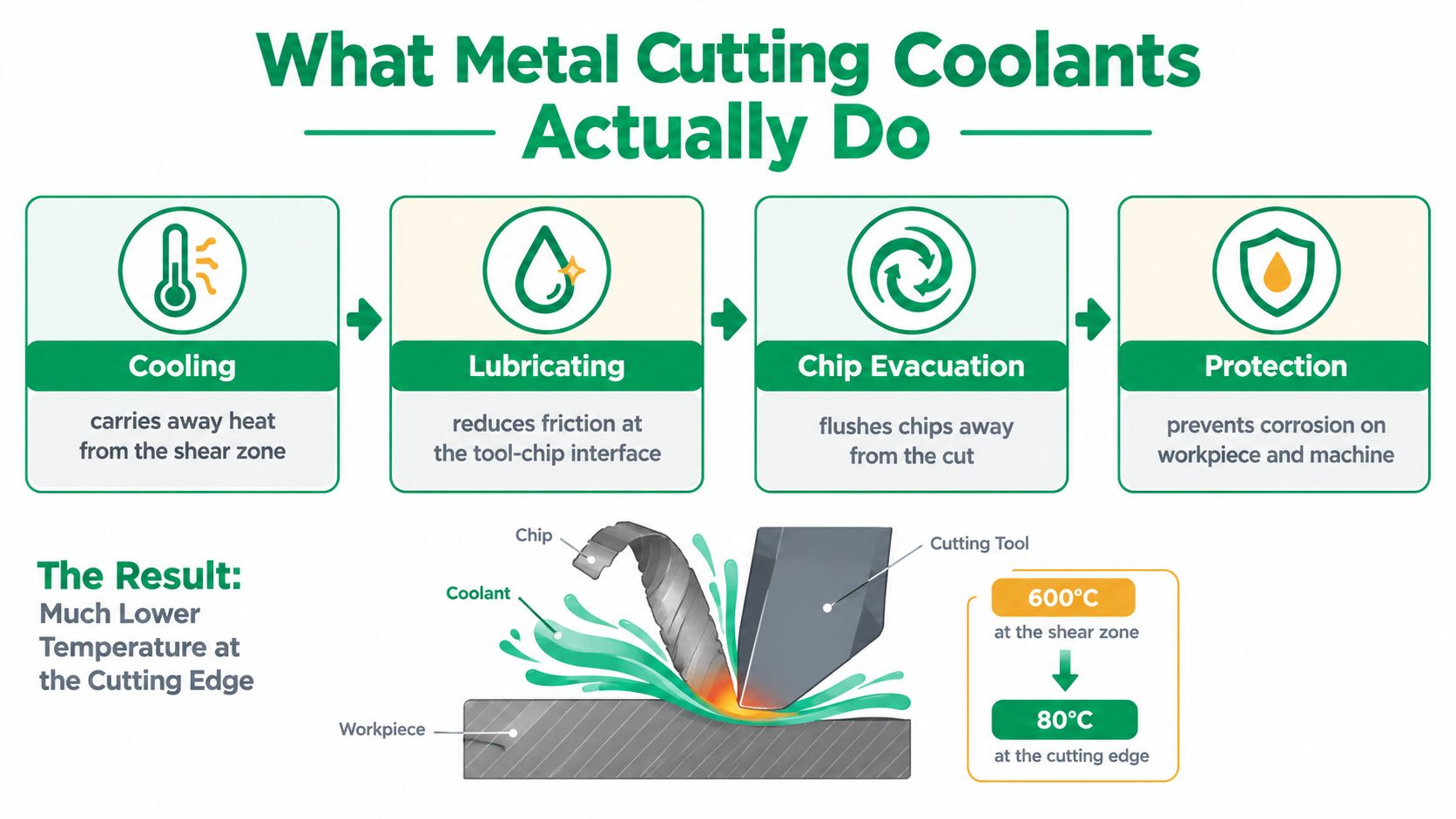
The four jobs that must work together
Comparing the Four Main Coolant Families
Inside the Additive Package- Extreme-pressure and friction control
Selecting Coolant by Material and Operation- Concentration is part of the cutting recipe
Concentration, Filtration, and Delivery Control- Measure the fluid before changing the program
Health Risks and Sustainable Fluid Management- Sustainability starts with fluid life
A Practical Coolant Plan for Short-Run Production
Why Coolant Choice Matters on the CNC Floor
A junior machinist may first blame a deteriorating finish on feeds and speeds. That's a reasonable starting point, but it can miss the true cause. If the coolant concentration has drifted, the nozzle is aimed behind the cutter, or the fluid lacks enough boundary lubrication, the same toolpath can produce a different cutting process.
Think of coolant as another process variable alongside spindle speed, feed rate, depth of cut, tool geometry, and workholding. A fluid has to perform several jobs at once:
- Control heat: Remove heat from the tool, chip, and workpiece before thermal damage affects the process.
- Reduce friction: Limit adhesion and sliding resistance where the chip moves across the rake face.
- Move chips: Prevent recutting, chip packing, and damage in pockets or drilled holes.
- Protect surfaces: Reduce corrosion and staining on the part, machine, and tooling between operations.
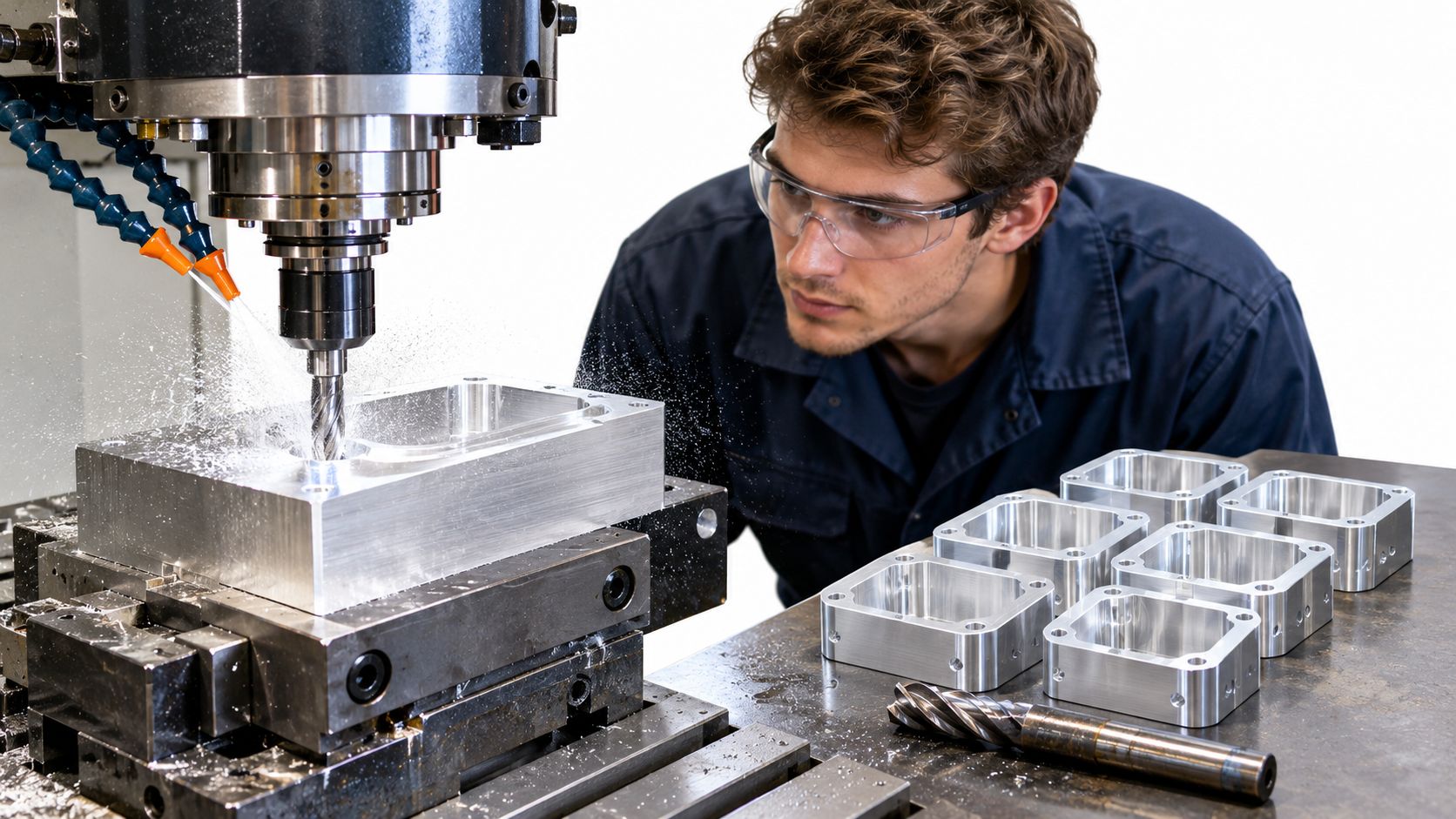
A practical example makes the point. Suppose an aluminum prototype needs a thin-wall pocket and a consistent cosmetic finish. If the fluid doesn't wet the tool's cutting zone properly, aluminum can adhere to the tool. The resulting built-up edge changes the effective geometry, increases rubbing, and transfers marks to the wall. If the concentration is too low, corrosion protection and lubrication can also weaken. If it's too high, residue, foam, or poor rinsing may become the new problem.
Practical rule: When tool wear or finish changes unexpectedly, check the coolant system before changing the entire cutting program.
This is why coolant decisions belong in the same process conversation as the broader CNC machining process. For prototype work, where material and geometry can change from job to job, a documented fluid-control plan prevents every new part from becoming a trial-and-error exercise.
What Metal Cutting Coolants Actually Do
Metal cutting coolants, also called metalworking fluids, are engineered fluids used to manage the interface between a cutting tool, a workpiece, and the chips being formed. They may be straight oils, soluble oils, semisynthetic fluids, or synthetic water-based formulations. Each family balances cooling, lubrication, cleanliness, and protection differently.
The cutting zone behaves like a tiny furnace. Mechanical deformation and sliding contact generate heat, while the tool edge must remain hard enough to keep its shape. Coolant acts partly like a fire crew, carrying heat away, and partly like a thin protective film that reduces the friction creating that heat.
The four jobs that must work together
- Cooling removes heat through fluid flow and heat transfer. Water-rich formulations usually provide strong cooling, provided the fluid can reach the cutting zone.
- Lubricating reduces friction at the tool-chip and tool-workpiece interfaces. This matters when adhesive wear, built-up edge, or high cutting force controls tool life.
- Chip evacuation flushes chips out of holes, slots, and pockets. A fluid stream that reaches only the top of the workpiece won't solve chip packing at the tool tip.
- Protection helps limit corrosion on freshly machined surfaces and machine components. The additive package and concentration both influence this protection.
The scale of exposure explains why fluid performance and fluid safety can't be separated. NIOSH reports that more than 100 million gallons of metalworking fluids are produced annually and that over 1 million employees are exposed to them. The principal occupational routes are inhalation of fluid mist and skin contact.
NIOSH established recommended exposure limits of 0.5 mg/m³ for total metalworking-fluid particulate and 0.4 mg/m³ for the thoracic particulate fraction, measured as time-weighted averages for exposure of up to 10 hours per day during a 40-hour workweek. Those values don't turn coolant selection into a paperwork exercise. They reinforce a shop-floor reality: fluid chemistry, enclosure design, ventilation, delivery pressure, and maintenance all affect the working environment.
For a deeper finish discussion, distinguish the measurement method before troubleshooting. A part may pass a roughness requirement while still showing directional lay or waviness, which is why the difference between Ra and Rz surface finish matters during inspection.
Comparing the Four Main Coolant Families
The simplest way to compare coolant families is to place them on a line from maximum cooling to maximum lubrication. Water-based fluids generally remove heat effectively, while oil-rich fluids tend to form stronger lubricating films. Additives can shift that balance, but they can't eliminate the underlying trade-off.
| Family | Typical Concentration | Cooling Performance | Lubrication Performance | Best-Fit Operations |
|---|---|---|---|---|
| Soluble oils | Use the supplier's specified working range | Strong | Strong | Heavy milling, drilling, and difficult ferrous cuts |
| Semisynthetics | Use the supplier's specified working range | Strong | Moderate to strong | General CNC milling and turning |
| Full synthetics | Use the supplier's specified working range | Very strong | Moderate, formulation dependent | High-speed work, clean machining, and operations needing heat removal |
| Straight oils | Used neat, according to supplier instructions | Limited compared with water-based fluids | Very strong | Tapping, broaching, threading, and low-speed finishing |
Soluble oils combine an oil phase with water and emulsifying chemistry. They're useful when a cut needs both cooling and boundary lubrication, especially in tough ferrous work. Their weaknesses appear when the sump is neglected. Poor tramp-oil control, weak concentration control, and microbial contamination can create odor, staining, foam, or unstable performance.
Semisynthetics occupy the practical middle ground. They provide meaningful cooling while retaining more lubricating character than many fully synthetic formulations. That balance makes them a sensible starting point for mixed prototype work, but the exact result depends on the supplier's chemistry and the material being cut.
Full synthetics contain no mineral-oil phase and are often chosen when cleanliness, heat removal, and low residue matter. They can suit aluminum, high-speed milling, and systems where fluid access and chip evacuation dominate. A formulation with insufficient boundary lubrication may be a poor choice for a heavily loaded, adhesive cut.
Straight oils provide the strongest lubrication but don't carry heat away like water-based fluids. They can be effective for tapping, broaching, and threading, where friction and adhesion dominate. They also require careful mist, housekeeping, fire, and disposal controls.
Selection principle: Don't ask which coolant family is universally best. Ask whether the operation is limited by heat, friction, chip evacuation, corrosion, or exposure control.
Inside the Additive Package
A base fluid rarely performs every required job by itself. The additive package gives it the behavior needed at the tool-workpiece interface, in the sump, and on the machine surface. Treat those additives as a coordinated system, not a list of interchangeable ingredients.
Extreme-pressure and friction control
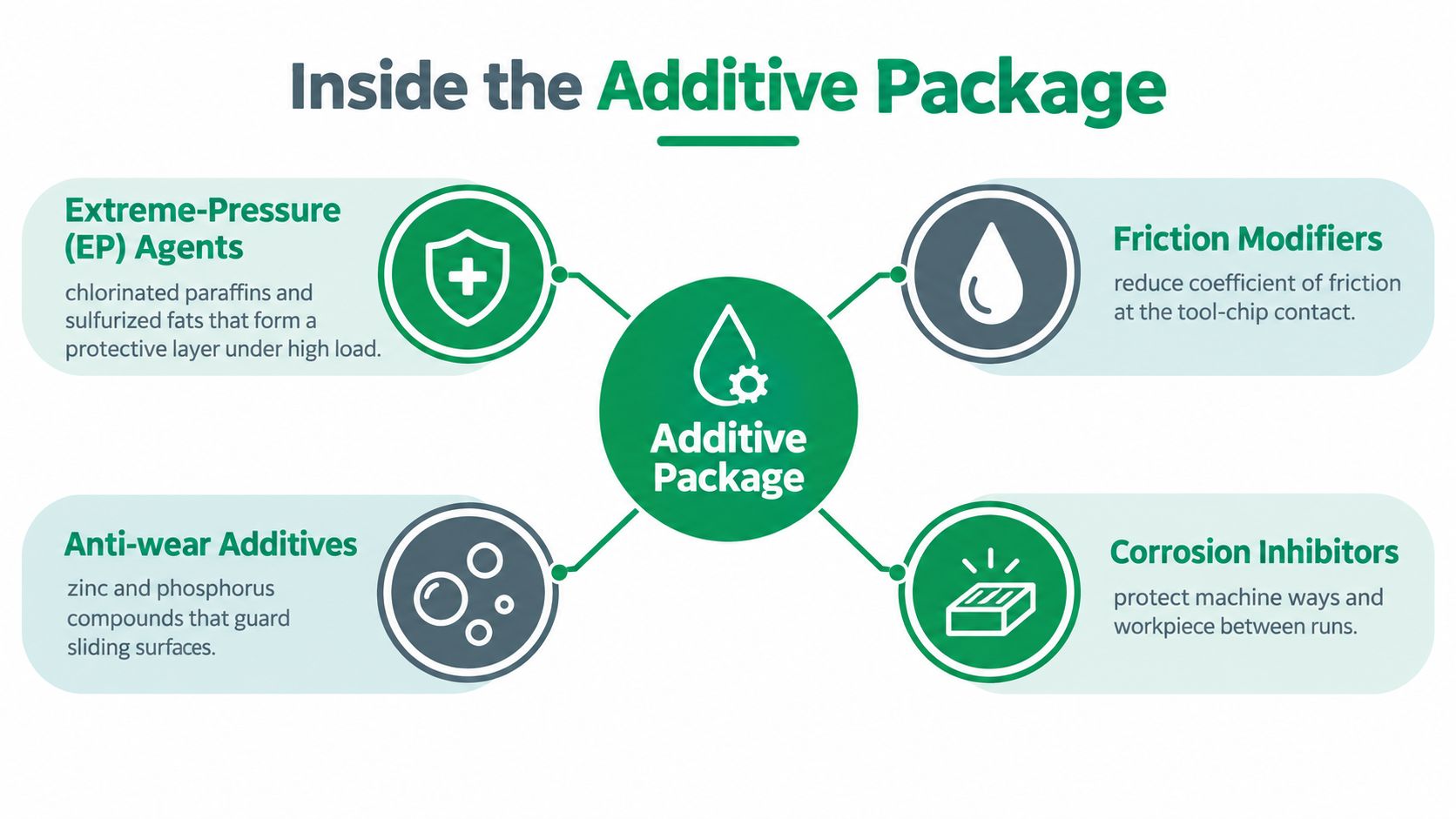
Extreme-pressure agents help protect surfaces when load and temperature squeeze out an ordinary fluid film. Chlorinated paraffins and sulfurized fats are examples of chemistries used for this purpose, forming sacrificial films under demanding contact conditions. They can help with tapping, broaching, and other operations where metal-to-metal contact is severe.
The trade-off is compatibility. Some additive chemistries can create staining, odor, regulatory, or downstream finishing concerns. The technical sheet should identify material compatibility and restrictions instead of relying on the phrase “heavy duty.”
Friction modifiers reduce sliding resistance at the tool-chip interface. Anti-wear additives provide another layer of protection for sliding surfaces. The infographic supplied for this guide groups these functions with EP agents and corrosion inhibitors, which is useful because the functions overlap in practice.
Corrosion, microbes, and wetting
Corrosion inhibitors protect both the machined part and the machine. A fluid that cuts well but stains aluminum, attacks exposed steel, or leaves vulnerable surfaces after shutdown isn't a complete process solution.
Biocides and fungicides act like the coolant's immune system. They limit microbial growth, but they don't replace filtration, tramp-oil removal, circulation, or concentration control. Adding chemistry to a dirty sump can mask the cause while leaving the underlying contamination in place.
Surfactants and wetting agents behave somewhat like dish soap. They help the fluid spread across metal, wet chips, influence foam, and manage the interaction between oil and water. Too little wetting can leave dry spots at the tool. Too much agitation or unsuitable surfactant behavior can create persistent foam.
A useful specification should therefore cover material compatibility, additive restrictions, foam behavior, microbial-control instructions, and disposal requirements. Don't add a tank-side chemical unless the coolant supplier confirms that it belongs in that formulation.
Selecting Coolant by Material and Operation
Material alone doesn't determine coolant choice. The same alloy may need a different fluid for milling, drilling, tapping, grinding, or finishing because each operation changes the dominant failure mode.
| Workpiece Material | Recommended Coolant Family | Concentration Range | Best-Fit Operations |
|---|---|---|---|
| Aluminum alloys | Aluminum-compatible semisynthetic or synthetic | Supplier target range | Milling, drilling, turning, finishing |
| Copper alloys | Compatible water-based formulation | Supplier target range | Milling, turning, drilling |
| Carbon and low-alloy steels | Soluble oil or semisynthetic | Supplier target range | Milling, turning, drilling |
| Stainless steels | Semisynthetic or synthetic with suitable lubrication | Supplier target range | Milling, turning, drilling, tapping |
| Titanium and nickel alloys | High-performance water-based fluid or operation-specific oil | Supplier target range | High-load milling, drilling, difficult turning |
| Mixed prototype materials | Semisynthetic with documented compatibility | Supplier target range | General short-run CNC work |
Aluminum and copper need compatibility checks before a fluid enters the machine. Staining, residue, and galvanic effects can appear even when the cut itself looks stable. For aluminum prototypes, a clean water-based formulation may be preferable when parts need later anodizing, bonding, painting, or cosmetic inspection. The FIRMFG aluminum machining guidance is a useful reference when material, geometry, and finish requirements must be considered together.
Steels and stainless steels often need a balance of cooling and lubrication. General milling and turning may favor a semisynthetic, while heavy drilling, tapping, or interrupted cuts can justify a more lubricating formulation. Stainless steel can punish a process that allows rubbing, work hardening, or built-up edge, so delivery and tool engagement matter as much as fluid family.
Titanium and nickel alloys demand disciplined heat management and access to the edge. A high-pressure delivery system can be more important than selecting a more expensive coolant. If the fluid stream can't penetrate the cutting zone or remove chips from a deep feature, the chemistry can't compensate.
Concentration is part of the cutting recipe
A milling investigation found that reducing cutting-fluid concentration from 5% to 3% lowered tool life, with the effect especially pronounced at a cutting speed of 300 m/min. The same research reported approximately 20.0% lower surface roughness, 42.9% lower cutting force, and 25.6% greater tool life for a formulated coolant relative to its comparison condition. These findings come from a specific investigation, not a universal promise, but they show why concentration belongs in the process specification. The published milling study links concentration and formulation to lubrication, wear, force, and surface behavior.
Concentration, Filtration, and Delivery Control
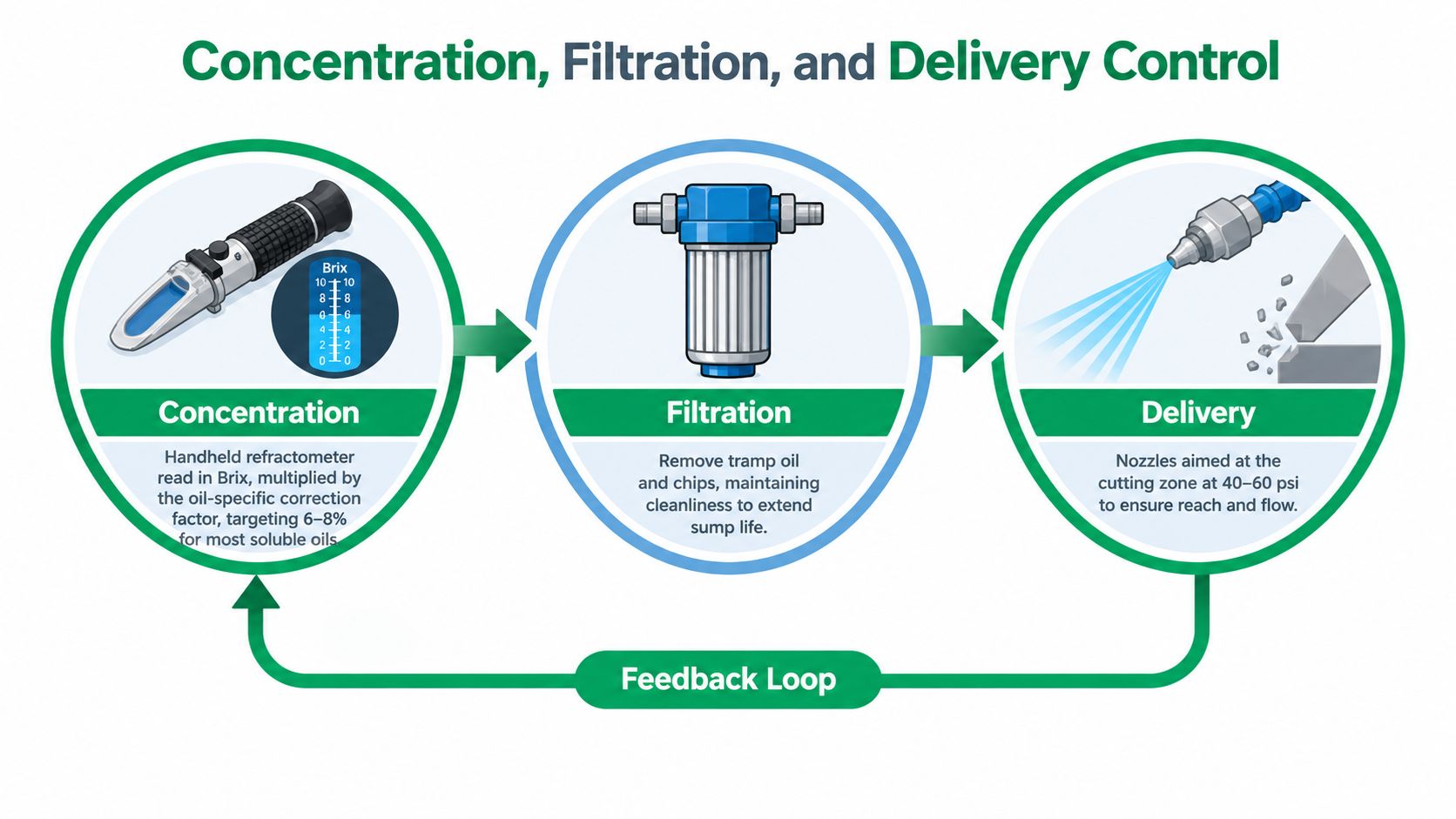
A coolant system is a control loop. Concentration affects lubrication and protection, filtration affects contamination, and delivery determines whether the fluid reaches the place where heat and friction are generated. Checking only one of the three leaves a blind spot.
Measure the fluid before changing the program
Use a calibrated refractometer at the machine sump and compare the reading with the coolant supplier's target range. Record the result with the job or machine identifier. If the mixture is too dilute, correct it with concentrate according to the supplier's instructions rather than adding arbitrary amounts of water or chemical.
The measurement should sit beside process observations:
- Tool wear: Is the wear pattern changing after concentration drift?
- Surface finish: Are roughness or visible marks worsening?
- Corrosion: Are parts, fixtures, or machine surfaces staining?
- Fluid condition: Is there odor, foam, tramp oil, or visible sediment?
- Chip behavior: Are chips recutting or packing into the feature?
Remove contamination before it becomes a cutting variable
Filtration should match the material, chip shape, and finish requirement. Coarse separation may handle large chips, while finer filtration is useful for operations where particles can recirculate across a finished surface. Tramp-oil removal matters because leaking way oil and hydraulic oil can destabilize the sump and support microbial growth.
Delivery needs the same attention. OSHA's exposure-evaluation guidance recommends coolant delivery systems that minimize mist, optimized nozzle placement, adequate coolant capacity, machine cleanliness, and exhaust ventilation. A pump can deliver plenty of flow while the cutting area receives very little if the nozzle is blocked, too far away, or aimed at the wrong side of the tool.
For a short-run cell, use a repeatable routine:
- Check concentration before production.
- Inspect nozzle aim and flow during setup.
- Remove chips and tramp oil from the sump.
- Record fluid condition and tool-life observations.
- Investigate trends before making a large program change.
Health Risks and Sustainable Fluid Management
Coolant safety isn't a separate concern owned by an HR file. It's part of process engineering because the machine, delivery system, fluid condition, and operator exposure are connected.
The main exposure routes are inhalation of fluid mist and skin contact. Enclosures, local exhaust ventilation, splash control, gloves selected for the fluid, and good hygiene reduce exposure, but they work best when the shop also controls aerosol generation at the source. High-speed spindles, compressed-air blow-off, and uncontrolled spray can turn a fluid problem into an airborne exposure problem.
Historical regulation shows why formulation and maintenance matter. The long-term U.S. occupational record includes a manufacturing cohort of 38,549 workers followed from 1941 through 2015, while industry chemistry changed in response to concerns about refined oils, polycyclic aromatic hydrocarbons, and nitrosamine exposure. The occupational-health review describes those changes and explains why risk depends on formulation, contamination, aerosol generation, and maintenance rather than on the label “oil” or “water.”
A recent systematic review associated metalworking-fluid exposure with a 6% higher prostate-cancer incidence risk and a 20% higher standardized mortality ratio, while also making clear that these associations don't prove coolant exposure alone caused the outcomes. The occupational-hygiene guidance supports surveillance, enclosure or local exhaust ventilation, fluid hygiene, and documented monitoring.
Sustainability starts with fluid life
Switching to a plant-based or “bio” fluid isn't automatically the most sustainable choice. A fluid that needs intensive biocide treatment, fails early, or creates difficult disposal streams may perform worse environmentally than a stable fluid that is filtered, maintained, and reused.
Practical sustainability controls include:
- Remove tramp oil: Skim contamination before it feeds microbial growth.
- Filter consistently: Keep chips and fines from recirculating through the cut.
- Control concentration: Avoid premature replacement caused by dilution or over-concentration.
- Set replacement triggers: Use odor, microbial indicators, corrosion results, particle load, and tool-life changes.
- Separate waste streams: Keep used coolant apart from production oils and follow local wastewater and hazardous-waste requirements.
Technical industry analysis notes that onsite or mobile recycling can suit small and medium machining plants, and that microfiltration may extend usable fluid life while reducing procurement, disposal, occupational-health, and environmental burdens. The STLE coolant-management analysis also highlights regulatory changes affecting certain additive chemistries. Recycling only works when the recovered fluid meets the required quality for the next operation.
A Practical Coolant Plan for Short-Run Production
A short-run shop needs a plan that survives material changes without turning every job into a new chemistry experiment.
Start with a documented semisynthetic if the cell handles mixed milling and turning. Set the working concentration from the supplier's specification, then verify it with a calibrated refractometer. Don't copy a percentage from another machine unless the product, water quality, material mix, and operation are comparable.
Use this day-one checklist:
- At setup: Confirm the coolant family is compatible with the material, finish, and downstream process.
- During production: Aim the nozzle at the tool-chip interface, not merely at the part.
- During maintenance: Remove chips and tramp oil, inspect filters, and look for foam or odor.
- In the job record: Track concentration, fluid condition, tool wear, finish results, and corrective actions.
- At review: Compare coolant observations with scrap, inspection results, and tooling consumption before changing products.
Choose a more lubricating fluid for difficult cuts, interrupted engagement, tapping, or threading. Choose a more cooling-focused formulation when heat, cleanliness, or high-speed chip evacuation dominates. Reserve straight oils for operations that need their boundary-lubrication advantage, and control their mist and disposal requirements carefully.
FIRMFG supports CNC rapid prototyping and precision machining for metal and plastic parts, with process planning that considers material, geometry, coolant delivery, surface finish, and short-run inspection needs. Visit FIRMFG to discuss a prototype or low-volume project where coolant control must support both reliable machining and documented quality.