Cost of Machining: What Drives the Price and How to Cut It

U.S. machine shops reported $16.198 billion in total costs of materials in 2024, according to the Federal Reserve Bank of St. Louis FRED series built from U.S. Census Bureau data. That single line is larger than most buyers expect when they open a machining quote and look straight past it to the hourly rate.
A machining price is built in layers. Material sits at the bottom, then setup and programming, then the minutes the cutter spends in the metal, then tooling wear, inspection and finishing, and finally the order quantity that spreads the fixed layers across every part you buy. Electricity, the cost often pictured when hearing the word machining, is usually the thinnest layer of all.
Understanding the cost of machining means knowing which layer is doing the damage in your own quote. The sections below take the drivers one at a time, largest first, and pair each one with a lever you control before a drawing ever leaves your desk.
Table of Contents
The Largest Line Item in Most Quotes- Grade choice sets both the purchase price and the cutting speed
Tolerances, Geometry and Setups That Multiply Machine Time- Geometry decides how long the cutter runs
How Production Volume Spreads Setup Cost Across Parts- A worked example with 5 parts and 500 parts
Cost per Accepted Part After Scrap, Inspection and Finishing- Yield is the number nobody quotes
How to Lower Your Machining Bill Before You Request a Quote
Confirm the Quote Basis Before You Order
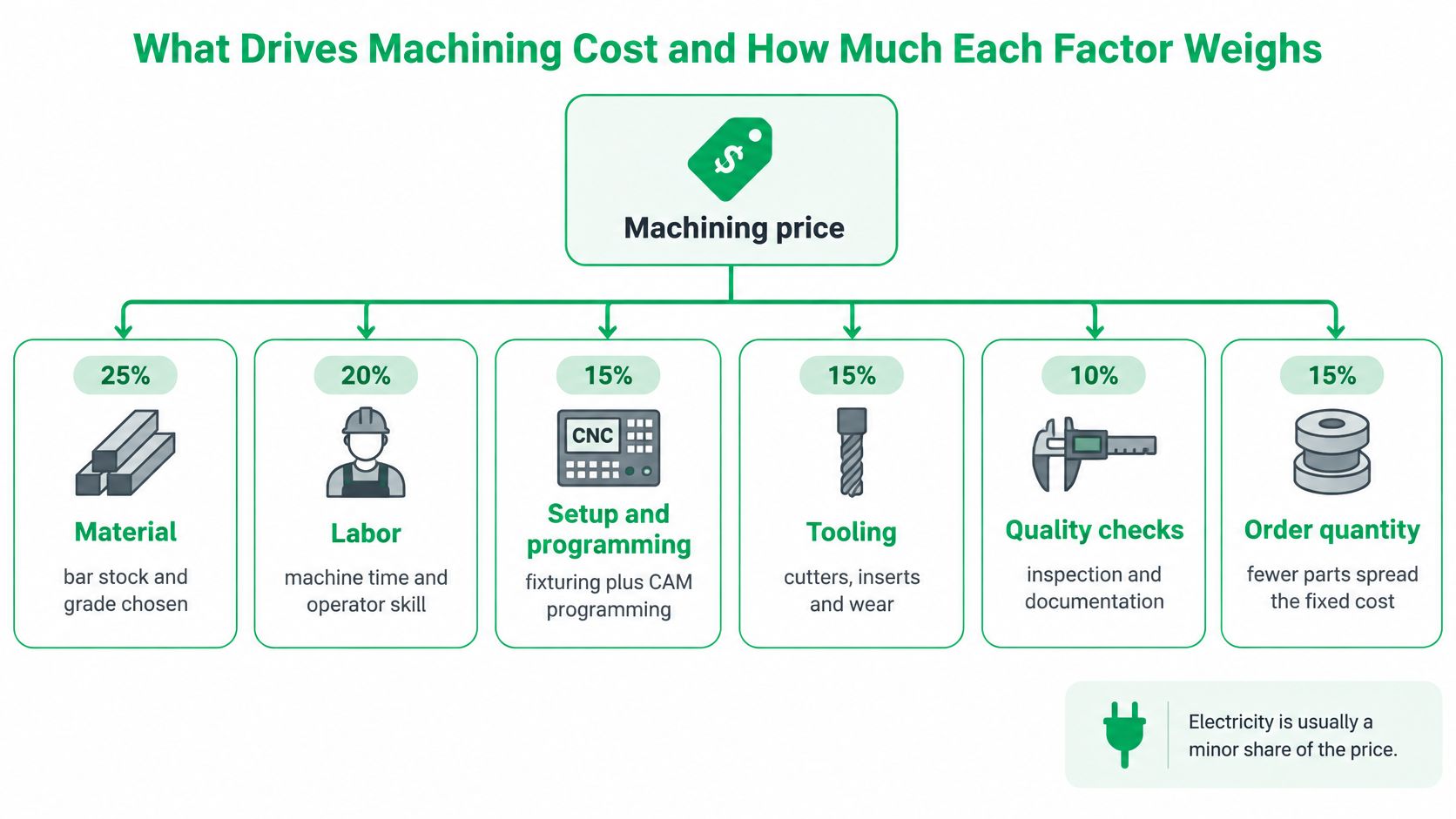
What Drives Machining Cost and How Much Each Factor Weighs
A machining price is built from material, labor, setup and programming, tooling, quality checks and order quantity. The power the spindle draws while cutting is a minor share, which is why two quotes for the same part can land far apart without either shop being dishonest.
The structure looks like this.
| Cost driver | Reported share or effect | What moves it | Practical lever |
|---|---|---|---|
| Material | The largest line in most quotes, ahead of cutting | Grade, stock size, buy-to-fly waste, metal price swings | Choose a common grade and a stock size close to the finished part |
| Labor, setup and programming | U.S. machine-shop hourly compensation up 14.6% from 2021 to 2024 | Number of setups, programming complexity, inspection hours | Reduce setups and simplify the drawing |
| Energy | The smallest line in a typical short-run quote | Long unattended cycles, high-power machines, hard materials | Stop optimizing it and spend the effort on setups instead |
| Tooling and programming | Custom fixtures are charged once per lot, cutters wear with every part | Special tools, custom fixtures, complex toolpaths | Standard tool sizes and standard fixtures |
| Tolerances and features | Priced per feature and per setup, never averaged over the part | Tight bands, deep pockets, undercuts, multi-axis access | Tight tolerance only on functional faces |
| Production volume | Setup is paid once per lot and spread across the run | Spreading fixed lot costs across parts | Order at two or three quantities |
| Finishing and inspection | Finishing is priced per part, documentation per lot | Surface treatments, outside processing, inspection reports | Specify finishes and inspection only where required |
Labor is the driver buyers miss most often, because it hides inside the phrase "machine time". Hourly compensation in the Bureau of Labor Statistics category covering machine shops, turned-product manufacturing, and screw, nut, and bolt manufacturing, including wages and employer-paid benefits, rose from an index value of 113.718 in 2021 to 130.340 in 2024, a 14.6% increase, according to the Federal Reserve Bank of St. Louis series on BLS data. Fabricated metal product manufacturing unit labor costs rose 8.5% in 2024, according to the U.S. Bureau of Labor Statistics.
The machine hour is the visible tip
Treat a quote as an iceberg. The hourly rate is the part above the waterline, easy to see and easy to argue about. Below it sit the CAM programming hours, fixture build, first-article inspection, deburring, packing and the opportunity cost of a skilled machinist's afternoon. A shop that shaves a few dollars off its hourly rate but needs three setups instead of one is not cheaper.
Practical rule: when a quote surprises you, count the drivers before you argue about the rate. Material grade, setup count, tolerance band and lot size explain most of the gap.
Which driver is biggest in your quote? That answer decides where to act. A material-heavy part responds to grade and stock size, a complex part responds to setup reduction, and a tight-tolerance part responds to relaxing the bands that carry no function.
The Largest Line Item in Most Quotes
In a 2024 EU cost breakdown for machined parts, materials accounted for 57% of cost, labor for 26%, energy for 2% and other expenses for 15%, according to Tacto's machined-parts cost analysis. When more than half of the bill is the metal itself, the grade and the stock size you specify move the total further than any tweak to cutting speed.
Grade choice sets both the purchase price and the cutting speed
Aluminum 6061 is the workhorse: affordable, fast to cut, forgiving on tooling, and it takes most finishes. 7075 buys you strength and costs more in both directions, because the bar stock is pricier and the cutter has to slow down. Stainless steel removes heat slowly, work-hardens if the tool dwells, and eats inserts, so a stainless part usually carries more machine time than the same shape in aluminum. Titanium and Inconel sit at the top of the range: expensive per kilogram, expensive per hour, and slow enough that tool life becomes a line item of its own.
Engineering plastics are their own group. They cut quickly but deflect under clamping pressure, so wall thickness and support become the constraint rather than cutting speed. Choose a plastic because the part needs chemical resistance, electrical insulation or low weight, not because you assume it's automatically cheaper.
Stock size and buy-to-fly waste
Say your finished part measures 60 x 40 x 20 mm and the shop pulls 100 x 80 x 40 mm bar because that's what sits on the rack. You pay for every cubic millimetre that ends up as chips, and you pay again to cut it away. A stock size closer to the finished envelope lowers the material bill and the cycle time at the same time.
The same logic applies to condition. Annealed, tempered, pre-hardened or stress-relieved stock carries different prices and different machining behaviour. If you need a mill certificate for traceability, say so at the quoting stage, because it's a fixed charge added to the lot and not something the shop can add later for free.
Volatility between quote and shipment
Metal prices, freight and tariff treatment can all move between the day you approve a quote and the day the parts ship. That's why the validity period matters as much as the number printed next to it. Outside processing adds another layer: heat treatment, anodizing or plating goes to a second vendor, picks up a handling margin and stretches lead time, and none of that is visible in a machine hourly rate.
Five questions to put to any supplier before you compare prices:
- Grade and condition: which alloy, and in what temper?
- Stock dimensions: what bar or plate size is being priced?
- Certificate: is a mill certificate included or extra?
- Outside processing: which operations leave the building, and at what markup?
- Price hold: how long is the quoted material price valid?
Tolerances, Geometry and Setups That Multiply Machine Time
Two things drive machining time: how long the cutter stays in contact with the part, and how many times someone has to re-clamp it. Every decision in this section feeds one of those two.
Geometry decides how long the cutter runs
Three-axis milling handles simple to moderate parts and removes metal at the lowest hourly cost. Four-axis work adds undercuts and features on several faces. Full simultaneous 5-axis reaches the most complex geometry, and it also collapses setups, which is why a 5-axis quote can come in under a 3-axis quote on a part that would otherwise need three flips. The comparison of 3-axis versus 5-axis CNC machining is worth a read before you assume more axes always means more money.
Thin walls, deep narrow pockets and sharp internal corners push cost the other way. A deep pocket needs a long, slender tool that must run slowly and take light passes. A sharp internal corner forces a small cutter into a slot where a larger one would clear the same material faster and with less chatter.
Tolerance bands and what they cost
Standard CNC machining holds plus or minus 0.005 inch (plus or minus 0.13 mm), and high-precision work reaches plus or minus 0.0005 inch (plus or minus 0.013 mm). Tightening a callout from plus or minus 0.005 inch to plus or minus 0.001 inch can multiply machining cost by roughly 3 to 5 times, according to one industry estimator's cost guide, which labels that figure illustrative rather than universal. Take the label seriously: that multiplier depends on the feature, the material and how the shop verifies it.
| Tolerance or feature | Reference value | Likely cost effect | Where to apply it |
|---|---|---|---|
| Standard CNC tolerance | Plus or minus 0.005 inch (plus or minus 0.13 mm) | Baseline | Non-critical dimensions and clearances |
| Tight tolerance | Plus or minus 0.001 inch | About 3 to 5 times the standard cost, illustrative estimate | Only mating and functional faces |
| High-precision tolerance | Plus or minus 0.0005 inch (plus or minus 0.013 mm) | Slower finishing passes plus planned CMM inspection | Bearing seats and sealing surfaces with inspection planned |
| Micro features | From 0.1 mm, plus or minus 5 µm | Small cutters, slow feeds, a separate quoting route | Miniature parts that need specialist micro machining |
We quote standard work at plus or minus 0.005 inch and high-precision work at plus or minus 0.0005 inch, and the second band costs more to reach for a simple reason: it takes slower passes, a more careful setup and more measurement time per part. Put the tight band on mating faces, bearing seats and sealing surfaces. Leave clearance holes, chamfers and non-fitting exterior surfaces at the standard band.
Every re-clamp adds time you never see
Each flip, re-fixture or secondary operation adds alignment, probing and inspection time on top of the actual cutting. A part that finishes in one setup is cheaper than the same part split across two, even when the second setup machines one small face. If a single back-side feature forces a whole extra operation, ask whether that feature can be added in the same orientation or dropped entirely.
Look at your drawing and find the two features that set both the tolerance band and the setup count. Relax those two where the function allows, and the rest of the quote usually follows.
How Production Volume Spreads Setup Cost Across Parts
Setup and programming are paid once per lot. Material, machine time and tooling wear repeat for every part. The moment you separate those two buckets, prototype pricing stops looking mysterious.
A worked example with 5 parts and 500 parts
Say a bracket needs 90 minutes of programming and setup and 15 minutes of machine time per piece. These numbers are illustrative, not a quote, but the arithmetic is the same everywhere. Across 5 parts, the 90 minutes adds 18 minutes to every single part, more than doubling the cutting time and dominating the unit price. Across 500 parts, the same 90 minutes adds about 11 seconds per part, and the price falls toward material plus cycle time.
That gap is the whole story of prototype economics, and it has nothing to do with the shop being greedy. You're paying for a machinist's morning on a run of five.
| Order size | Setup share of total cost | Per-part cost trend | Best approach |
|---|---|---|---|
| 1 to 5 prototypes | Very high | Highest per part | Accept the unit price and minimize revisions |
| 10 to 50 bridge parts | High | Falls quickly | Combine design fixes before ordering |
| 100 to 500 low-volume parts | Moderate | Falls toward material plus cycle time | Order two quantities and compare |
| 1,000+ production | Low | Flattens near the variable cost floor | Lock the price rules, not just the price |
Where energy fits, which is near the bottom
Electricity deserves a mention only because it's overestimated so often. A technical study of CNC machining reported that energy costs accounted for approximately 1% to 6% of total machining cost, and a National Institute of Standards and Technology case study found the energy cost of machining titanium to be about $0.50 per machine hour under the U.S. electricity prices examined, according to the published CNC energy and cost study. That same work concluded potential energy savings from CNC operations were financially minimal in the cases studied.
Energy climbs in importance only when machines run long unattended cycles, when several high-power machines run continuously, or when a difficult material forces very low material-removal rates. For short runs, it's noise next to setup hours. Request quotes at two or three quantities, and the setup cost will visibly fall away as the lot grows. FIRMFG runs low-volume CNC machining for exactly this band of work, where the setup share is high and design decisions still matter.
Cost per Accepted Part After Scrap, Inspection and Finishing
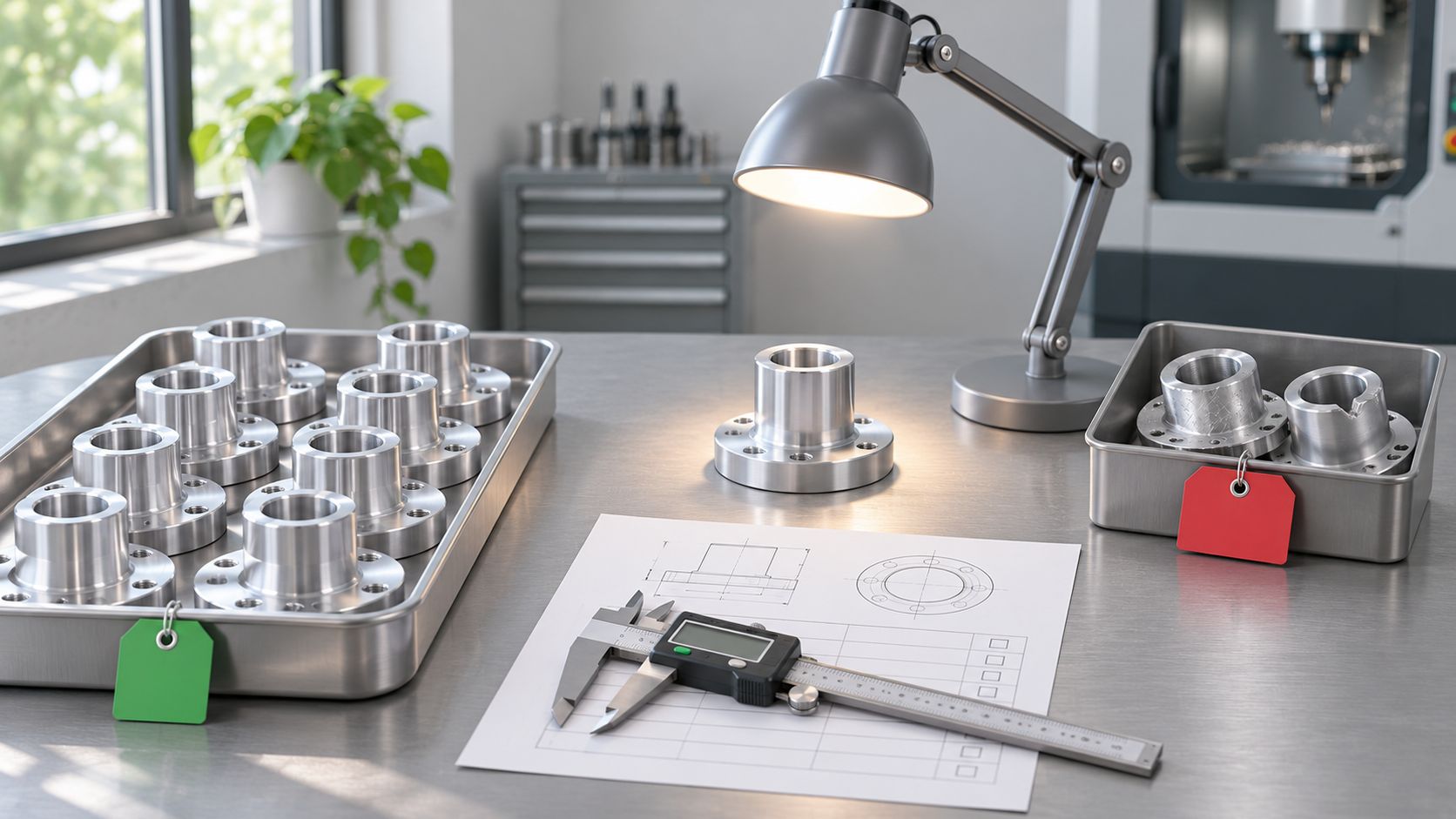
The lowest unit price on the table is often not the lowest cost. What you buy is accepted parts, and a cheap quote with a poor yield raises the price of every one of them.
The formula is simple: total lot cost divided by the number of parts that pass inspection. A 20-part lot quoted at $1,000 sounds like $50 a piece, until two parts are scrapped and you've paid $55.56 for each usable one. That's an illustrative calculation, and it's the one your finance team will eventually run.
Yield is the number nobody quotes
An estimate built on 100% yield is an upper-bound manufacturing scenario, not a buying price. First-article inspection, rework loops and rejected units all consume the lot you paid for, and no one refunds the machining time that went into a part that failed.
Finishing and documents are priced differently
Surface work is charged per part, and each option adds its own lead time. Anodizing, powder coating, electroplating, bead blasting and passivation all behave differently, and masking a small area for a two-tone finish adds a handling step before the process even starts. The guide to surface finishing technologies explains how those processes differ in cost and durability.
Inspection documents work the other way. A dimensional report, a certificate of conformance or a CMM program is a fixed charge on the lot, so its cost per part falls as quantity rises, while its absence can cost you an entire shipment at the customer's receiving dock.
| Scenario | Yield and inspection | Cost per accepted part | Question to the supplier |
|---|---|---|---|
| Low-risk run | Sampling inspection, near-full yield | Lowest | What yield do you assume? |
| Base run | First-article inspection, a few rejects | Moderate, rises with every reject | Who pays for rework? |
| High-risk run | Full dimensional report, traceability, documented acceptance | Highest, with a fixed documentation cost per lot | Which documents are included in the quote? |
A shorter cycle time saves little when scrap or finishing dominates the bill. Ask for the yield assumption in writing before you compare two quotes.
Two questions close the loop: what yield did you assume, and who pays for rejected parts and rework? Get both answered before you order, not after.
How to Lower Your Machining Bill Before You Request a Quote
Six moves change the price most, in the order a buyer should make them.
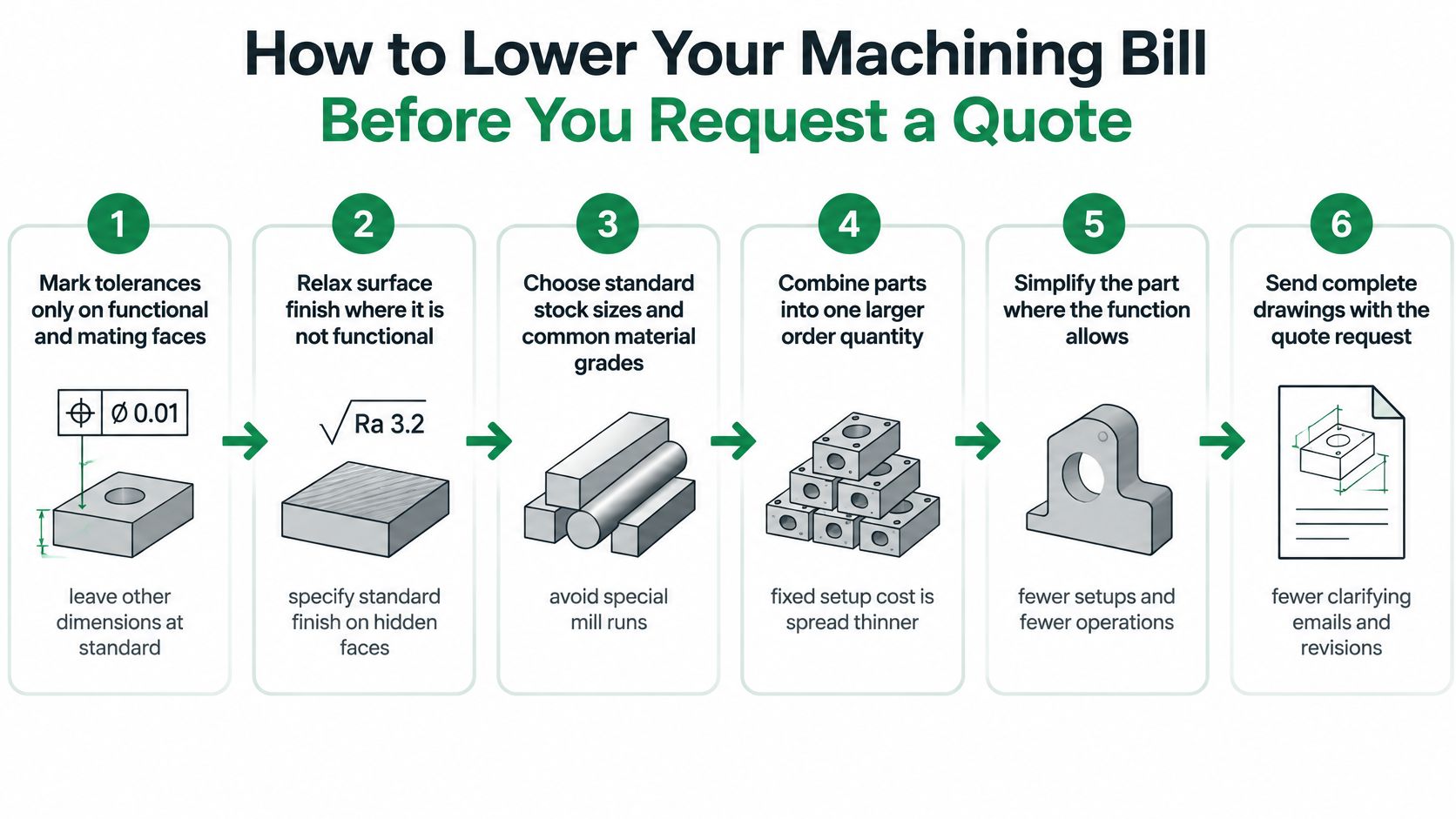
- Mark tolerances only on functional and mating faces. A tight band drives slower cutting and more measurement everywhere it appears. The common mistake is tolerancing every dimension to the same band because it feels safer.
- Pick a common grade and a stock size near the finished envelope. You pay for the chips as well as the part. Specifying an exotic alloy with no functional need is the classic overspend.
- Simplify geometry where function allows. Add internal corner radii that match standard tool diameters, keep pocket depth sensible and avoid sharp internal corners.
That third point deserves a sentence of its own. A pocket with square internal corners forces a small cutter into a space where a larger one would work, and the penalty is paid in feed rate, tool life and cycle time. Matching corner radii to the tools a shop already stocks costs nothing at the design stage. The guide to CNC metal milling covers how toolpath and fixturing choices interact with part geometry.
- Orient the part so most features machine in one setup. Each re-clamp adds fixture time and alignment error. Flipping a part to machine a single cosmetic face is rarely worth it.
- Specify finishes only where they're needed. Separate cosmetic requirements from functional ones, and name the specific faces that need them. Finishing an entire part for one visible surface multiplies a per-part cost.
- Send CAD files before you ask for a number. Design for manufacturability feedback catches costly features while they're still free to change. Waiting until the quote is final turns every suggestion into a revision.
FIRMFG provides free DFM feedback, with engineers reviewing designs and flagging the features that add cost before the quote is fixed.
For each step, name the drawing feature it changes. If you can't name one, that step won't save you anything on this part.
Confirm the Quote Basis Before You Order
Choose the quote with the lowest cost per accepted part under the same assumptions, not the lowest headline price. That's the decision rule, and it only works when every supplier is pricing the same thing.
Fix the basis first, then compare:
- Material grade and stock form: same alloy, same bar or plate condition.
- Tolerance scope: the same tight callouts on the same faces.
- Inspection level: same sampling plan and same report.
- Quantity breaks: the same lot size, plus one alternative volume.
- Yield assumption: the scrap and rework expectation in writing.
- Finishing and outside processing: which operations are in scope and which aren't.
- Quote validity and freight terms: how long the price holds and who pays for tariffs and carriage.
- Lead time: the same delivery basis for every bid.
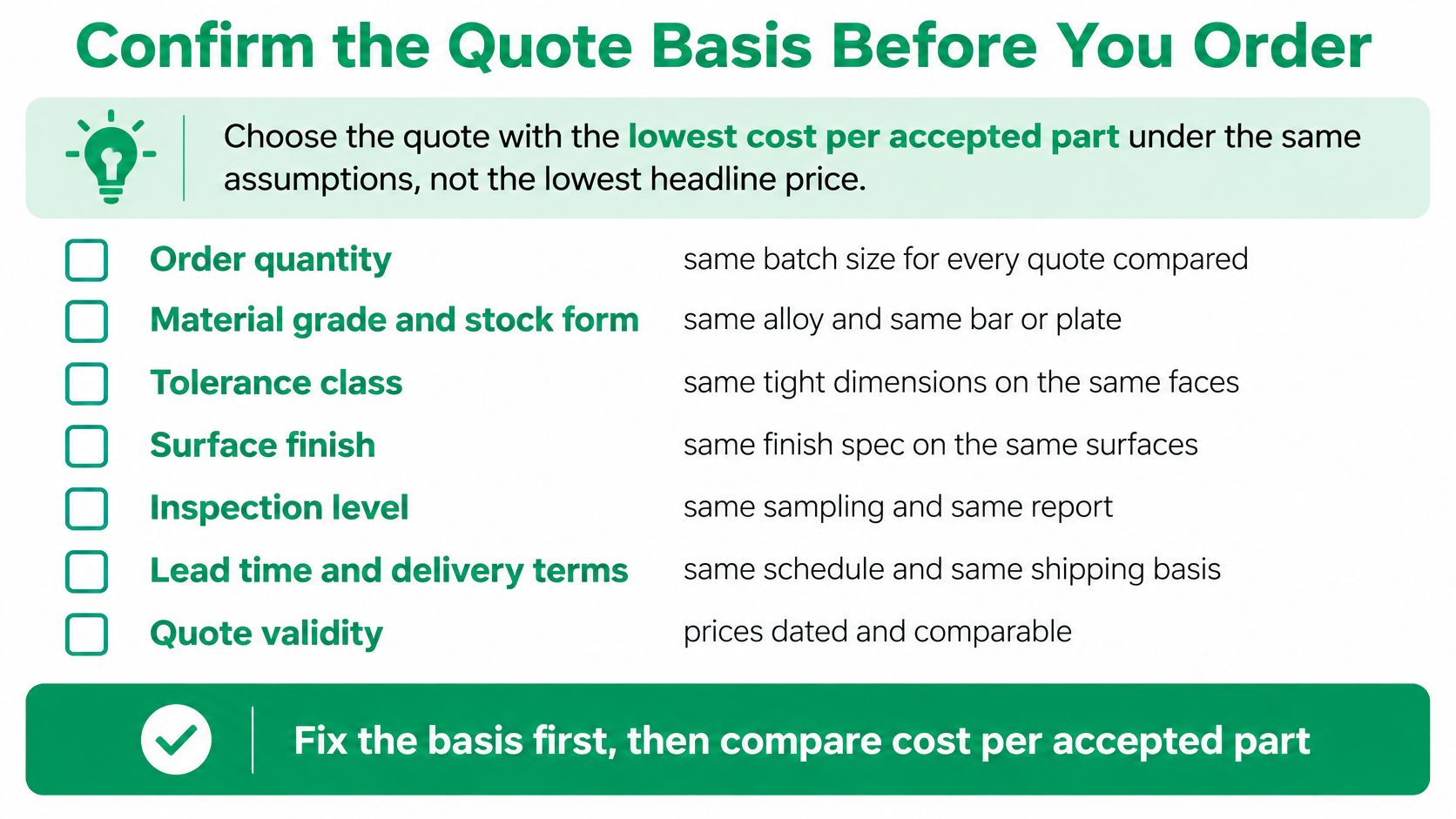
Mark any missing row as a question to the supplier rather than a safe assumption. A quote that omits material condition or inspection scope isn't cheaper, it's incomplete, and the difference usually surfaces as an invoice line or a rejected batch.
The same logic applies inside a single supplier relationship. Ask whether the quoted price holds until shipment, and confirm who carries the cost of rework on a dimension the drawing specified. Put the answer in the purchase order notes so it survives staff changes on both sides.
FIRMFG provides a free CNC machining quote within 24 hours after CAD file upload, and the returned quote separates material, machining, finishing and inspection so you can line it up against the checklist above instead of guessing what's inside a single number.
Fix the basis, upload the CAD file, and compare the returned quotes line by line. That's the whole discipline: same assumptions, same scope, and a price expressed per accepted part rather than per hour of spindle time. FIRMFG quotes machining, finishing and inspection as separate lines, gives free DFM feedback before the price is locked, and works with no minimum order quantity, so a five-part prototype run and a five-hundred-part bridge build can be priced on the same transparent basis. Start with your drawing and let the quote show you which driver is really setting your price.