Sheet Metal Fabrication Cost: A Practical Pricing Guide
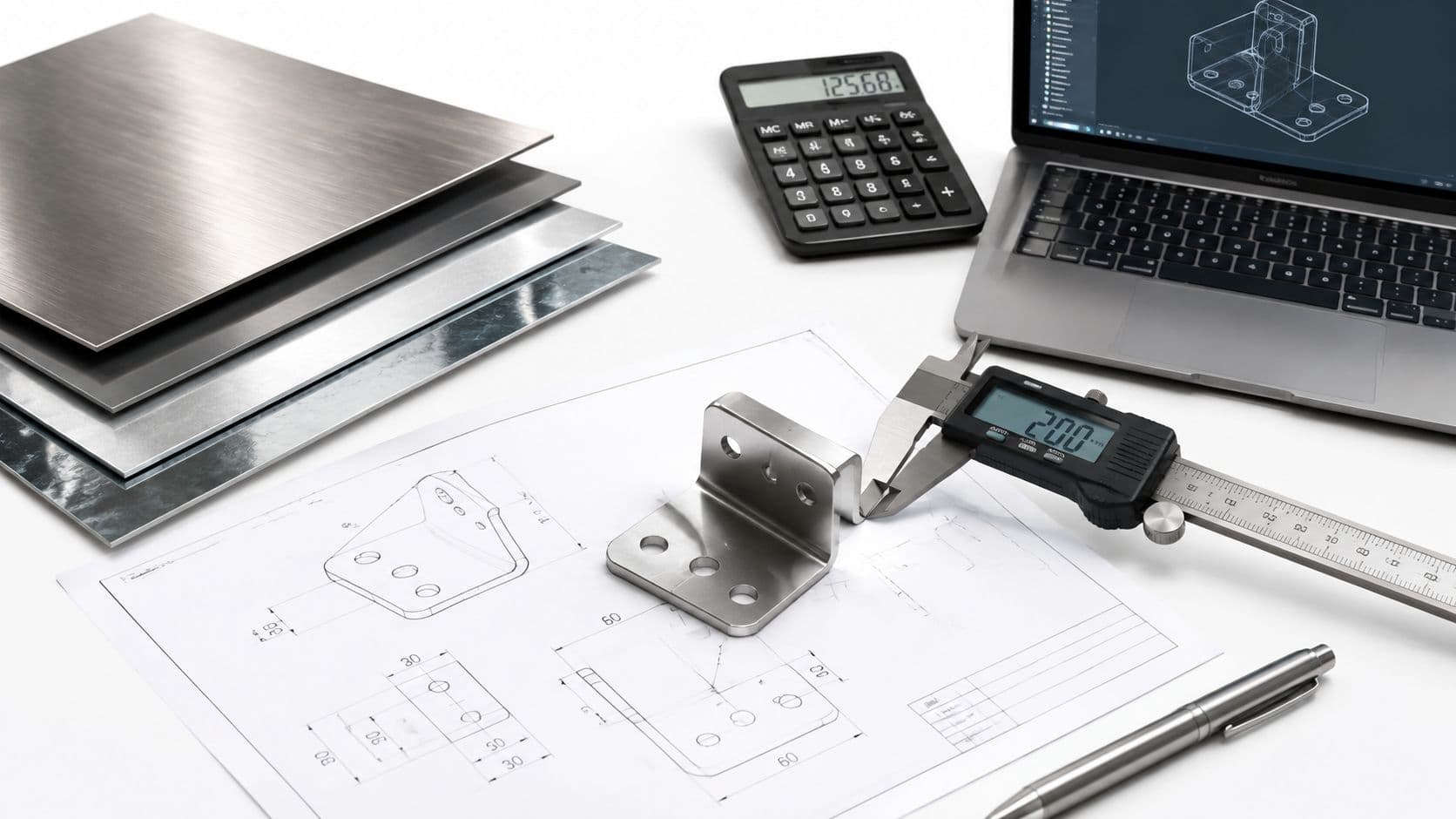
A typical prototype sheet metal part lands between roughly $20 and $200 per piece, while batch parts often fall between $2 and $20, before material, geometry, tolerance, finish, and quantity are fully accounted for. The spread is wide because suppliers aren't pricing a flat piece of metal, they're pricing a sequence of operations.
You upload one bracket, expecting a straightforward answer. A few hours later, three suppliers return quotes that barely resemble one another. One says $48, another says $120, and the third says $340. The drawing looks identical in every email, so the natural conclusion is that somebody is overcharging.
Usually, that's the wrong diagnosis. The supplier is reacting to details that your drawing either specifies differently, leaves open to interpretation, or forces the shop to resolve manually. A bend radius, a finish note, an unusual material grade, a tight hole position, or a one-piece order can change the manufacturing route completely.
For U.S. residential and light-commercial work, reported sheet metal fabrication projects average about $1,564 to $1,573, with a typical range of roughly $420 to $3,018. Small jobs can start near $100, while complex installations can reach about $9,500. Those figures aren't a universal price list, but they show why sheet metal fabrication cost is a design outcome, not a fixed commodity price. (HomeAdvisor's sheet metal fabrication cost guidance)
Table of Contents
- Why a Sheet Metal Quote Can Vary So Widely
- The Main Cost Drivers Behind Every Quote
Material sets the floor
Cutting charges reflect path and machine time
Bends create setup and handling work
Tooling and programming are fixed costs
Secondary operations add separate labor
Tolerances change the inspection plan
Quantity determines how fixed cost is shared
Finishes can become a separate project
Where the Money Actually Goes in a Part
How to Estimate Per-Part Cost From a Drawing- Prototype example
Typical Price Ranges by Material and Process
The Hidden Costs of Tight Tolerances and Finishes- Tolerances trigger inspection
Design Choices That Lower Sheet Metal Fabrication Cost- Simplify forming
- Improve nesting before changing alloys
- Apply tolerances only where function demands them
- Make holes easy to produce
- Choose the finish for the job
Getting Reliable Quotes and Avoiding Surprise Fees- Compare quotes on equal terms
Why a Sheet Metal Quote Can Vary So Widely
The first quote you receive often reflects the supplier's interpretation of the job as much as the geometry itself. One estimator may assume standard cold-rolled steel, a conventional finish, and relaxed tolerances. Another may price stainless steel, full deburring, tighter inspection, and a faster production slot because your drawing or purchase request leaves those points unclear.
Four surprises create most of the variance:
- Setup burden: A single bracket still needs programming, material handling, machine setup, and inspection. Those costs don't disappear just because the order contains one part.
- Bend complexity: Each bend adds press-brake handling, tooling selection, and an inspection point. Closely spaced bends can require a slower or less convenient sequence.
- Secondary work: Deburring, hardware insertion, welding, plating, powder coating, and packaging can cost more than the cutting operation.
- Commercial assumptions: Lead time, minimum-order rules, material availability, and whether tooling is amortized across the batch can move the quote sharply.
Practical rule: If two suppliers quote the same file very differently, compare their assumptions before comparing their prices.
A supplier isn't only charging for the sheet. The quote may include a nesting decision, a laser path, a press-brake program, tool changes, manual finishing, and quality documentation. A shop with available automation may spread those tasks differently from a job shop handling the part manually.
The central point is simple. You control much of the price before the CAD file leaves your desk. Material specification, bend count, tolerance strategy, finish, quantity, and the quality of the upload package all influence the route that the supplier prices.
The Main Cost Drivers Behind Every Quote
A quote becomes easier to audit when every line answers a practical question: what must the supplier buy, program, run, inspect, or finish? Trace each charge back to the drawing, material specification, quantity, or upload package. For a clear overview of the operations involved, review this guide to what sheet metal fabrication involves.
Material sets the floor
Material grade and thickness establish the starting stock cost, cutting behavior, forming load, and likely tool wear. Choosing the cheapest sheet can still raise the finished price if it creates poor nesting, difficult bends, or a coating requirement. A costlier alloy can be the better choice when it removes a secondary operation.
Suppliers price the sheet consumed, including unusable remnants and scrap, rather than only the finished part's mass. A large blank, inefficient geometry, or poor nesting increases material, handling, and storage cost. Before submitting the drawing, confirm whether the design can share a parent sheet efficiently.
Cutting charges reflect path and machine time
Laser cutting, turret punching, and similar operations turn geometry into cycle time. Long perimeters, numerous holes, small internal features, and frequent pierces all increase machine time. The supplier then applies its operating rate to that estimated time.
Prototype and production pricing differ sharply because programming and setup are spread across different quantities. Prototype laser cutting may run about $1.50 to $5.00 per cut, compared with $0.10 to $1.00 in production. CNC bending may cost about $3.00 to $10.00 per bend for prototypes versus $0.50 to $3.00 in production, according to broader job-costing guidance for fabrication.
Bends create setup and handling work
Bend count measures more than press-brake strokes. The operator must select tooling, orient the blank, verify the sequence, and inspect formed dimensions. Closely spaced bends, tight radii, deep flanges, and awkward part orientations slow handling and raise rework risk.
Reduce bends where the function allows it. A simpler formed shape can cut setup time while making inspection more repeatable.
Tooling and programming are fixed costs
The supplier may create a laser program, nesting layout, press-brake sequence, or special tooling before producing the first part. That work exists whether the order contains one piece or a batch. Low-volume orders therefore carry a much larger setup charge per part.
Send native CAD, a controlled drawing, material and finish requirements, quantity, and inspection expectations together. Missing information creates estimating work, clarification cycles, and avoidable quote assumptions.
Secondary operations add separate labor
Welding, tapping, countersinking, PEM hardware insertion, riveting, deburring, and assembly each add labor and handling. Prototype welding alone may cost about $15 to $50 per assembly, while production welding may fall to about $5 to $20 as repeatability improves and setup is shared across the run. (TWC Industrial job-costing references)
Specify only the operations the part needs. A decorative finish, unnecessary hardware, or avoidable welded joint can add cost without improving performance.
Tolerances change the inspection plan
A standard sheet-metal tolerance lets the shop use normal process controls. Tight positional, flatness, or bend-angle requirements may require fixtures, extra measurements, first-article checks, or additional documentation. Do not apply machining tolerances to every feature because the CAD system permits them. Tie each tight tolerance to fit, function, or assembly need.
Quantity determines how fixed cost is shared
One prototype absorbs nearly all programming, tooling, material preparation, and first-piece inspection cost. A larger batch distributes those charges across more parts, so the unit price can fall substantially even when the geometry remains unchanged.
If demand is uncertain, request separate prototype and production quantities. That comparison shows whether a design change reduces real production cost or only shifts a small setup charge.
Finishes can become a separate project
Powder coating, anodizing, plating, passivation, bead blasting, and cosmetic masking add handling and outside-vendor coordination. Each finish also requires acceptance criteria for color, coverage, thickness, gloss, edge coverage, and protected areas.
| Cost Driver | What It Controls | Typical Quote Impact |
|---|---|---|
| Material and thickness | Stock price, cut speed, forming load | Raises base material and processing cost |
| Cut path and holes | Laser or punch time | Increases cycle time and programming effort |
| Bend count and radius | Tooling, handling, inspection | Adds setup and per-bend labor |
| Quantity | Setup allocation | Reduces unit cost as volume rises |
| Secondary operations | Welding, hardware, deburring, assembly | Adds labor and operation-specific charges |
| Tolerances | Inspection and possible rework | Raises quality-control cost |
| Finish | Coating, plating, masking, handling | Adds finishing and coordination charges |
These drivers interact. A thick stainless part with four tight bends and a cosmetic finish may need slower cutting, special tooling, more inspection, protective handling, and another finishing supplier. Price each design choice before the CAD file leaves your desk.
Where the Money Actually Goes in a Part
Raw sheet is visible, so engineers often assume it dominates the quote. In low-volume fabrication, that assumption is frequently wrong. Labor, machine time, setup, and finishing carry the economic weight when the supplier can't spread fixed work across a substantial batch.
A neutral pricing breakdown assigns roughly 35% to 50% of part cost to raw material, 30% to 45% to CNC or laser processing and setup, and 15% to 25% to post-processing such as coating, plating, and assembly. (JC Proto's sheet metal cost breakdown) These are broad planning bands, not a promise that every bracket will fit them.
For a small prototype, the processing share can be especially aggressive because programming, setup, and first-piece checks are concentrated in very few units. For production, setup dilutes and material utilization becomes more important, particularly when the supplier nests many parts into a parent sheet.
| Bucket | Prototype, quantity 5 | Production, quantity 500 |
|---|---|---|
| Material | Often a smaller share of the total | Becomes more prominent as setup dilutes |
| Cutting and bending | Usually the largest burden | More efficient per part |
| Finishing and secondary work | Can dominate if handled individually | Easier to standardize and batch |
| Setup and inspection | Heavy per-part effect | Spread across the order |
Consider a $40 prototype bracket. A sensible internal model might treat material as the smallest bucket, primary processing as the largest, and finishing or secondary work as the remaining burden. The exact allocation depends on the drawing, but the important point is that a few dollars of steel won't explain a $40 price. Machine time and labor do.
Now consider a $6 batch bracket. The finished geometry may be identical, but nesting, repeated bending, and shared setup reduce the burden carried by each unit. The material share can rise because fixed processing cost no longer overwhelms the price.
This is why the same drawing can look uneconomical at prototype quantity and highly competitive in a batch. The supplier isn't changing the metal. The supplier is changing how much fixed work each piece must carry.
How to Estimate Per-Part Cost From a Drawing
A drawing can give you a defensible preliminary estimate, but only if you connect each cost to a design choice. Separate fixed work from variable work, then write down every assumption before sending the file to a supplier.
Use this planning equation:
Per-part cost ≈ setup amortized over quantity + material cost + cutting cost + bending cost + secondary operations + finishing + inspection overhead.
For a more detailed estimate:
Per-part cost ≈ setup cost ÷ quantity + stock area × sheet price × utilization factor + cut path time × machine rate + bend time × machine rate + secondary operations + finish surcharge + inspection allowance.
Start with utilization. For simple parts, a planning factor around 0.20 to 0.35 may be reasonable. Parts with many holes may fall around 0.10 to 0.20, based on the provided estimating guidance. Treat the factor as an input to verify, not as guaranteed yield. Nesting can affect cost more than choosing between two similar material grades. MIT research on sheet utilization identifies sheet utilization as a primary cost driver because wasted parent sheet, remnant handling, and downstream movement all add manufacturing cost.

Prototype example
Take one 200 × 150 mm, 2 mm thick 5052 aluminum part with four bends and no finish. The drawing establishes the footprint, thickness, alloy, and bend count. It does not establish the final price. You still need stock pricing, machine rates, setup charges, bend cycle time, and the actual nesting result.
For a one-piece prototype, setup cost is divided by one. Programming, nesting, first-piece inspection, and press-brake preparation therefore remain prominent in the unit price. A poorly nested blank can consume a disproportionate share of the parent sheet even when the finished part is relatively small.
Production example
Order 200 pieces of the same part, and setup amortization changes immediately. Programming and first-piece work spread across the order, while repeated bending produces a predictable cycle. Material cost may also improve when the supplier nests the parts together instead of cutting each one separately.
Use the formula to expose missing inputs, not to claim false precision. Ask the supplier to list setup, material, cutting, bending, secondary operations, finishing, and inspection separately. That breakdown shows which drawing decisions are driving the quote and gives you specific targets for cost reduction.
Typical Price Ranges by Material and Process
A supplier quote becomes easier to judge once you separate the process from the part. A laser-cut blank belongs in a different cost category from a laser-cut, four-bend, deburred, powder-coated enclosure. Welding, installed hardware, cosmetic standards, and inspection requirements can move the same material into a higher-priced category.
For prototypes, laser cutting may run about $1.50 to $5.00 per cut, CNC bending about $3.00 to $10.00 per bend, and welding about $15 to $50 per assembly. In production, repeat work can reduce those figures to about $0.10 to $1.00 per cut, $0.50 to $3.00 per bend, and $5 to $20 per welded assembly. Use these ranges to challenge a quote, not to replace a supplier's detailed process breakdown. (TWC Industrial's process costing references)
Material selection sets another major boundary. 304 stainless steel is roughly two to three times the cost of mild steel per kilogram. Aluminum generally falls between those materials, while copper can reach four to six times mild steel. (FastPreci's sheet metal prototyping guidance)
| Material | Prototype, 1 to 2 pcs | Small batch, 50 to 500 pcs | Relative material cost vs. mild steel | Typical thickness range |
|---|---|---|---|---|
| Cold-rolled steel | Low to moderate | Low | Baseline | Drawing dependent |
| Hot-rolled steel | Low to moderate | Low | Near mild-steel baseline | Drawing dependent |
| Galvanneal | Moderate | Moderate | Above plain mild steel | Drawing dependent |
| 304 stainless | High | Moderate to high | Roughly 2 to 3 times mild steel | Drawing dependent |
| 316 stainless | High | Moderate to high | Higher than common stainless grades | Drawing dependent |
| 5052 aluminum | Moderate | Moderate | Between mild steel and stainless in many applications | Drawing dependent |
| 6061 aluminum | Moderate to high | Moderate | Between mild steel and stainless in many applications | Drawing dependent |
| Copper | High | High | Roughly 4 to 6 times mild steel | Drawing dependent |
For early budgeting, use $20 to $200 per piece for a prototype and $2 to $20 per piece for a batch. Treat those as planning bands, not purchase commitments. Geometry, tolerance class, nesting, finish, and available supplier capacity determine the final position within each band. Put those design choices on your pre-upload checklist before asking for a quote.
The Hidden Costs of Tight Tolerances and Finishes
Tolerances and finishes are production requirements, not decorative additions. Each one changes the work instructions, inspection plan, handling, or supplier coordination that appears in the quote.
A practical DFM starting point is an inside bend radius near one times material thickness for many materials. Softer aluminum can often tolerate about 0.5 to 1 times thickness, while work-hardening 304 and 316 stainless commonly need about 1 to 2 times thickness to reduce cracking or distortion. A tighter radius or stricter forming requirement can require coining, special tooling, slower forming, or rework. Follow the bend geometry guidance before releasing the drawing.
Each additional bend can add about $0.50 to $3.00 per part, depending on size and material. Closely spaced bends, tight tolerances, added hardware, and welding push the cost toward the higher end. Treat bend count and bend access as quote variables, not just CAD details.

Tolerances trigger inspection
A tight tolerance on a mating hole may be justified. The same requirement on a nonfunctional outer edge usually adds cost without protecting performance. It can require fixtures, in-process checks, additional documentation, and slower production. Ask the supplier which measurement method a tolerance will trigger before putting it on the drawing.
Assign tight limits only to functional features. Use general tolerances elsewhere, and identify datums, inspection points, and critical surfaces clearly. That makes the quote easier to audit because every inspection activity connects to a design requirement.
Finishes stack operation by operation
Deburring, powder coating, anodizing, bead blasting, plating, and primer systems each add handling or vendor coordination. A part requiring a clean edge, blasted surface, primer, and topcoat is moving through multiple controlled operations, not receiving one finish.
If a raw cut-and-bend part is quoted at $15 per piece, a tolerance-heavy inspection plan plus several finishing steps can push the final figure past $35, even when cutting and bending barely change. Remove requirements that do not protect function, or budget for the complete process.
For surface specifications, use a defined reference such as this surface roughness chart, then state which areas matter. A note such as “smooth finish” gives the supplier no reliable acceptance standard. Specify the surface, measurable requirement, and inspection expectation before uploading the drawing.
Design Choices That Lower Sheet Metal Fabrication Cost
A drawing can add several dollars to a part before any material changes. The usual causes are extra bends, inefficient nesting, unnecessary inspection, and finishes that do not support the part's function. Treat each quote line as a design decision you can change before releasing CAD.
Simplify forming
Keep bend directions consistent where the geometry permits. Use generous inside radii, reduce the bend count, and provide enough flange length for stable forming. A common planning rule sets minimum flange length at about four times material thickness, although tooling, material, and geometry determine the limit. Each added bend can add about $0.50 to $3.00 per part. Review the supplier's guidance on sheet metal bending before locking the geometry.
Use standard press-brake tooling whenever possible. A special radius or short flange can require custom tooling, extra setup, and more handling. Those charges belong to the design choice, not to an unexplained supplier surcharge.
Improve nesting before changing alloys
Check the flat pattern against the supplier's sheet sizes and grain direction. Reduce unnecessary cut travel, remove isolated slivers, and place related parts on one nest when practical. Better utilization lowers scrap and can reduce the material and cutting cost of a low-volume job. Review the FastPreci's sheet metal forming guidance when refining bend and blank layouts.
Apply tolerances only where function demands them
Reserve ±0.1 mm for mating or performance-critical features. Use the supplier's normal capability elsewhere instead of requiring inspection across the entire part. Identify functional datums and critical surfaces clearly, so inspection effort follows the design rather than covering every dimension.
Make holes easy to produce
Avoid holes smaller than material thickness unless the function requires them. Where the design permits, keep holes at least two times material thickness plus the bend radius from bends. Standardize diameters to reduce tool changes and simplify inspection.
Choose the finish for the job
Use raw mill finish when appearance and corrosion protection do not matter. Choose powder coating over anodizing when a colored aluminum-like appearance is sufficient for the application. Do not specify a premium cosmetic process for an internal bracket.
Efficient layouts also matter across multiple parts. MIT's sheet-utilization research supports treating material utilization as a design variable, not a supplier mystery.

Getting Reliable Quotes and Avoiding Surprise Fees
A reliable RFQ removes interpretation from the job. Send the supplier a complete package, then ask for the quote to expose its assumptions.
Include these items:
- Flattened CAD data: Provide a flattened DXF or a STEP model with bend notes and orientation information.
- Controlled drawing: Attach a PDF drawing with material, thickness, bend direction, critical dimensions, and GD&T callouts.
- Material definition: State the exact grade, temper where relevant, and thickness. “Aluminum sheet” isn't enough.
- Finish reference: Identify coating, plating, anodizing, color, masking, and cosmetic surfaces.
- Quantity split: Request separate pricing for prototype, pilot, and planned production quantities.
- Acceptance criteria: Define inspection requirements, certificates, first-article expectations, packaging, and allowable cosmetic variation.
Compare quotes on equal terms
A low quote can become expensive after the supplier adds charges that another vendor included. Normalize:
- Setup and tooling: Ask whether programming, nesting, and special tooling are included or amortized separately.
- Secondary operations: Confirm deburring, hardware insertion, welding, assembly, and inspection.
- Lead time: Compare standard and expedited schedules separately.
- Shipping terms: Check whether freight, export packaging, and delivery charges are included.
- Material validity: Ask how long the material price remains valid and what event triggers a re-quote.
Raw-material volatility makes quote validity especially important. Coverage of 2026 U.S. steel pricing reported hot-rolled coil at about $1,200 per short ton in late August, up from roughly $800 in parts of 2025, while the BLS reported steel mill products up 1.7% in August 2026. (EVS Metal's raw-material pricing discussion) Treat those figures as a reminder to agree on validity windows and re-quote rules, not as a permanent market price.

FIRMFG provides sheet metal fabrication with CAD upload, laser cutting, bending, stamping, welding, finishing, and DFM support. Its quoting workflow is designed for prototype and low-volume work, with quote responses issued in hours and no minimum order quantity stated in the supplied company information.
Upload your flattened CAD file, drawing, material specification, finish requirements, and quantity split to FIRMFG for a quote that can be reviewed against the actual cost drivers. Ask for setup, material, processing, finishing, and inspection to be separated so you can correct the design before the supplier turns ambiguity into cost.