CNC Milling Cost: How to Estimate and Reduce It
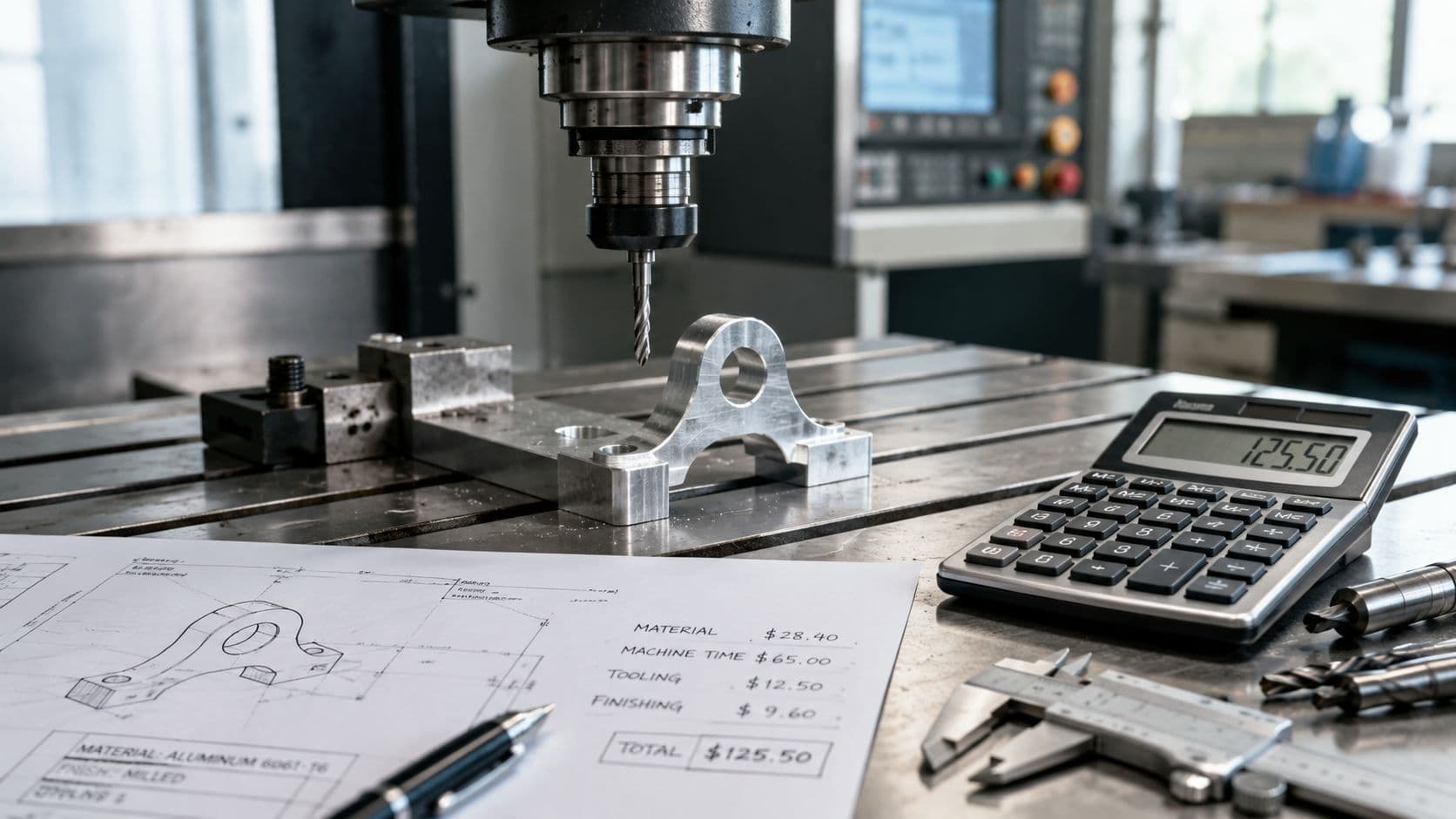
CNC milling cost typically breaks down into material (20–40%), machining time (30–50%), setup and programming (10–20%), tooling (5–15%), surface finishing (10–25%), and inspection (5–15%), with 3-axis rates around $35–120/hour and 5-axis rates reaching $150–300/hour depending on region. The machine-hour rate matters, but it rarely tells you what the finished, inspected, delivered part will cost.
A product engineer can discover that quickly after sending the same bracket CAD file to three machine shops. One quote may look manageable, another surprisingly high, and a third may appear inconsistent with the simple geometry on screen. The difference usually comes from setup strategy, tolerance interpretation, tool access, inspection requirements, finishing, and the way each supplier spreads fixed costs across the order.
Table of Contents
- Why Your CNC Milling Quote Looks Higher Than Expected
The machine-time calculation is only a starting point
Quantity changes the meaning of a fixed cost
The Full Anatomy of CNC Milling Cost- Material and machining time
Comparing 3-Axis 4-Axis and 5-Axis Milling Rates- When the premium earns its place
How to Estimate CNC Milling Cost for Your Part- Build the estimate in layers
Hidden Cost Drivers That Inflate Your Quote- Specifications that deserve a second look
Design for Manufacturability Tips to Lower Cost- Make the cutter's job predictable
When to Choose CNC Milling Over Alternative Processes
Why Your CNC Milling Quote Looks Higher Than Expected
A product engineer can send the same CAD file to three machine shops and receive three very different quotes. The gap often comes from setup strategy, tolerance interpretation, workholding, inspection requirements, and finishing assumptions, rather than from the visible geometry alone.
An online machine rate, such as a 3-axis estimate multiplied by an assumed cycle time, is only a starting point. The finished price also includes programming, setup, material, tooling, labor, inspection, finishing, packaging, and overhead, as outlined in this CNC machining cost breakdown.
The machine-time calculation is only a starting point
Suppose a shop cuts one part for 15 minutes on a machine billed at $60 per hour. The spindle-time portion is $15 per part. That figure is valid, but it excludes the work required before and after cutting.
The shop may still need to program the toolpaths, prepare workholding, load tools, prove out the first piece, inspect dimensions, deburr edges, and send the component for anodizing. For a prototype, those fixed activities can outweigh the short cutting cycle. A small batch may reduce the burden per part, but it does not remove the work.
Practical rule: Treat the hourly rate as a production input, not as the finished-part price.
Quantity changes the meaning of a fixed cost
A two-hour setup affects one part very differently from a repeat batch. For a single prototype, the full setup and programming burden falls on one unit. Across a larger order, the same work is spread over more parts, while material and cycle time account for a larger share of the total.
Batch size also changes how finishing and inspection should be evaluated. A prototype may carry a disproportionately high setup, first-article inspection, and outside-processing burden. In production, those costs can be amortized, but difficult materials, multiple orientations, tight tolerances, tool wear, and required documentation can still keep the quote high.
Compare suppliers using a line-item breakdown for setup, programming, machining, tooling, inspection, finishing, packaging, and logistics. Two shops may quote similar machine-hour rates while making different assumptions about what is included. The useful comparison is the total landed cost for the required quantity, not the hourly figure in isolation.
The Full Anatomy of CNC Milling Cost
The six-bucket model helps diagnose a high quote. Identify which bucket expanded, then trace the manufacturing decision behind it. Typical cost shares include 20–40% for material, 30–50% for machining time, 10–20% for programming and setup, 5–15% for tooling, 10–25% for surface finishing, and 5–15% for inspection and quality control (CNC machining cost guide).
These ranges are planning references, not an invoice template. Quantity, geometry, material, tolerances, and the supplier's process can move each share significantly.

Material and machining time
Material covers the purchased stock, billet size, and material removed as waste. A small finished part may still require an expensive blank if its dimensions force the shop to buy a larger piece. Harder or less machinable alloys also raise cost indirectly by slowing cutting and increasing tool consumption.
Machining time is spindle-on time multiplied by the shop's machine rate. That rate recovers more than electricity. It contributes to equipment depreciation, maintenance, labor, tooling infrastructure, facility costs, scheduling risk, and margin. A short cycle on a high-rate machine can therefore cost more than a longer cycle on a lower-rate platform.
Setup, programming, tooling, finishing, and inspection
Setup and programming include CAM preparation, fixture design, workholding, tool selection, machine loading, probing, and first-part prove-out. These are largely fixed job costs. A prototype absorbs them across few parts, while a batch spreads them across the order.
Tooling includes cutters, drills, inserts, tool presetting, and wear allowances. Deep pockets, abrasive materials, small radii, and demanding finishes require more tool changes and monitoring.
Surface finishing may involve bead blasting, anodizing, passivation, plating, powder coating, or another outsourced operation. Inspection and quality control become more demanding with tight tolerances, critical features, CMM work, certifications, and documentation.
Setup amortization separates a prototype quote from a batch quote. Finishing may remain a per-part charge, while inspection can add a substantial burden when every unit requires documented checks.
A prototype is often setup-dominated. A repeat batch usually shifts more cost toward material, cycle time, and process control.
Ask which costs are fixed, which repeat per part, and which requirements create a second operation. The useful comparison is total landed cost for the required quantity, not the machine-hour rate alone.
Comparing 3-Axis 4-Axis and 5-Axis Milling Rates
Axis count changes both the hourly rate and the manufacturing route. Regional benchmarks reported for 2026 place China at about $35–60 per hour for 3-axis, $45–80 for 4-axis, and $70–150 for 5-axis work, while U.S. and Western European 3-axis work often runs around $75–120 per hour and 5-axis work around $150–300 per hour (regional CNC machining rate comparison).
| Axis Configuration | North America ($/hr) | Western Europe ($/hr) | East Asia ($/hr) | Typical Cost Impact vs. 3-Axis |
|---|---|---|---|---|
| 3-axis | $75–120 | $75–120 | $35–60 | Baseline for accessible geometry |
| 4-axis | Regional quote varies | Regional quote varies | $45–80 | Higher machine and programming burden |
| 5-axis | $150–300 | $150–300 | $70–150 | Higher rate, potentially fewer setups |
The table should be read as a planning comparison, not a guaranteed supplier quote. Another published benchmark places standard 3-axis work around $40–80 per hour and 5-axis work around $150–300 per hour in major markets (low-volume CNC milling cost guide).
When the premium earns its place
A 5-axis machine can reach several faces of a complex component without repeated manual repositioning. That may reduce handling, fixture changes, datum transfer risk, and inspection effort. The higher machine rate can therefore produce a lower total landed cost when the geometry requires angled access.
A simple enclosure with orthogonal pockets is different. If every feature is accessible from one or two straightforward orientations, 5-axis capability adds cost without solving a real manufacturing problem. The same principle applies to 4-axis work. A rotary table can be useful for indexed side features, but it shouldn't be selected merely because the machine is available.
A practical axis-count heuristic
If the part needs more than two setups or includes compound-angle features, evaluate 5-axis machining against the complete process, including fixtures and inspection. If the features are accessible from two orthogonal directions, start with 3-axis and ask the shop whether a 4-axis indexed operation adds value.
For a deeper explanation of the capability trade-off, review this guide to 5-axis CNC milling. The decision should be based on total operations, not the impressive number attached to the machine.
How to Estimate CNC Milling Cost for Your Part
A dependable quote starts with the process plan and quantity, not the CAD model's finished volume. Use this structure:
Total Cost = Material + (Machine Rate × Cycle Time) + (Setup Time × Labor Rate) + Finishing + Inspection
The formula separates recurring machining from job-level preparation. It also shows why a prototype can carry a high landed cost even when its spindle time is modest.
Build the estimate in layers
Begin with the stock blank. For an aluminum 6061 bracket, record the required stock dimensions, expected billet waste, and the supplier's actual material price. The purchased blank is usually larger than the finished part volume.
Estimate cycle time by listing roughing, semi-finishing, finishing, drilling, tapping, tool changes, and probing separately. Base those entries on the shop's feeds, speeds, toolpaths, and machine capability. A quoted machine-hour rate does not mean every minute produces cutting time.
Setup and programming belong on their own line. Include fixture preparation, workholding, datum setting, tool loading, first-piece prove-out, and first-article inspection. List finishing and inspection separately as well, even if the supplier combines them in the initial quote. For prototypes, these fixed charges may dominate the total. In a batch, the same charges are spread across the parts.
A repeatable worksheet
The table below is a hypothetical calculation method, not a market price or verified case study. Replace every input with a supplier quote before using it for procurement.
| Cost Component | Qty 1 | Qty 10 | Qty 100 |
|---|---|---|---|
| Material | $18 | $180 | $1,800 |
| Machining | $60 | $600 | $6,000 |
| Setup and programming | $240 | $24 per part | $2.40 per part |
| Finishing | $30 | $300 | $3,000 |
| Inspection | $100 | $10 per part | $1 per part |
| Illustrative total | $448 | $114 per part | $93.40 per part |
The arithmetic highlights the quantity effect. Setup and inspection fall sharply per unit as volume rises, while machining and material continue to repeat. These figures illustrate the method only, and do not establish what a particular shop will charge.
Estimator's habit: Request a line-item breakdown that identifies charges incurred once per job and charges applied to every part.
For harder alloys or fragile features, include a qualitative allowance for tool wear and possible rework. Ask the shop to explain how it has handled that risk in the quote. Keep logistics, packaging, taxes, and finishing transport visible. They belong in total landed cost, even when they are absent from the machining line.
Hidden Cost Drivers That Inflate Your Quote
A drawing can raise the quote without changing the part's silhouette. Tolerance callouts, surface requirements, access conditions, and documentation may force a different process plan even when material and overall dimensions stay the same.
Tighter tolerances slow cutting, increase scrap risk, and add inspection time. The shop may need slower feeds, extra finishing passes, probing, tighter datum control, and further verification. Equipment, labor, tooling, and overhead must also be recovered during productive spindle hours, so demanding work carries more burden when it reduces machine utilization, as explained in this overview of precision CNC cost drivers.

Specifications that deserve a second look
A tight tolerance belongs on a mating feature, sealing surface, bearing fit, or functional datum that needs it. Applying the same precision to every face makes the shop control surfaces that do not affect performance.
A fine surface finish can require smaller stepover, more toolpath passes, hand deburring, and careful cosmetic handling. On a prototype, that finishing work may become a large share of landed cost. Across a batch, the same setup and finishing preparation can be distributed over more parts, so ask the supplier to model both quantities rather than relying on the quoted machine-hour rate.
Deep pockets with small corner radii create another cost center. Long-reach cutters deflect more easily, chatter can require conservative parameters, and tool breakage adds replacement cost and schedule risk.
Quality paperwork has a manufacturing cost
Material certificates, heat or lot traceability, first-article reports, CMM records, and customer-specific documentation consume engineering and inspection labor. They may be mandatory for regulated work, but adding them to a prototype that needs only basic dimensional confirmation can distort the quote.
Request a line-item breakdown separating one-time setup, programming, finishing, inspection, packaging, transport, taxes, and other quantity-scaled charges. Use tight-tolerance machining guidance to identify where precision is functionally necessary, then separate critical dimensions from general dimensions in the drawing. Specify cosmetic surfaces by face instead of applying a finish requirement to the whole part.
Design for Manufacturability Tips to Lower Cost
The most effective cost reductions usually happen before the drawing reaches procurement. A machinist can optimize toolpaths, but the designer controls whether the part needs deep cavities, unusual radii, multiple orientations, or unnecessary precision.
Make the cutter's job predictable
Use internal corner radii that match common end mills whenever the function allows. Sharp internal corners require specialized tooling or additional operations, while a sensible radius lets the shop cut with standard tools.
Design around accessible stock sizes and avoid unnecessary billet volume. A part that fits efficiently within common material dimensions reduces waste and simplifies workholding. For assemblies, consider whether several simple components can be machined more economically than one highly complex monolithic part.
Reserve precision for function
Keep tight tolerances on mating, sealing, locating, or load-bearing features. Use a more general tolerance for non-critical faces. This gives the machinist room to use efficient cutting parameters and reduces the inspection burden without weakening the design.
Thin walls and deep narrow pockets deserve the same scrutiny. Increasing structural thickness where possible reduces vibration and tool deflection. Shortening pocket depth or opening tool access can eliminate a long-reach operation.

Design around setups
Features should be reachable from one or two stable orientations. Every additional flip creates workholding effort, datum-transfer risk, and another opportunity for cosmetic damage or dimensional drift.
A practical DFM review should ask:
- Can standard tooling reach every pocket? Replace unnecessary deep cavities, custom radii, and obstructed features.
- Can the part sit on a flat datum? Stable workholding simplifies setup and improves repeatability.
- Does each tolerance serve a function? Remove precision callouts that don't protect assembly or performance.
- Can finishing be limited to visible faces? This avoids paying for unnecessary secondary processing.
- Can the supplier route the work efficiently? A partner offering machining, finishing, and related processes can reduce handoffs.
For a broader framework, see what design for manufacturability means. Don't assume a lower quote comes from cutting quality. Often it comes from removing avoidable operations before manufacturing begins.
When to Choose CNC Milling Over Alternative Processes
A prototype may need a fast fit check, while the production version must withstand heat, load, or repeated use. CNC milling suits parts that require predictable metal or engineering-plastic properties, controlled dimensions, design changes, and a practical path from prototype to repeat production.
Compare total landed cost across the planned quantity. A machine-hour rate can look attractive until setup time, finishing add-ons, inspection, and logistics are allocated across a small prototype order. In a batch, those fixed tasks spread across more parts, while finishing or inspection requirements can still keep the total above the quoted cutting time.
For highly complex shapes in limited materials, 3D printing can avoid tooling and support rapid iteration. Sheet metal fits folded enclosures and brackets made from uniform stock. Casting or injection molding becomes more attractive after the design stabilizes and the quantity supports tooling.
| Process | Best Quantity Range | Typical Cost per Part | Material Options | Tolerance Capability | Lead Time |
|---|---|---|---|---|---|
| CNC milling | Prototypes to repeat batches | Setup-sensitive, then falls with quantity | Metals and engineering plastics | Strong for controlled machined features | Moderate |
| 3D printing | Early prototypes and complex low-volume forms | No cutting setup, part complexity varies | Process-specific polymers and metals | Depends on process and material | Short |
| Sheet metal fabrication | Brackets, panels, and enclosures | Efficient for formed geometry | Aluminum and steels | Strong on cut and bend features | Short to moderate |
| Die casting | Stable high-volume metal designs | Tooling-sensitive, lower marginal cost | Selected casting alloys | Good for repeat cast geometry | Tooling-dependent |
| Injection molding | Stable high-volume plastic designs | Tooling-sensitive, low marginal cost | Broad resin selection | Good for molded features | Tooling-dependent |
Choose the process that minimizes total operations, not the one with the most axes listed on the machine nameplate. Material behavior, load requirements, cosmetic expectations, tolerance, design maturity, and schedule determine the better route. A printed prototype may answer a fit question quickly, while a milled aluminum part may be necessary for thermal, structural, or functional testing.
Supplier consolidation can also change landed cost. FIRMFG provides CNC machining alongside 3D printing, sheet metal fabrication, molding, casting, and surface finishing. One supplier can help compare routing and reduce coordination across separate vendors. For a quote, provide the CAD file and requirements, then request line items for setup, machining, finishing, inspection, and logistics.