Rapid Tooling Services: The Complete Guide for Engineers
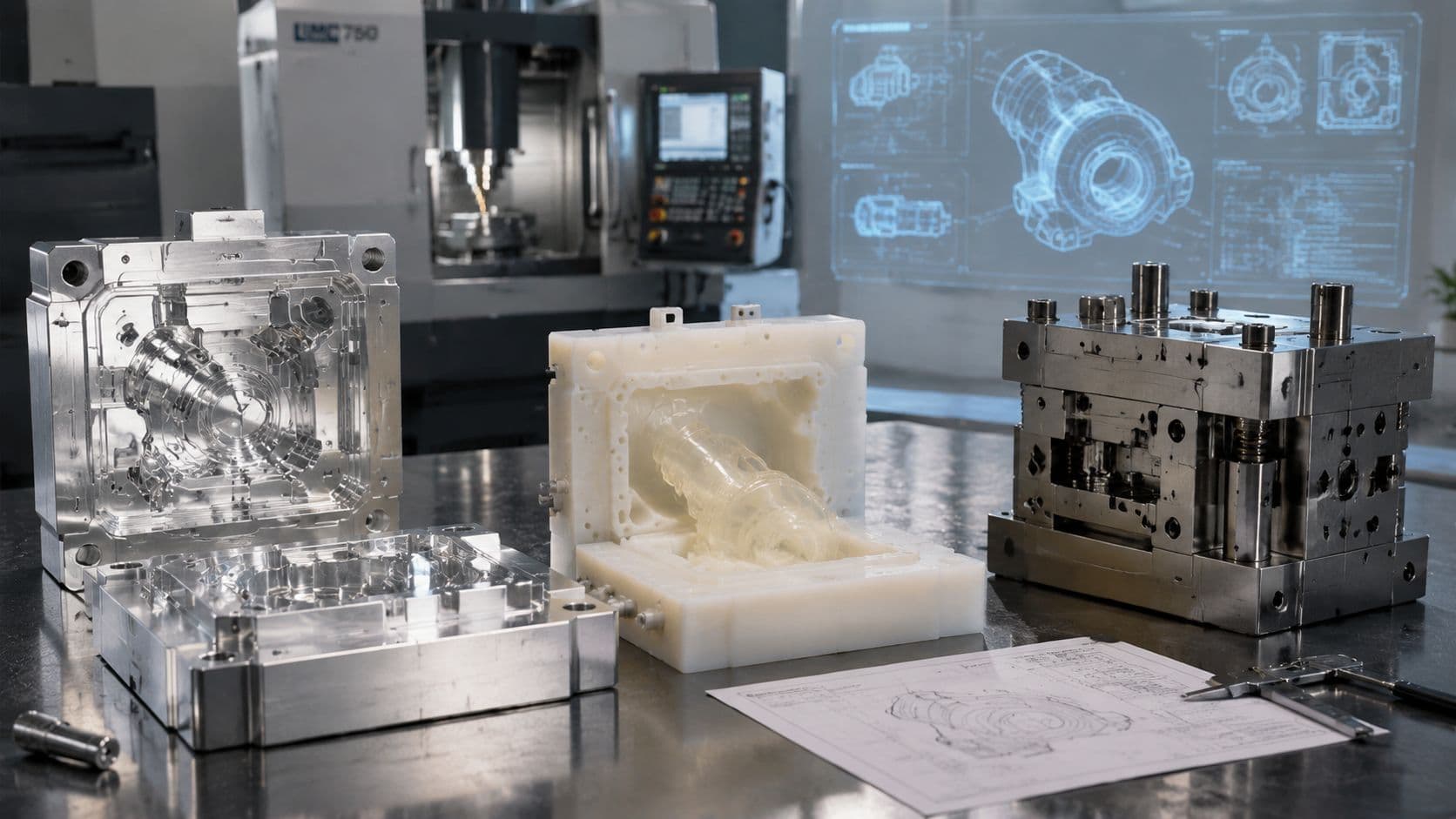
Rapid tooling services usually save schedule first, then spend the money earlier in the program. A simple aluminum prototype mold can take 7 to 10 business days, and soft tooling is typically the right move for 50 to 10,000 cycles depending on the process.
That's the trade many teams are facing right now, usually after a clean prototype review and before the next milestone slips. The CAD is stable, the parts look right in hand, and now procurement wants functional units that behave like the final product without waiting for hard tooling or accepting the limits of 3D printing.
Table of Contents
The Core Technical Trade-Off Cycle Life Versus Speed- What the insert material really decides
Choosing Between Soft Tooling Aluminum CNC and Vacuum Casting- Match the tool to the part's actual purpose
Design for Manufacturability Rules That Actually Matter- Geometry that helps the tool release cleanly
Understanding True Cost and Total Lead Time- Why the cheap-looking option can still be expensive
How to Evaluate Rapid Tooling Providers Correctly- What to check before you send CAD
Why Tooling Speed Accounts for Only Part of the Delay
Why Rapid Tooling Matters for Modern Manufacturing
A hardware team can get through prototype sign-off and still be stuck. The enclosure fits, the clips work, and the electronics stack passes bench checks, but the next gate needs 500 functional parts for pilot testing, fit checks, or customer sampling. Injection tooling is the right route for real material behavior and production-like finish, yet a full steel tool can tie up the schedule for months and lock the program into a bigger spend than the team is ready to approve.
That gap is where rapid tooling services became practical instead of theoretical. The category grew out of the same enabling methods that pushed prototyping into industrial use in the late 1980s and 1990s, especially stereolithography and layered manufacturing, and CIRP was already describing rapid prototyping as widely accepted in 2003, with an estimated 3.55 million models and prototypes produced in 2001 and growing at about 20% per year. In that same discussion, rapid tooling was treated as a real manufacturing application, not a side note, because it could support both soft tools for limited series and hard tools for runs up to 100,000 shots. Historical context from CIRP discussion

A bridge, not a detour
The practical value is simple. Rapid tooling keeps the digital design workflow intact while giving engineers a mold or insert that can produce parts with real molded properties, not just visual stand-ins. That matters in programs where the next decision depends on wall thickness, sealing, snap fit behavior, or surface quality that additive prototypes can't fully replicate.
The market picture matches that usage pattern. One independent industry report values rapid tooling services at US$642 million in 2024 and projects US$959 million by 2031, which implies a 5.7% CAGR. Another study places the broader service market on a similar growth path through 2033, which suggests the category is now a stable part of the sourcing field rather than a niche workaround. Rapid tooling service market outlook
Practical rule: if the next program gate depends on molded material behavior, tooling is often the right move even when it doesn't look cheapest on paper.
The reason buyers keep choosing it is that rapid tooling fills the middle of the manufacturing funnel. It's not meant to replace hard tooling for full-rate production, and it's not a cosmetic substitute for a quick print. It's the bridge that lets teams validate form, fit, function, and early production behavior before they commit to the long, expensive path.
The Core Technical Trade-Off Cycle Life Versus Speed
The engineering reality is blunt. You don't get maximum speed and maximum durability from the same insert strategy, and a project can fail if the team chooses the wrong side of that trade. Polymer-based inserts are fast to make and useful for short runs, but their thermal limits show up quickly once cycle count or part heat load increases.
What the insert material really decides
A systematic review of additive insert production found maximum successful injection-cycle counts of 116 for material-jetting inserts, 85 for vat-photopolymerized inserts, and more than 500 for laser powder bed fusion metal inserts. That spread is the key decision tree, because it tells you whether the tool is meant for a small proof run, a bridge batch, or something closer to production behavior. Cycle-life review of AM inserts
A better insert doesn't just survive longer, it changes how the program behaves. Metal inserts tolerate heat and wear better, so they're less likely to drift as part counts climb. Polymer inserts can get you parts sooner, but they're a poor match when the resin is aggressive, the cavity is hot, or the geometry demands stable dimensions over repeated shots.
Cooling architecture matters as much as base material
Conformal cooling is where a lot of teams leave performance on the table. One study reported roughly 30% shorter cycle time than conventional cooling, which means the cooling layout can affect throughput as much as the insert material itself. In practice, that's why tool architecture matters more than people expect. You can buy speed with additive geometry, but only if the thermal path matches the part.
A fast insert that can't shed heat is still a slow tool.
This is also where process planning gets more honest. If the run is tiny, a polymer insert might be enough. If the run has to repeat, or if the part has thin walls and a tight cooling window, metal AM or hybrid tooling usually makes more sense. For a practical adjacent process comparison, the economics and material behavior of urethane casting services often sit in the same sourcing conversation as rapid tooling because both are used to bridge volume and validation gaps.
The right question isn't whether the tool is made quickly. It's whether the insert can hold shape, move heat, and survive the number of shots your program needs.
Choosing Between Soft Tooling Aluminum CNC and Vacuum Casting
The hardest mistake I see is teams choosing a tooling method by habit instead of by use case. They pick the fastest path, then discover they needed better finish, different resin behavior, or a longer cycle life than the process can support. The fix is to match the process to the part's job, not to the calendar alone.

Match the tool to the part's actual purpose
Soft tooling and vacuum casting are strongest when appearance, low volume, or short validation loops matter more than true injection-molded behavior. Aluminum CNC prototype molds are better when you need functional parts and dimensional confidence without committing to hardened steel. Rapid steel belongs in the bridge zone when the part will see more cycles, higher wear, or a longer pre-production phase.
| Process | Best fit | What it does well | Where it breaks down |
|---|---|---|---|
| Soft tooling | Appearance models, very small batches | Low upfront commitment, fast iteration | Limited durability and lower thermal robustness |
| Aluminum CNC prototype molds | Functional validation, short runs | Better precision and molded material behavior | Less durable than steel for long runs |
| Rapid steel tooling | Bridge production, higher shot counts | Better wear resistance and longer life | Slower and usually more expensive than aluminum |
| Vacuum casting | Cosmetic parts, transparent parts, small series | Good surface finish and quick replication | Not a substitute for true molded performance |
If your part is mostly about look and feel, vacuum casting can be the cleaner move. If you need actual molded behavior, fasteners, snap features, or thermal response, aluminum or rapid steel is usually the better fit. That's why the same part can belong in two different processes at two different stages of the program.
For teams comparing service options, vacuum casting services often make sense when the goal is presentation or low-volume duplication, not injection-molding validation.
A selection rule that saves budget
- Choose soft tooling when the purpose is visual approval or ultra-low volume.
- Choose aluminum CNC molds when the part must function like production plastic.
- Choose rapid steel when cycle life matters more than shortest lead time.
- Choose vacuum casting when finish quality matters and molded mechanics don't.
The main benefit is avoiding overbuying tool life. Many programs spend too much on a tool that will never earn back its extra durability.
Design for Manufacturability Rules That Actually Matter
Rapid tooling punishes part geometry faster than people expect. A shape that prints cleanly can create sticking, poor fill, ugly gate marks, or slow cycles once it has to be molded. Good DFM isn't generic advice here, it's the difference between a smooth pilot build and a tool that keeps coming back for rework.

Geometry that helps the tool release cleanly
Draft is the first thing I check. A part that doesn't release cleanly puts load on soft aluminum, polymer inserts, and even polished surfaces, and that leads to wear, scuffing, or stuck parts. The mold may still work, but the process becomes fragile, which is a bad place to be when the schedule is already tight.
Wall behavior matters next. Uniform sections help the material fill and cool predictably, while sharp internal corners and abrupt section changes create stress, sink, and uneven shrink. If the part needs ribs, keep them balanced with the surrounding wall so the molding process doesn't turn a simple feature into a cosmetic defect.
Gate location and cooling should be designed together
Gate placement is not just about fill. It affects witness marks, packing balance, and whether the cosmetic face ends up with a visible scar. On a rapid tool, that decision is amplified because you have less tolerance for trial-and-error than you would on a long production program.
Practical rule: if a detail can be simplified in CAD without hurting function, it usually should be.
The same applies to cooling. Conformal cooling only pays off when the channels are planned to support even thermal removal. If cooling is uneven, the tool spends more time fighting hot spots than producing parts. That can erase a lot of the time advantage rapid tooling was supposed to deliver.
For engineers who want a deeper design lens, the DFM guidance in what is design for manufacturability is worth comparing against the constraints of the specific molding process. The right geometry can cut iteration pain before the mold is even cut.
Understanding True Cost and Total Lead Time
The cost question is usually asked too late. By the time a team asks whether rapid tooling is cheaper, the quote is already in hand and the schedule pressure has narrowed the options. The better question is whether the total program cost, including validation and logistics, beats the alternatives.
Why the cheap-looking option can still be expensive
Rapid tooling is often compared against a single number from a printed prototype or a full production mold, but that misses the decision point. The comparison is against repeated 3D printing, vacuum casting, or direct low-volume machining, because those are the methods that compete in the same volume band. A quick tool may reduce time, but it can also shift cost earlier in the schedule without reducing the total burden as much as buyers expect.
Lead time is equally nuanced. Industry reporting pegs simple aluminum prototype molds at 7 to 10 business days, while production steel tools can take 4 to 8 weeks. That spread explains why people overestimate the savings. A faster mold is not the same thing as a finished supply chain, and the slow part of the program may still be validation, sampling, or shipping rather than tool fabrication. Lead-time and procurement questions in rapid tooling
Total landed lead time is the number that matters
The hidden delay is everything after the tool is cut. That includes first-article inspection, cavity matching, cosmetic review, packaging, freight, and any rework before the parts are considered usable. In one report, repeat-production timelines still ran 3 to 6 weeks, and first-article orders with new tooling could take 6 to 10 weeks to reach a European dock once tooling, production, and freight were included. Total lead-time reporting for injection molding programs
The tool can be done while the program is still waiting on documentation.
That's especially true in regulated or quality-critical work. Medical, automotive, and export-heavy programs usually carry more inspection and traceability burden, so the winning supplier is the one that shortens the whole chain, not only the machining step.
A simple way to evaluate a quote is to ask three questions together.
- How fast is the tool built? Useful, but incomplete.
- How fast are approved parts in hand? This is the key milestone.
- What work happens after cutting? Inspection, rework, and freight often dominate the calendar.
Rapid tooling makes the most sense when the cost of delay is higher than the extra spend. If the program only needs a few dozen parts, another process may be cheaper. If the program needs molded validation and a controlled path to pilot production, rapid tooling usually earns its place.
How to Evaluate Rapid Tooling Providers Correctly
A fast quote means very little if the supplier can't support the rest of the program. Teams get burned when they compare vendors only on tool lead time, then discover that inspection, surface finish, sampling, or change control adds more delay than the machining saved. I'd rather work with a provider that asks hard questions early than one that promises a quick turnaround and leaves the cleanup to the customer.
What to check before you send CAD
The first filter is quality systems. For regulated or traceable work, ISO 9001 and ISO 13485 matter because they show the supplier has a structured process, not just machines. For automotive-related programs, IATF 16949 capability is a meaningful signal that the factory understands process discipline and documentation expectations.
The second filter is process breadth. A shop that can handle CNC machining, injection molding, vacuum casting, and finishing under one roof reduces handoffs, which reduces errors. It also makes cosmetic matching and functional matching easier because the same team can see the part through more than one process stage.
Why consolidation reduces risk
Fragmented suppliers create small delays at every transfer. One vendor machines the tool, another samples it, a third finishes the part, and someone else manages packaging. Each handoff adds the chance of mismatch, especially when cosmetic specs and functional specs need to line up on the same part.
FIRMFG is one example of a provider built around that consolidation model, with 300+ in-house machines, ISO-based quality systems, and multiple processes available for prototype and low-volume work. The value of that setup isn't the brochure language, it's that one team can handle the geometry, tool path, molding behavior, and post-processing without forcing the customer to coordinate each step separately.
Buyers should ask for process ownership, not just process access.
A practical vendor review should also include response speed, DFM support, and after-sales handling. If a supplier gives useful feedback before quoting, the eventual build is usually easier to manage because the risky features are discussed before they become scrap. That's the kind of early discipline that saves both time and budget.
Why Tooling Speed Accounts for Only Part of the Delay
A tool can leave the machine and still miss the customer date. Inspection, rework, packaging, freight, and repeat sampling all sit after fabrication, and each step can stretch the schedule even when the mold itself was built quickly.
That is why a fast tool does not automatically mean fast parts. For buyers running launch-critical or regulated programs, the practical question is whether the supplier can deliver validated parts, not just a finished cavity. If quality checks reveal a mismatch, the calendar slips again while the tool is adjusted and resampled.
The supplier's process control matters as much as cutting speed. A shop that can verify dimensions, confirm surface finish, and handle rework without sending work to another vendor usually has a shorter landed lead time than a shop that only machines metal. That is where supplier SLAs on inspection turnaround, rework response, and shipping handoff become useful.
Recent reporting on China injection molding lead times shows how the downstream stages still shape delivery, especially once production and freight are included. Industry report on China injection molding lead times
For that reason, the right rapid tooling partner is the one that compresses the whole path from CAD review to usable parts. Tool speed matters, but it is only one part of the delay.