Sustainability in Manufacturing: A KPI Roadmap for 2026
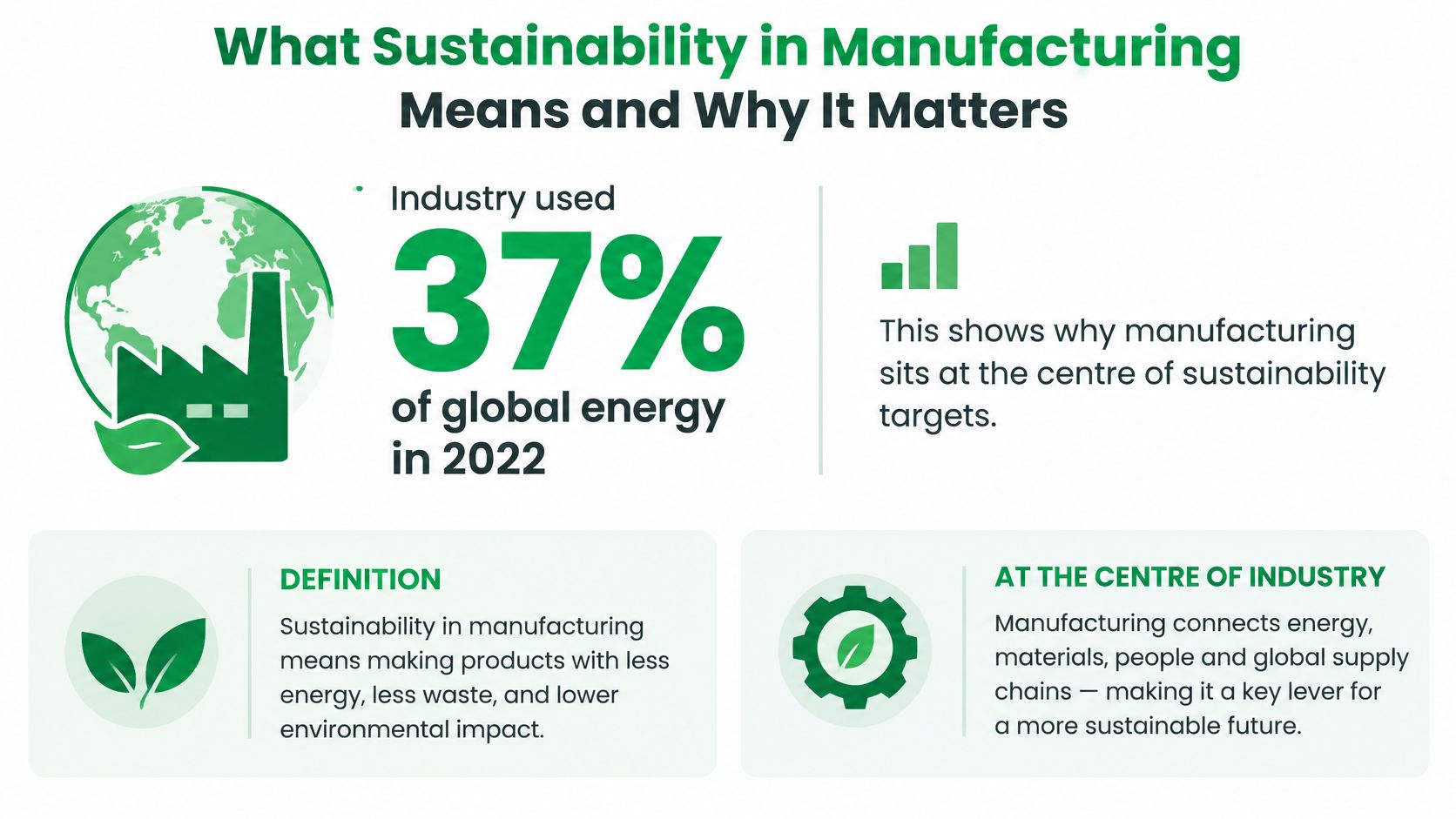
Industry accounted for 37% of global energy use in 2022, according to the International Energy Agency. That reframes sustainability in manufacturing: it isn't primarily a packaging or recycling exercise. For designers and buyers of prototypes and short runs, it starts with how much material, processing, and rework it takes to deliver a part that performs its job.
Table of Contents
- What Sustainability in Manufacturing Means and Why It Matters
Environmental, social, and commercial responsibilities
Key Metrics and Standards to Know Before You Measure- Match the measure to the decision
Designing Parts That Waste Less Material and Energy- Change the features that drive manufacturing effort
Matching Materials and Processes to Your Volume- Resolve the prototype trade-off
Cutting Shop-Floor Waste and Proving Payback- Prioritize controllable losses
Choosing Suppliers When Carbon Data Is Missing- Build an evidence ladder
Start Your Roadmap with a Baseline Audit- Establish the sequence
What Sustainability in Manufacturing Means and Why It Matters
Say you're sourcing a machined enclosure for a functional prototype. The drawing specifies thick walls, tight tolerances across every surface, and a cosmetic finish on faces nobody will see. The supplier can make it, but you're purchasing more than the finished enclosure: you're also paying for removed stock, cutting time, inspection, finishing, and the risk of rejection.
Sustainability in manufacturing means making useful parts with less energy, material waste, emissions, and harm to people while keeping the business viable. The useful part matters. An apparently efficient process isn't an improvement if its output fails testing and forces another build.
Every scrapped part is like a leaking tap. The individual loss looks small, but repeated across setups, revisions, and production runs, it becomes a persistent drain on resources.
Environmental, social, and commercial responsibilities
Industrial production still relies heavily on fossil fuels. A machining program therefore needs to address both how much energy it consumes and how that energy is supplied. Efficient equipment alone doesn't resolve the impact of material production, process heat, or purchased electricity.
Responsibility also extends beyond carbon. Operators need safe coolant handling, effective extraction, and workable procedures for collecting contaminated waste. Buyers need documentation that connects the material ordered to the material delivered, rather than an environmental claim disconnected from the job.
The commercial case is equally practical:
- Material losses affect margins. Excess machining allowance becomes purchased stock that never reaches the customer.
- Quality failures consume resources twice. A replacement repeats some combination of machining, finishing, inspection, packaging, and transport.
- Unclear requirements create avoidable work. A buyer who specifies appearance criteria after manufacture can trigger refinishing or replacement.
- Documentation supports purchasing decisions. Material certificates and process records make alternatives easier to evaluate without compromising engineering requirements.
Practical rule: Judge improvement per conforming, useful part, not per machine cycle or kilogram sent to a recycler.
Start with questions that someone on the team can answer: Where does energy go per accepted part? Where does purchased material leave as scrap? Which customer, safety, and documentation requirements already apply? Those questions turn a broad sustainability ambition into engineering work.
Key Metrics and Standards to Know Before You Measure
Buyers, engineers, and auditors use overlapping terminology, but these measures answer different questions. Keep the distinction clear before asking a supplier for a sustainability report.
Core sustainability metrics and standards for manufacturers
| Metric or standard | What it measures | Best use for prototypes and low-volume parts |
|---|---|---|
| Life cycle assessment (LCA) | Environmental impacts from raw material extraction to end of life | Comparing process or material options for the same functional design |
| Carbon footprint, including Scope 1, Scope 2, and Scope 3 | Greenhouse gases from direct operations, purchased energy, and value-chain activities | Answering customer emissions requests and tracking change |
| ISO 14001 environmental management | A documented system for managing environmental responsibilities and improvement | Assessing management discipline and meeting relevant procurement requirements |
| Circular economy rate | Material returned to use relative to a defined material-use boundary | Evaluating circular material use, with a separate recovery measure for shop-floor scrap |
| Scrap rate and material utilization | Rejected output and the share of purchased stock incorporated into finished parts | Shop-floor control, process comparison, and quoting accuracy |
Match the measure to the decision
An LCA can examine environmental effects beyond greenhouse gases, including resource use and other impact categories. A carbon footprint focuses on greenhouse-gas emissions. Both need explicit boundaries, assumptions, and a defined output.
For a prototype comparison, define the output as something like a functional enclosure that passes the specified mechanical and thermal tests. Comparing equal masses of printed polymer and machined metal won't help if the designs have different service lives or performance.
A detailed LCA requires more inputs and interpretation than a simple operational KPI. Don't commission one merely because it sounds more rigorous. Use it when competing options have meaningful trade-offs that simpler measurements can't resolve.
Separate accounting from management
Direct fuel use belongs in Scope 1. Purchased electricity falls within Scope 2. Purchased materials, outsourced processing, transport, and other value-chain activities can fall within Scope 3, subject to the accounting boundary.
Supplier information is usually less accessible than your own meter readings. That makes it important to distinguish measured values from estimates rather than combine everything into an apparently precise total.
ISO 14001 certification concerns an environmental management system, not a guaranteed emissions level. A certificate doesn't establish that a particular part has a lower footprint than an alternative.
For a shop-floor starting point:
- Use scrap rate to identify rejected production, keeping rework visible separately.
- Use energy per accepted part to connect consumption with usable output.
- Use a carbon footprint when a customer needs emissions information.
- Use an LCA when the design decision requires a broader environmental comparison.
Keep circularity measures separate from material utilization. Recovering chips is worthwhile, but it doesn't mean those chips became finished product during the original manufacturing operation.
Designing Parts That Waste Less Material and Energy
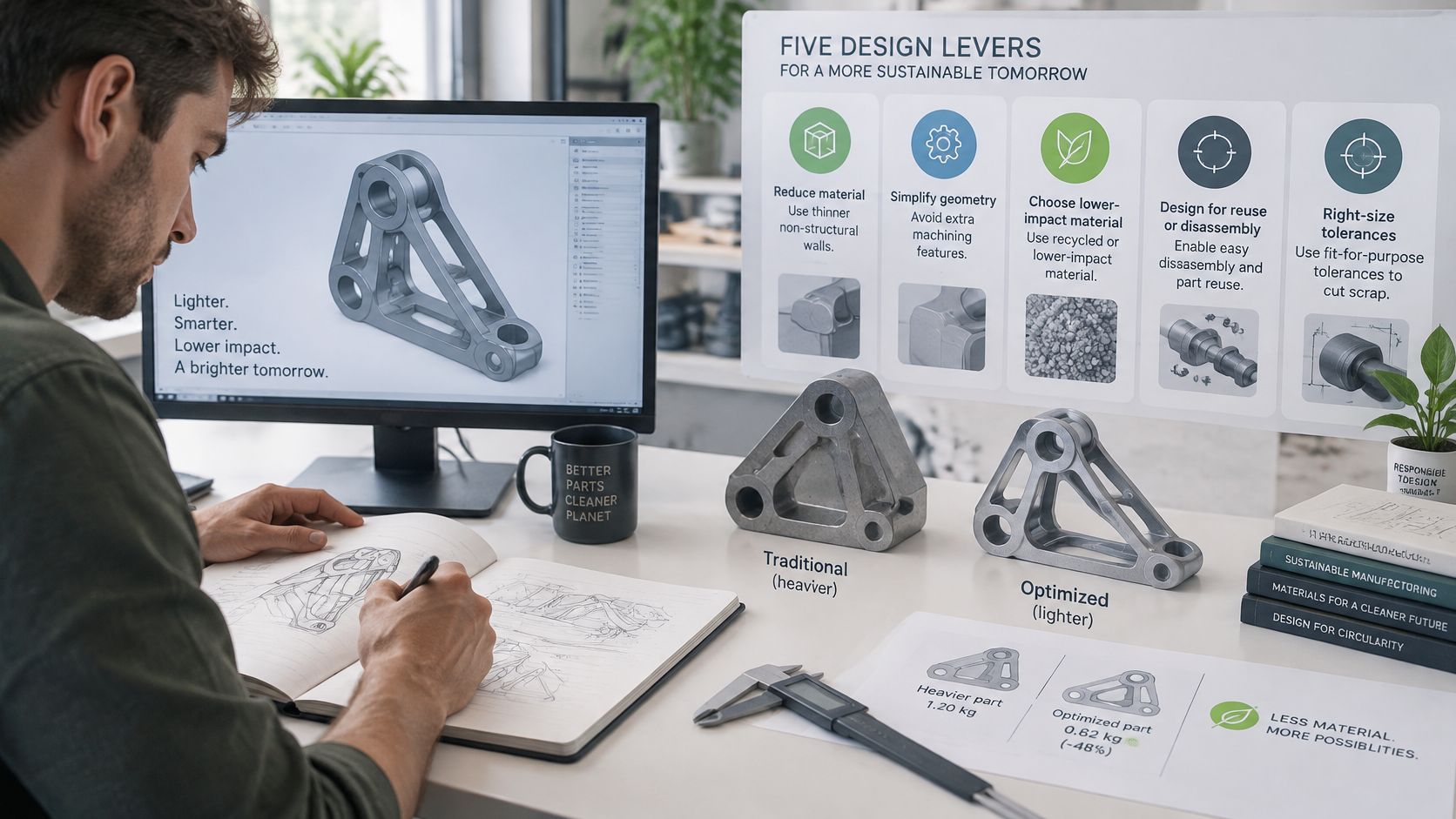
The drawing determines many of the losses the shop can't remove later. Deep pockets, inaccessible features, unnecessary surface requirements, and oversized starting stock can make an otherwise simple part resource-intensive.
The aim isn't minimum mass at any cost. It's enough material and processing to satisfy the actual load case, assembly conditions, and expected life.
Change the features that drive manufacturing effort
- Remove nonfunctional bulk. Replace a solid section with a ribbed geometry where the load path allows it. Check deflection, local stress, fastening loads, and manufacturability before releasing the revision.
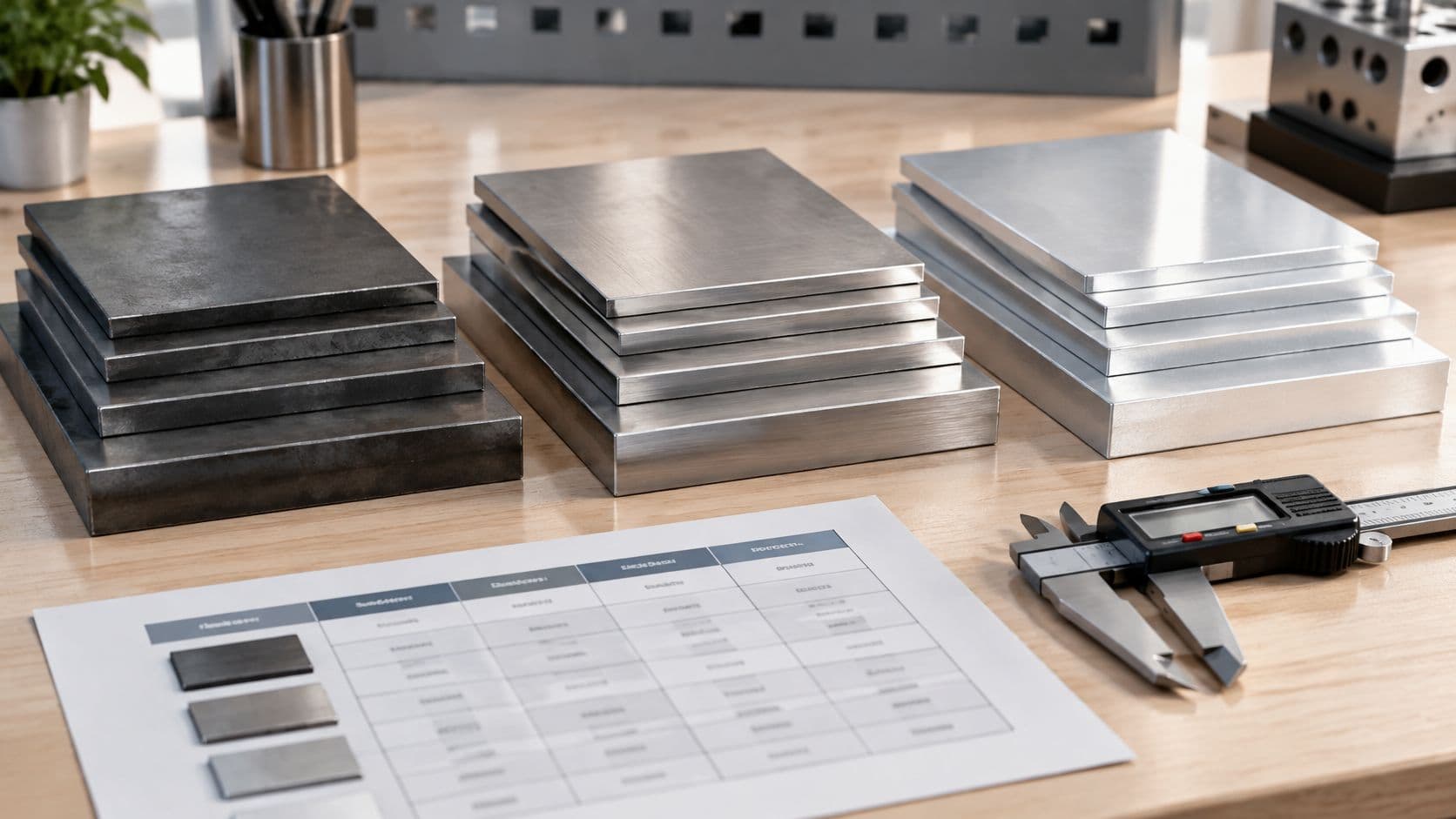
- Fit available stock. Adjust an external envelope to suit an available plate thickness or bar size when the interface permits. A small dimensional change can avoid buying and removing unnecessary stock.
- Consolidate selectively. Integrate a locating feature into a housing instead of adding a separate bracket and fasteners. Keep replaceable wear components separate when consolidation would make repair impractical.
- Locate precision where it works. Apply tight tolerances to bearing seats, sealing interfaces, and alignment features, not every surface. Use an agreed general-tolerance specification for noncritical geometry.
- Make separation possible. Identify polymer grades where practical, retain access to fasteners, and avoid permanent adhesive joints between materials that should be recovered separately.
Check the redesigned part, not just the CAD mass
Consider a solid mounting bracket redesigned with thinner walls and ribs. The CAD model may show less mass, but the ribs could create narrow pockets that require small tools, long reach, or extra setups.
The right comparison includes stock size, tool access, workholding, predicted cycle time, and inspection. Validate stiffness and fatigue performance against the actual load case rather than assuming that adding ribs preserves function.
A lighter part isn't automatically a lower-impact part. The manufacturing route has to support the geometry.
Design rules also change with the process. Our guide to DFM for injection molding explains considerations that shouldn't be carried over unchanged from machined designs.
At FIRMFG, we provide free DFM feedback, with engineers reviewing designs and suggesting changes to optimize CNC machining. Resolve those questions before cutting the first prototype, when changes still involve a drawing rather than discarded hardware.
Matching Materials and Processes to Your Volume
Process selection by volume and sustainability lever
| Process | Main sustainability lever | Main trade-off |
|---|---|---|
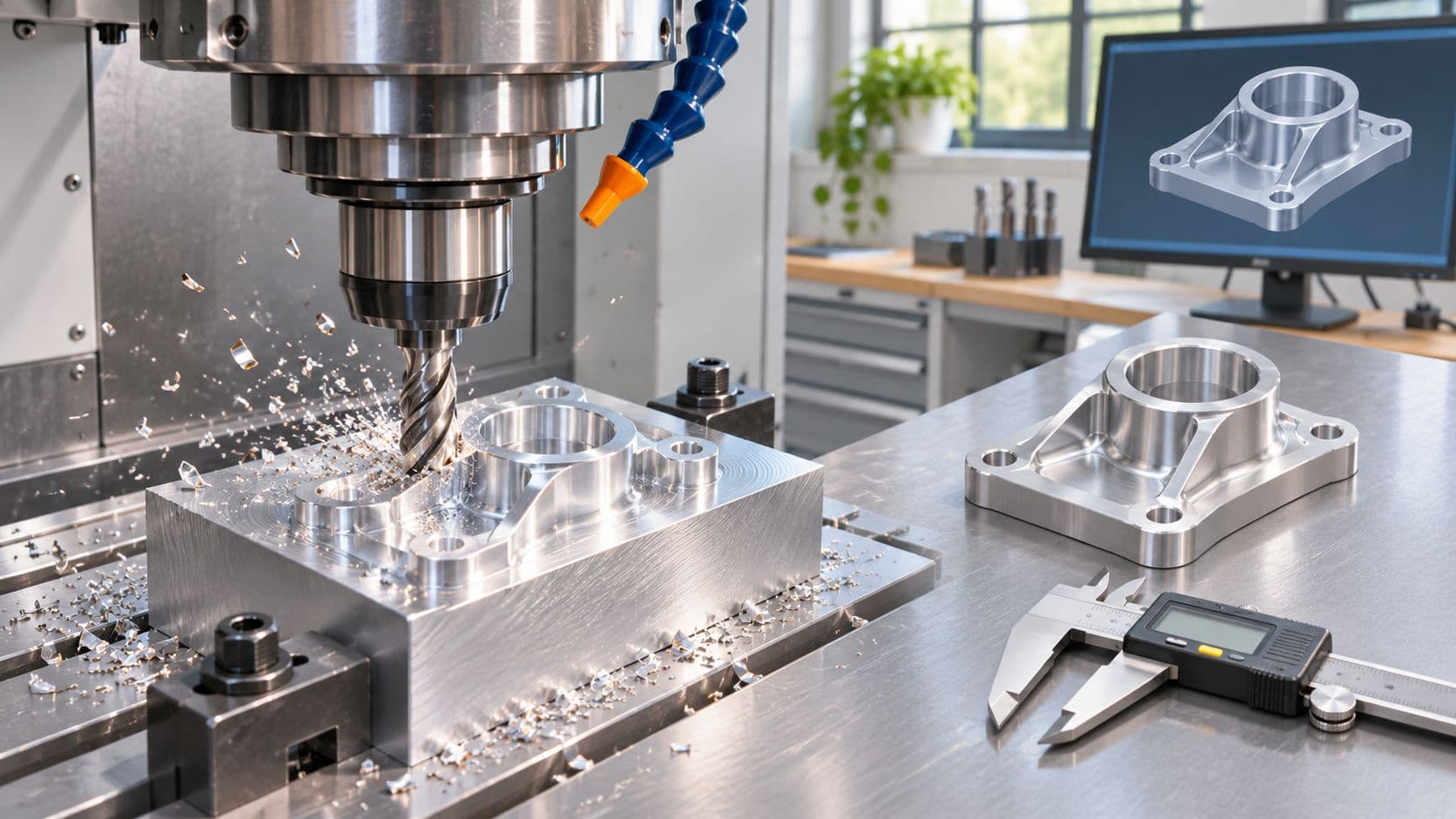
| CNC machining from recycled or near-net stock | Recycled inputs, appropriate tool life, and chip recovery; useful for prototypes and short runs without dedicated production molds | Subtractive waste, workholding requirements, and machine energy |
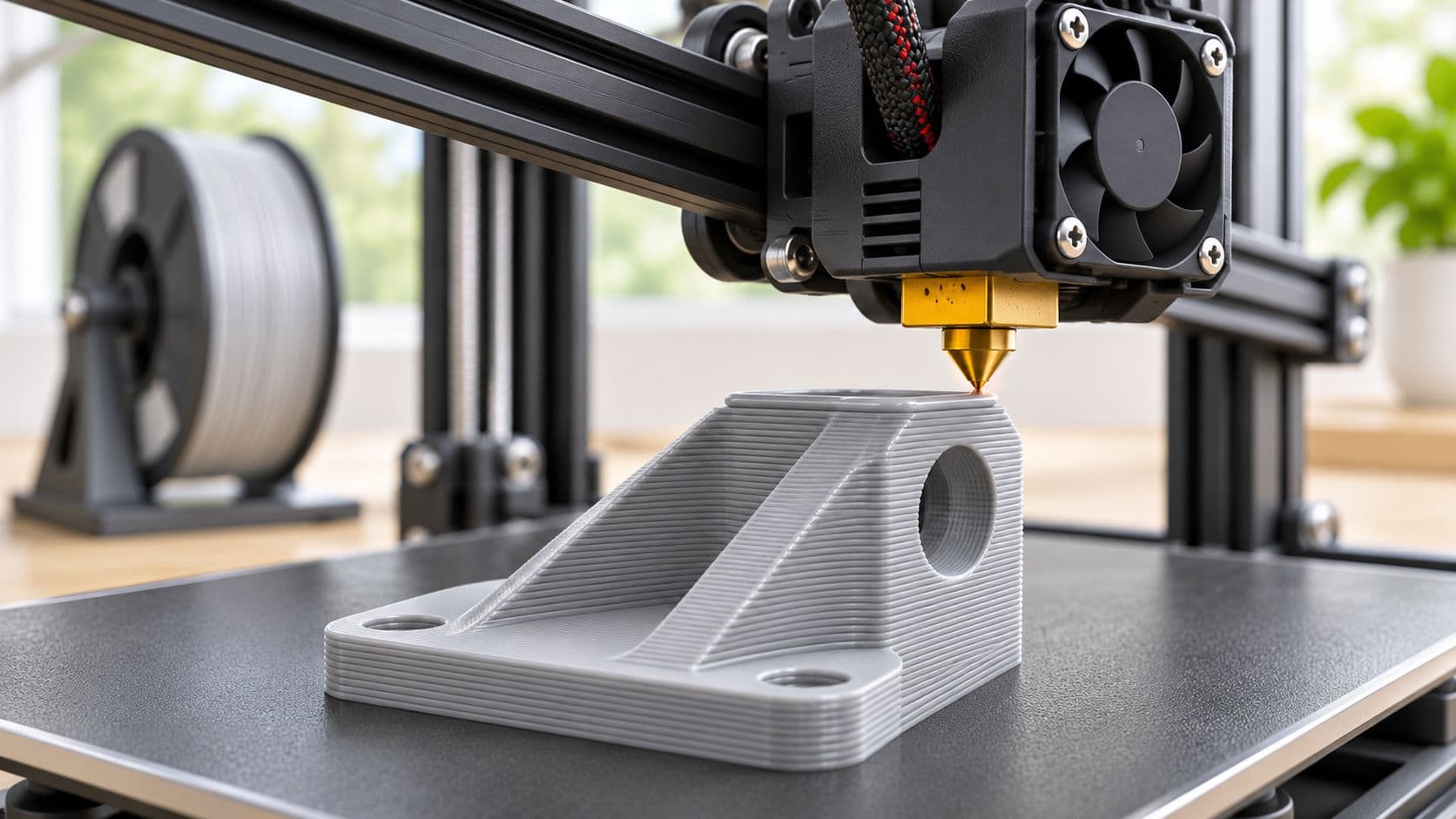
| Additive, including SLS, MJF, SLA, and FDM | Near-net geometry without dedicated molds; useful for iterative designs and complex short-run parts | Powder or resin management, supports, post-processing energy, and mechanical-property limits |
| Sheet metal fabrication | Nesting yield and offcut reuse for brackets, panels, and enclosures | Cut-off waste, forming constraints, joining, and finishing |
| Injection molding | Repeatable processing and efficient material use once sufficient demand supports tooling | Mold manufacture, trial shots, runners, and tooling investment spread over the actual quantity |
| Vacuum casting | Small-batch replication that avoids committing to production tooling prematurely | Silicone mold waste, consumable materials, and limited mold life |
Don't choose from this table by process reputation. Compare the complete route to accepted parts, including tooling, rejected builds, finishing, delivery, and expected replacement.
The World Economic Forum's industrial-transition analysis identifies insufficient near-term procurement of low-carbon materials as a barrier to industrial transition. A purchasing specification therefore needs to turn a general preference into an orderable material, supported by evidence.
Resolve the prototype trade-off
Machining recycled stock produces chips and offcuts, but it avoids dedicated production molds and may deliver the required properties directly. Near-net additive production can reduce removed material while introducing support removal, washing, curing, depowdering, or machining of critical interfaces.
Neither wins by default. A printed shape that needs extensive finishing deserves comparison with a simpler machined design, not just with the original complex CAD model. Our CNC versus 3D printing comparison helps frame the practical process differences.
Compare service delivered, not just production effort. A protective coating can add processing yet prevent premature replacement. Conversely, a decorative finish on a disposable fit-check prototype may add work without improving its purpose.
Make material claims usable
Request the alloy or resin grade, material condition, recycled-content statement, and relevant certification. A mill certificate establishes material identity and properties; it doesn't automatically establish a product carbon footprint.
For a low-carbon metal claim, ask what production route and electricity assumptions support it. Regional electricity mix matters, but supplier-specific evidence is more useful than assuming every factory in a region operates identically.
Use a short decision sequence:
- Fix the requirements. Confirm quantity, service life, tolerances, and finish.
- Choose viable alternatives. Exclude options that can't meet safety or material requirements.
- Compare complete routes. Include tooling, post-processing, rejects, and replacement.
- Record unresolved evidence. Don't turn a missing supplier declaration into a confident environmental claim.
At FIRMFG, we help customers choose the manufacturing approach based on timeline, budget, and quality requirements. Those discussions are most useful before the design is frozen.
Cutting Shop-Floor Waste and Proving Payback
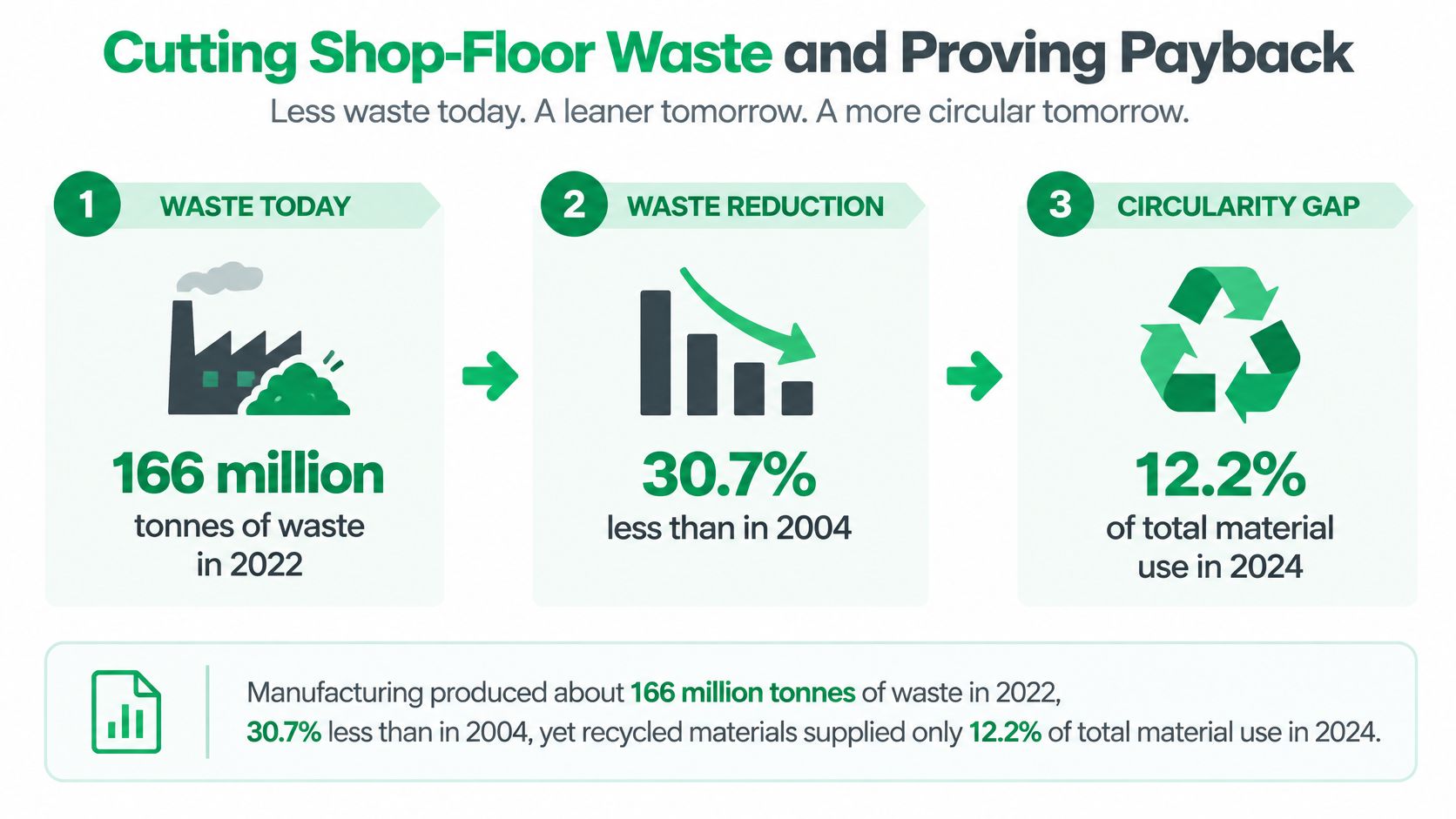
EU manufacturing generated approximately 166 million tonnes of waste in 2022, 30.7% less than in 2004, while recycled materials supplied 12.2% of total EU material use in 2024, according to Eurostat. The manufacturing waste figure and economy-wide circular material-use figure measure different things. Together, they show why preventing production waste and securing recovered material for use require separate attention.
Prioritize controllable losses
I would start with changes that need little capital and leave product requirements intact. The order below is a screening priority, not a promise of payback: actual savings depend on operating hours, utility costs, material value, and existing controls.
- Reduce unnecessary idle operation. Record idle hours and identify which auxiliaries can safely shut down. Follow equipment procedures for spindles, extraction, chillers, and compressors; don't disable systems needed for thermal stability or safety.
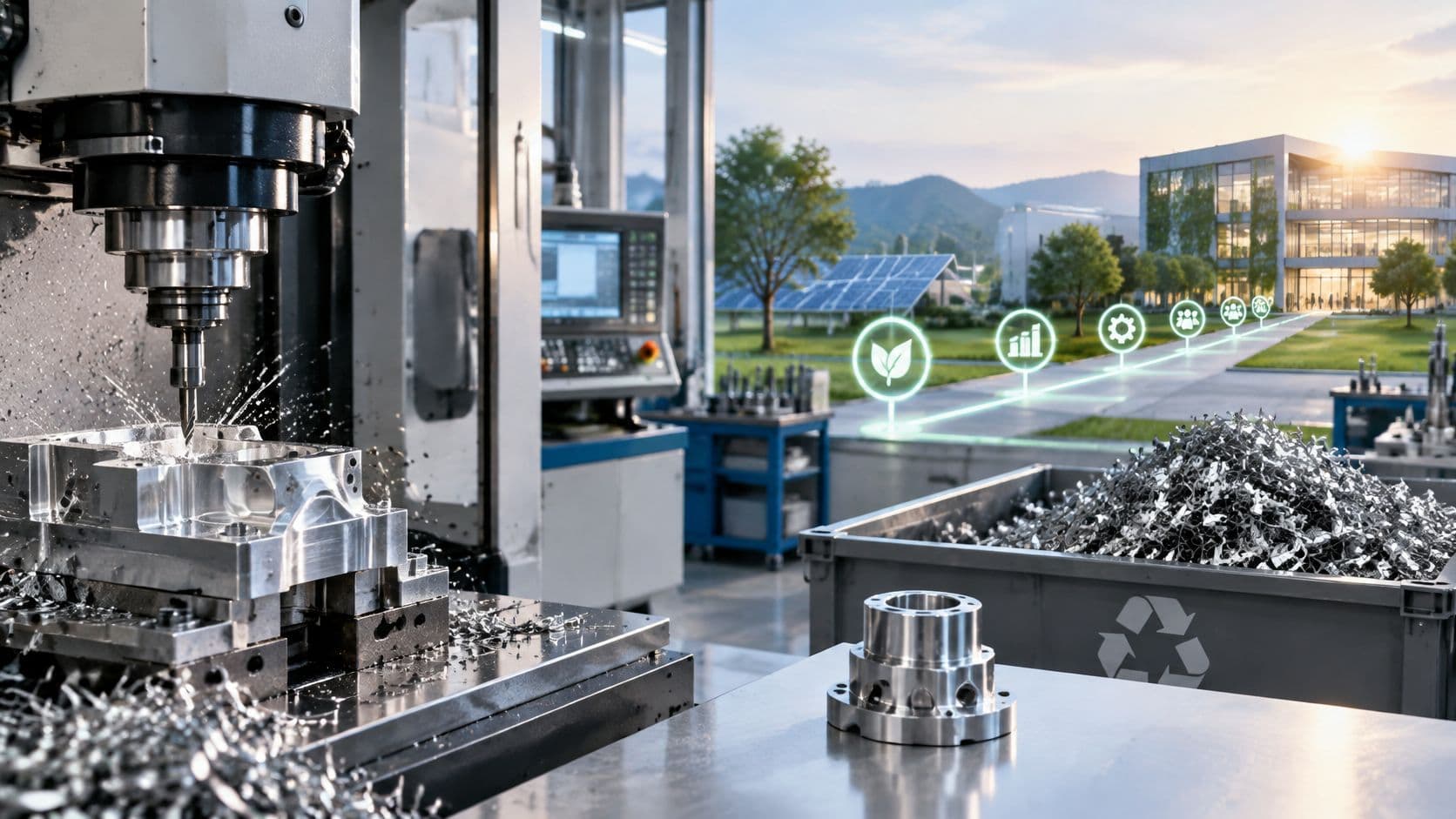
- Keep chips and offcuts identifiable. Separate alloys at collection, label bins, and keep reusable offcuts in a stock register. Track recovered mass and the recycler's acceptance conditions, not merely the number of bins collected.
- Maintain coolant condition. Monitor concentration with a refractometer, remove tramp oil, and filter solids. Track bath changes and disposal volume while maintaining coolant-supplier requirements.
- Control first-pass yield. Record defects by operation and cause. Use control charts for repeatable critical characteristics so operators can investigate drift before producing a batch of rejected parts.
- Optimize cutting parameters. Review speeds, feeds, engagement, tool condition, and chip evacuation together. The fastest cycle isn't the best setting if it creates unstable dimensions or frequent tool failure.
Verify the result at job level
Consider a short-run job with long waiting periods between operations and recurring dimensional rejects. The team introduces an approved shutdown routine and corrects the workholding condition responsible for the dimensional variation.
The shift log should show operating state, accepted output, rejects, rework, and any additional setup time. Metered energy then establishes whether consumption per accepted part fell. Faster throughput alone doesn't prove an energy reduction, and lower total consumption during a quieter production period doesn't prove better efficiency.
Track quality and delivery alongside the environmental measure. A shutdown routine that saves electricity but causes thermal drift on restart needs revision.
Calculate payback without hiding costs
Simple payback equals installed investment divided by annual net savings. Installed investment includes commissioning, training, and any production interruption, not just the purchase price.
Annual net savings should include avoided material purchases, disposal charges, energy, tooling, and rework, less new maintenance and consumable costs. Don't count the same benefit twice by claiming both avoided scrap material and the full selling price of the additional output.
Investment test: Who needs the change, what measurable annual saving will it produce, and could it compromise quality or lead time?
Separate operating habits from capital projects. Chip segregation may need containers and discipline; coolant filtration needs maintenance and waste handling; a major machine replacement requires a much broader case. An environmental study belongs in the decision-support budget, not in the same category as equipment that directly reduces an operating loss.
Choosing Suppliers When Carbon Data Is Missing
Waiting for perfect supplier carbon data can postpone decisions you can already make responsibly. A practitioner study published in Business Strategy and the Environment identifies limited supplier control, availability of lower-carbon alternatives, and data transparency as recurring barriers for SMEs, with purchased goods particularly important in manufacturing.
The answer isn't to pretend that estimates are measurements. It's to improve evidence in stages while keeping its limitations visible.
Build an evidence ladder
- Screen purchasing categories using spend. Separate metals, engineering plastics, coatings, outsourced machining, and logistics. Apply appropriate emissions factors where available, recording currency, geography, accounting period, and factor origin. Use the result to prioritize investigation, not to claim that a cheaper purchase necessarily has lower emissions.
- Send a short supplier questionnaire. Ask about production location, energy sources, recycled content, environmental management, and available material or process records. Give suppliers room to answer unknown rather than encouraging unsupported estimates.
- Collect declarations for important materials. Request mill certificates, resin identification, and recycled-content statements for priority purchases. Check that documents match the material grade, production route, and relevant supply period.
- Add process records you control. Connect machining and finishing energy records with job routing and accepted quantities. Keep purchased-material estimates distinct from operational measurements so you don't count the same processing twice.
- Request product-level information selectively. Focus supplier effort on purchases that materially affect the inventory or determine a consequential design choice. Ask for the reporting boundary, allocation method, electricity treatment, and included processing steps.
Decide what the evidence can support
Estimated category totals can identify where to investigate machining allowance, material choice, or outsourced finishing. They usually can't prove that competing suppliers have meaningfully different product footprints when the apparent difference comes from incompatible accounting methods.
Use traceability disciplines from quality control in manufacturing: connect each declaration to a purchase, material batch, drawing revision, or process record. Store assumptions and missing fields alongside the calculation rather than in someone's email.
Prioritize primary supplier data when a purchase represents both substantial spend and substantial estimated emissions, or when a customer explicitly requires it. Collect it sooner if uncertainty could reverse the purchasing decision. For a low-impact purchase with no realistic alternative, another questionnaire may be less useful than correcting a known production loss.
Start Your Roadmap with a Baseline Audit
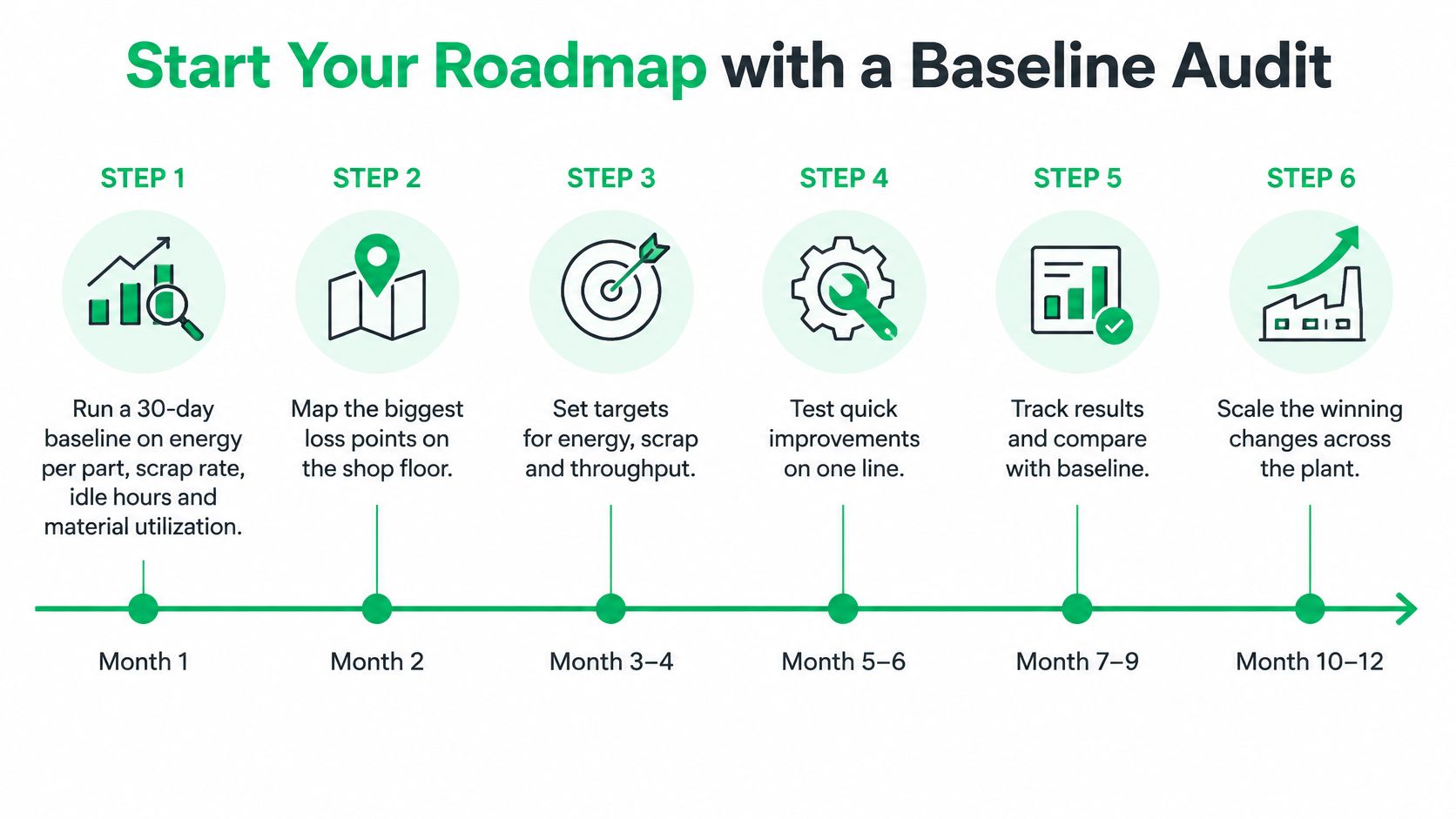
A useful roadmap assigns an owner, a measurement boundary, and a decision to every action. Treat the schedule as a working plan, not a promise that every supplier or production route will be ready at the same time.
Establish the sequence
- Run a baseline across representative work. Select recurring parts with different material or processing demands. Capture job identity, drawing revision, stock mass, accepted output, rejects, rework, energy, and idle states through a complete production cycle.
- Select a small KPI set and assign owners. Choose measures that someone can influence directly. Define where the records come from, who checks them, and when production and purchasing will review exceptions.
- Test low-cost operating changes. Trial approved shutdown routines, improved segregation, or a targeted process correction on a comparable job. Keep requirements unchanged so the comparison remains useful.
- Build the supplier evidence register. Send questionnaires, record missing information, and prioritize declarations using purchasing importance and estimated impact. Give each unresolved item an owner rather than leaving a shared spreadsheet untouched.
- Review the next prototype before release. Check stock fit, tool access, critical tolerances, finishing coverage, and disassembly. Record why the selected route meets the functional requirement.
- Make formal assurance a deliberate decision. Consider certification, a detailed LCA, or customer-facing environmental declarations when the accumulated records and commercial requirements justify them. Don't use an audit project as a substitute for correcting known losses.
Keep the dashboard auditable
KPIs for tracking sustainability in prototyping and low-volume production
| KPI | How to calculate | Review frequency |
|---|---|---|
| Scrap rate | Scrap parts divided by parts started | Weekly |
| Energy per finished part | kWh used divided by accepted finished parts | Monthly |
| Material utilization | Accepted finished-part mass divided by stock mass issued | Per job |
| Scrap recovery rate | Kilograms recycled divided by kilograms of scrap generated | Monthly |
| Supplier data coverage | Spend with product-level data divided by total spend within the defined purchasing boundary | Quarterly |
These review intervals are practical starting recommendations. For a short run, investigate a process problem during the job rather than waiting for the dashboard meeting.
Define each denominator consistently. If a customer changes the design during a build, separate obsolete parts from manufacturing defects. If a shared electricity meter includes unrelated equipment, document the allocation method instead of presenting the result as direct machine measurement.
At FIRMFG, our process includes design review through CAD manufacturability analysis, prototyping, optimization, and production. A baseline can be reviewed alongside an upcoming part run so the team connects measurements with a real manufacturing decision.
Choose assurance tools for a purpose. An environmental management system supports organizational control; an energy management system supports structured energy improvement; a product environmental declaration communicates information under defined rules. None removes the need for sound job records.
Start the baseline this month. Choose an upcoming repeatable part, name the person responsible, and prepare the traveler and measurement sheet before stock reaches the machine.
FIRMFG offers manufacturing support from design review and prototyping through optimization and production, helping teams evaluate process choices against timeline, budget, and quality requirements. Visit FIRMFG to discuss an upcoming part, bring the CAD model, quantity, material requirements, and critical tolerances so we can identify practical opportunities to avoid unnecessary stock removal, processing, and rework.